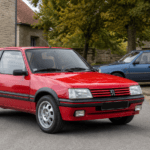
A turbocharged Peugeot 205 GTI can be extraordinarily quick, but there was no ordinary factory 205 “GTI Turbo”. Surviving cars are individual conversions whose engines, boost systems, brakes, suspension and build quality must be assessed on their own merits.
Did Peugeot make a 205 GTI Turbo?
Peugeot produced the naturally aspirated 1.6- and 1.9-litre 205 GTI, while the famous factory turbocharged model was the 205 Turbo 16 homologation car. The T16 used a bespoke mid-engined, four-wheel-drive layout and is fundamentally different from a front-engined GTI fitted with a turbocharger.
Peugeot Talbot Sport also offered period performance upgrades for the GTI, including an officially supported 125hp kit for the early 1.6. That upgrade was not a turbo conversion. Keeping these three ideas separate—standard GTI, modified GTI turbo and factory Turbo 16—prevents much of the confusion surrounding advertised cars.
Common approaches to a 205 turbo conversion
Turbocharging the GTI engine
The original engine may be rebuilt around lower compression, revised fuelling, engine management and a suitably sized turbo. The result depends on calibration and supporting systems.
Turbo engine transplant
Builders have installed engines from larger PSA models or later Peugeot and Citroën performance cars. Mounts, wiring, cooling, driveshafts and gearbox choice become central to reliability.
Some builds are carefully engineered packages; others are collections of mismatched parts. A familiar turbocharger brand or impressive intercooler does not establish that fuelling, ignition timing, heat management and boost control are safe.
Case study: the modified 1990 car originally featured here
This URL began as a report on an extensively modified 1990 Peugeot 205 GTI advertised online. The seller described a 2.0-litre eight-valve turbo engine associated with a Peugeot 605, a full loom transplant, Cosworth T28 turbo, custom six-injector inlet, intercooler, altered exhaust, Mi16 clutch and flywheel, Wilwood front calipers and a rear-disc conversion.
The car also combined coilovers, 17-inch wheels, a body kit and a substantially altered cabin. That specification illustrates why converted cars cannot be judged by a generic buying guide. Each system affects the others, and the original advert is now historical evidence—not proof of the car’s present condition, power or availability.
What a sound conversion needs
| Area | Questions to answer |
|---|---|
| Engine and management | Who built and mapped it? Is there a recent rolling-road record showing boost and fuelling? |
| Cooling and lubrication | Are radiator, oil cooling, pipe routing and heat shielding appropriate? |
| Transmission | Can the clutch, gearbox, differential and driveshafts tolerate the torque? |
| Brakes and tyres | Are components balanced, correctly installed and suited to the car’s weight and performance? |
| Shell and suspension | Is the structure sound, geometry correct and rear beam healthy? |
| Legal record | Are engine capacity, identity and modifications correctly documented and insured? |
Buying checks for a turbocharged Peugeot 205
- Start with the shell: inspect sills, floors, inner wings, suspension mounts, boot floor and accident repairs.
- Inspect cold start, hot restart, idle, smoke, crankcase pressure and fluid contamination.
- Check for fuel or oil leaks and heat-damaged wiring, hoses, paint or brake components.
- Ask for engine-build invoices, mapping records, wiring diagrams and parts specifications.
- Test boost progressively; hesitation, detonation, uncontrolled boost or overheating requires specialist investigation.
- Examine gearbox synchros, clutch behaviour, driveshaft vibration and torque steer.
- Confirm the speedometer, warning lights, cooling fans and diagnostic provisions work.
- Obtain an insurance quotation before buying and verify the V5C reflects relevant changes.
Turbo conversion versus original GTI
A converted car offers torque and individuality, but an original GTI is generally easier to understand, insure, maintain and value. The turbo car may need a specialist familiar with its exact engine-management and parts combination. Neither choice is automatically better; they serve different owners.
Returning a heavily modified car to standard can be expensive, while modifying an increasingly original survivor may reduce the qualities that made it desirable. Consider buying a completed conversion only when its execution, documentation and intended use align.
Frequently asked questions
Is a Peugeot 205 GTI Turbo a factory model?
No ordinary production GTI Turbo was offered. The factory turbocharged 205 was the structurally different Turbo 16 homologation car.
How much power can a turbo 205 make?
Outputs vary enormously. A reliable figure depends on engine specification, boost, fuel, mapping, cooling and drivetrain; a claimed number without evidence is not useful buying information.
Are turbo conversions reliable?
They can be, but reliability depends on engineering, calibration, maintenance and how the car is used. Every build needs individual inspection.
What is the PTS 125 kit?
It was a Peugeot Talbot Sport performance kit for the early 1.6 GTI. It increased output without turning the car into a turbo model.
Research note: factory GTI, Turbo 16 and Peugeot Talbot Sport distinctions were checked against official Peugeot heritage material. Details of the featured conversion originate from its historical seller description and should not be treated as a current condition report.