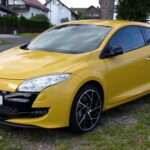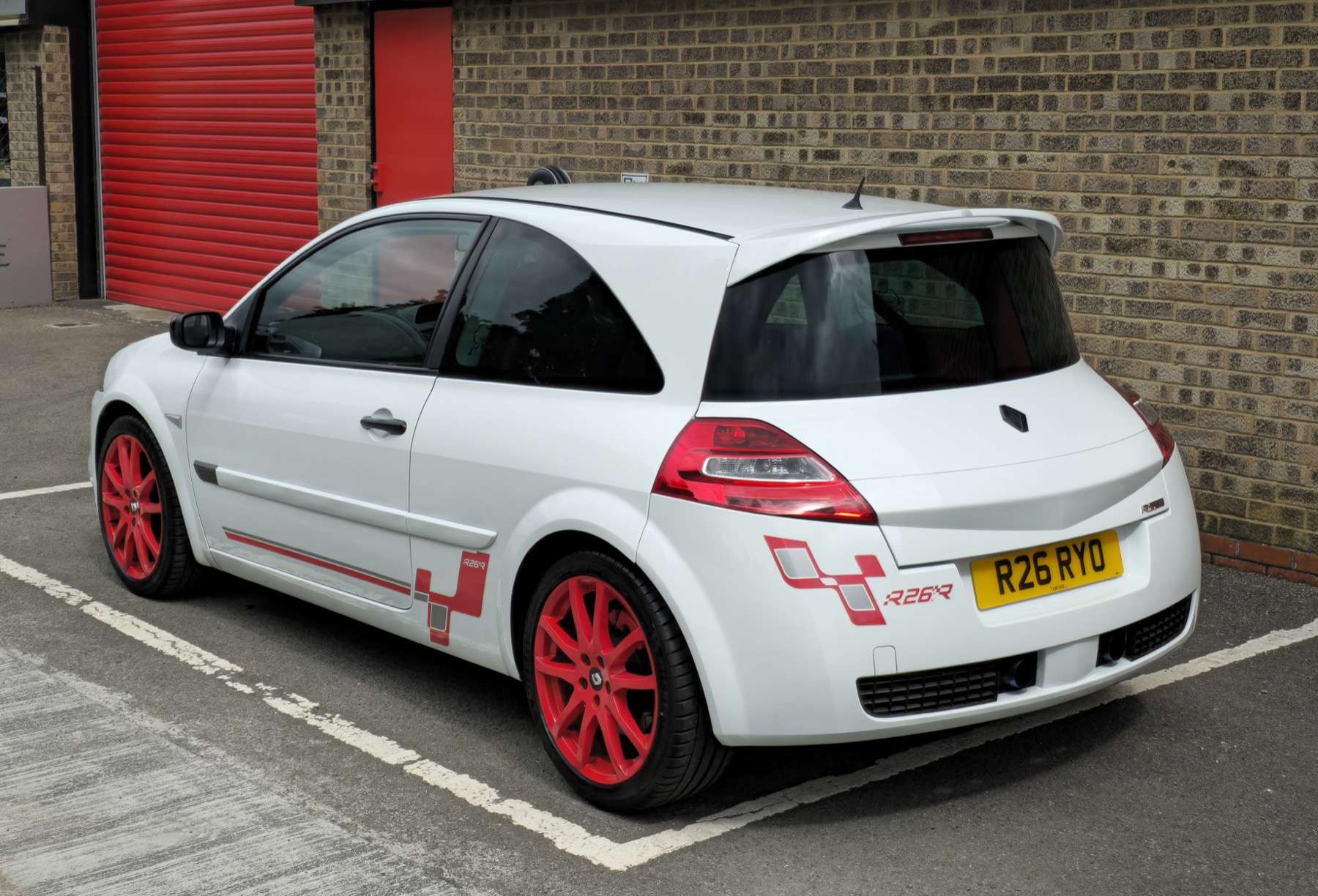
The Renault Mégane R26 and R26.R turned an unconventional family hatchback into one of the defining front-wheel-drive performance cars of the 2000s. The R26 combined 230hp with a limited-slip differential and focused Cup chassis; the R26.R removed weight, added serious track hardware and demonstrated what Renault Sport could achieve without chasing more power.
| Models | Mégane Renaultsport 230 F1 Team R26; R26.R |
|---|---|
| Engine | 1,998cc turbocharged four-cylinder |
| Power | 230hp |
| Drive | Front-wheel drive, six-speed manual |
| R26.R production | 450 cars planned |

From Mégane 225 to R26
Renault Sport launched the second-generation Mégane performance line with the 225. Its 2.0-litre F4Rt engine, Brembo brakes and distinctive body established a credible base, but continuing development created the car enthusiasts remember most strongly.
The F1 Team R26 celebrated Renault’s 2006 Formula One constructors’ championship. Output rose to 230hp and, crucially, Renault fitted a mechanical limited-slip differential. Working with the Cup chassis, firmer suspension and performance tyres, it allowed the front axle to deploy power earlier and with less waste.
The chassis was the headline
The R26 was not remarkable simply because it had 230hp. Its appeal came from the relationship between steering, brakes, differential and damping. The limited-slip differential reduced inside-wheel spin, while the Cup suspension gave the driver confidence to exploit the engine’s torque.
That balance helped change expectations of front-wheel-drive performance cars. Rather than treating understeer as inevitable, Renault Sport developed a car that could rotate, absorb difficult surfaces and put power down with unusual precision.
Love cars you don’t see every day?
Get forgotten cars, surprising motoring stories and the most interesting finds from Unusual Cars by email.
Free to join. No spam. Unsubscribe whenever you like. See our privacy policy.

R26.R: less weight, not more power
Renault resisted the easy route of increasing boost. The R26.R retained the 230hp engine but removed the rear seats and much of the sound insulation. A carbon-fibre bonnet, polycarbonate rear side and tailgate glazing, lighter seats and simplified equipment cut roughly 123kg compared with a regular R26, depending on specification.
Track-focused additions included stiffer suspension, grooved brake discs, optional titanium exhaust and optional six-point harnesses. The red roll cage became its visual signature, although equipment varied by market and individual car.

The Nürburgring statement
In June 2008 the R26.R recorded 8 minutes 17 seconds around the Nürburgring Nordschleife, then presented as a front-wheel-drive production-car benchmark. The lap gave Renault Sport an enduring marketing theme that later Mégane Trophy-R models would continue.
The important point is not the inevitable evolution of lap records. The R26.R proved that tyres, mass reduction, brakes and chassis detail could transform a familiar hatchback without a dramatic power increase.
Why R26 and R26.R belong together
The R26 is the usable road car that established the formula. It keeps four seats, normal glass and enough refinement for everyday use while retaining the differential and Cup chassis. The R26.R is the concentrated version—the historical endpoint of the second-generation Mégane Renaultsport.
Mégane R26 and R26.R FAQ
How much power do they produce?
Both use a 230hp version of Renault’s 2.0-litre turbocharged engine. The R26.R’s advantage comes primarily from lower mass and track-focused hardware.
Does the R26 have a limited-slip differential?
Yes. Its mechanical limited-slip differential is central to the way it deploys power through the front wheels.
How many R26.Rs were built?
Renault announced a limited production run of 450 cars for selected markets.
Did the R26.R have rear seats?
No. Renault removed them as part of the weight-reduction programme and fitted a visible rear roll cage.
Why is the Nürburgring lap important?
The 8:17 lap established a front-wheel-drive benchmark in 2008 and began a record-focused lineage continued by later Mégane Renaultsport models.
Continue the Renault story
Explore more unusual French performance cars in the Rare & Performance Renaults hub.
Research note: Model specifications, production claims and Nürburgring history should be checked against Renault press material and contemporary homologation documentation; images are licensed through Wikimedia Commons.