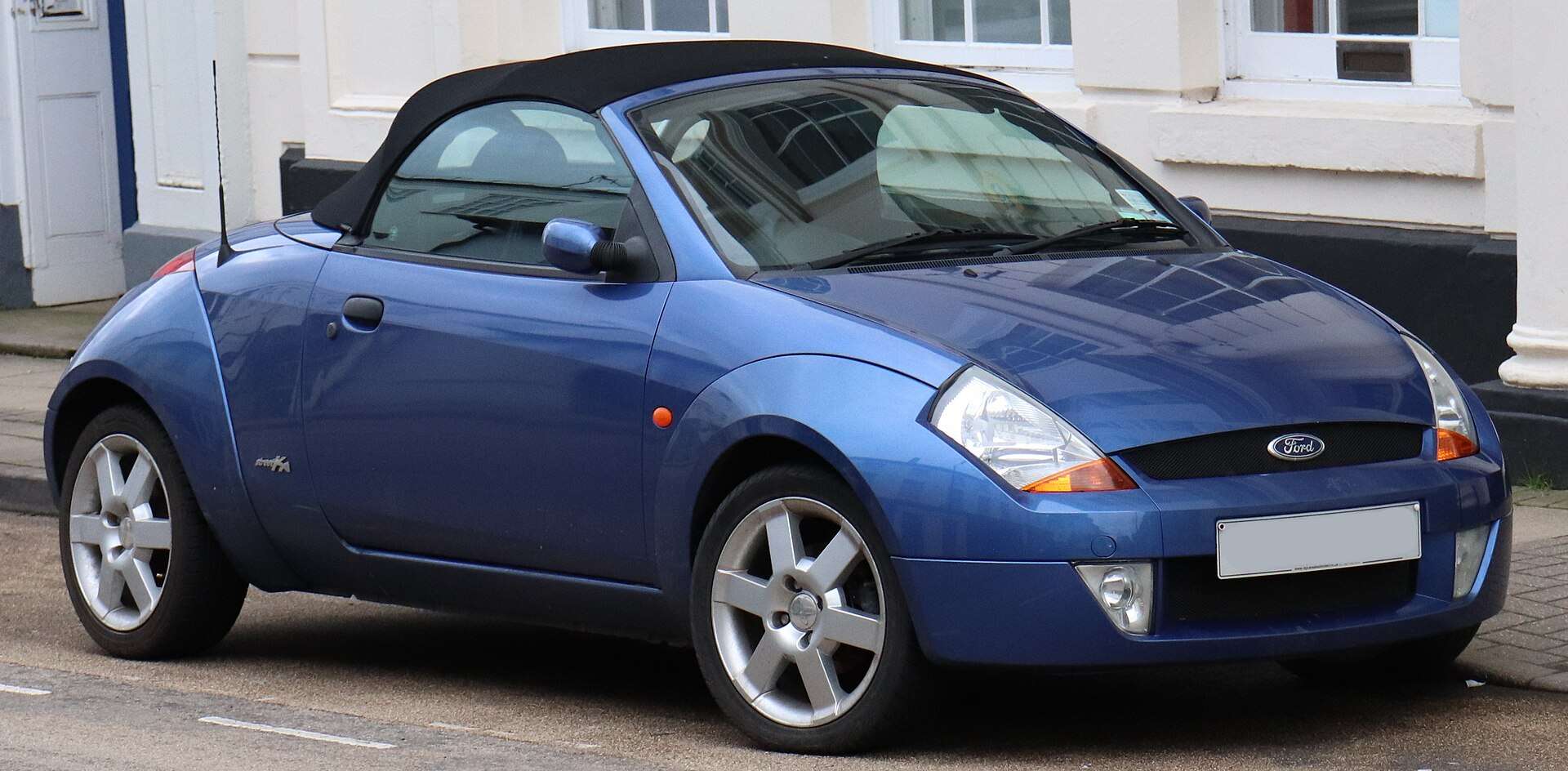
The Ford SportKa and StreetKa were two answers to the same question: how much more character could Ford extract from the original Ka? Launched in 2003, both used a 95PS 1.6-litre engine and tougher chassis tuning, but they were not simply fixed-roof and convertible versions of one car. The SportKa was an intensified production hatchback; the StreetKa was a separately engineered two-seat roadster, built in Italy by Pininfarina.

The Ka that made both cars possible
When the Ka appeared in 1996, its New Edge styling looked unlike any other small car. Beneath the dramatic surfaces was a simple platform related to the Fiesta, but Ford’s chassis engineers gave it unusually lively steering and a playful balance. By the early 2000s that design was still distinctive, yet the range lacked an enthusiast flagship.
Ford showed the StreetKa concept in 2000 and presented production StreetKa and SportKa models at the 2002 Paris Motor Show. The two reached customers in 2003, extending the original Ka into niches that ordinary city cars rarely occupied.
SportKa: the hot hatch in miniature
The SportKa retained the original three-door steel body but gained wider bumpers, flared arches, side skirts, a rear spoiler, larger wheels and a purposeful mesh grille. Ford’s own retrospective describes it as sharing much of the StreetKa’s technical DNA, including the 70kW (95PS) 1.6-litre Duratec petrol engine, short-ratio five-speed gearbox and sports suspension.
With modest power by modern standards, the SportKa relied on low weight, immediate steering and usable torque. Its appeal was not straight-line speed but the way it carried momentum through bends. Wider tracks, firmer damping and stronger brakes made it feel substantially more grown-up than the basic Ka without destroying the ride.

Love cars you don’t see every day?
Get forgotten cars, surprising motoring stories and the most interesting finds from Unusual Cars by email.
Free to join. No spam. Unsubscribe whenever you like.
StreetKa: a different car beneath the family resemblance
The StreetKa was more ambitious. Although its face and circular forms echoed the hatchback, its proportions, structure and body were extensively changed. It was a strict two-seater with a manually folded fabric roof, a separate boot and a lower, wider stance. Production was entrusted to Pininfarina in Italy, whose badge appeared on the car.
The roadster used the same basic 1.6-litre engine and five-speed transmission as the SportKa, but it carried more weight because an open car needs additional structural reinforcement. Its performance was therefore slightly less urgent. What it offered instead was occasion: low seating, open-air motoring and steering that preserved the Ka family’s sense of connection.

Shared engine, different priorities
Both models used Ford’s 1,599cc single-cam Duratec eight-valve engine, tuned for approximately 95PS and useful low-speed torque. It was not a high-revving racing engine, but it matched the cars’ accessible nature. The short gearing made urban driving lively, while the straightforward mechanical layout kept the experience analogue.
The SportKa made better use of the power because it was lighter. The StreetKa traded some acceleration for its reinforced roadster shell and richer equipment. Neither was designed as a miniature supercar; their engineering served involvement, affordability and character.
Cabins and everyday usability
The SportKa remained a four-seat hatchback, though rear accommodation was tight. Sports seats, silver details, a leather steering wheel and model-specific trim lifted the familiar Ka dashboard. It retained the practical hatch and folding rear seat, making it the easier daily car.
The StreetKa’s cabin sat lower and felt more intimate. Luxury versions brought leather upholstery, heated seats and air conditioning. Boot space was separate and the hood required manual operation, but the simplicity helped preserve the car’s lightweight-roadster atmosphere.
Why they were overlooked
Neither car fitted neatly into established enthusiast categories. The SportKa arrived when turbocharged hot hatches were becoming faster and more powerful, while the StreetKa’s styling-led marketing caused some drivers to overlook its chassis quality. Depreciation then pushed both into inexpensive-used-car territory.
Rust is now the defining survival issue. Original Kas can corrode around the sills, floor, fuel-filler area, rear arches and suspension mounting points. StreetKa structural repairs can be particularly involved because of its unique body. Neglect, roof leaks and scarcity of model-specific trim have further reduced numbers.
Two future classics for different reasons
The SportKa deserves recognition as one of Ford’s simplest and most entertaining small performance cars. It proves that modest power can be rewarding when steering, gearing and chassis balance work together. The StreetKa is interesting for a different reason: it was a rare collaboration between mass-market Ford engineering and Pininfarina production, created when manufacturers were willing to build distinctive niche cars.
Together they represent the final flourishing of the first-generation Ka. One sharpened the hatchback’s dynamic qualities; the other transformed its visual language into a genuine roadster. They shared components and attitude, but each had its own engineering identity.
Continue the Ford story
Browse the Rare & Performance Fords hub, discover the Fiesta RS1800, or read our Ford Orion guide.
Research note: Launch dates, Pininfarina production and the shared 95PS powertrain were checked against Ford’s official twentieth-anniversary Ka history.