The Nissan March Super Turbo sounds like a tuner’s fantasy: a tiny 930cc hatchback fitted with both a supercharger and a turbocharger. Yet it was a genuine factory model, developed from a competition programme and sold to the public in Japan.
Here are ten reasons this extraordinary little Nissan deserves to be remembered as much more than a modified Micra.
1. In Japan it was a March, not a Micra
Nissan introduced the first-generation K10 at the 1981 Tokyo Motor Show and launched it in Japan in October 1982. Its name—March—was selected from thousands of suggestions submitted by the public.
The same basic car reached Britain as the Micra, but the Super Turbo was a Japanese-market model. Calling every hot-looking K10 a “Super Turbo Micra” hides an important part of its identity.
2. The engine was only 930cc
Under the bonnet sat the MA09ERT, an overhead-cam four-cylinder displacing just 930cc. Nissan quoted 110PS at 6,400rpm and 130Nm at 4,800rpm.
Those figures are impressive for less than one litre even today. In the late 1980s they gave Nissan’s smallest hatchback the kind of output normally associated with a much larger engine.
3. It really did use two different compressors
The “Super Turbo” badge was literal. A mechanically driven supercharger supplied boost and response at lower engine speeds, while an exhaust-driven turbocharger took over higher in the rev range.
This sequential twin-charging arrangement was intended to reduce the lag that afflicted many small turbo engines without choking the top end. It was clever, complicated and unlike almost anything else in its class.
4. The road car grew out of motorsport
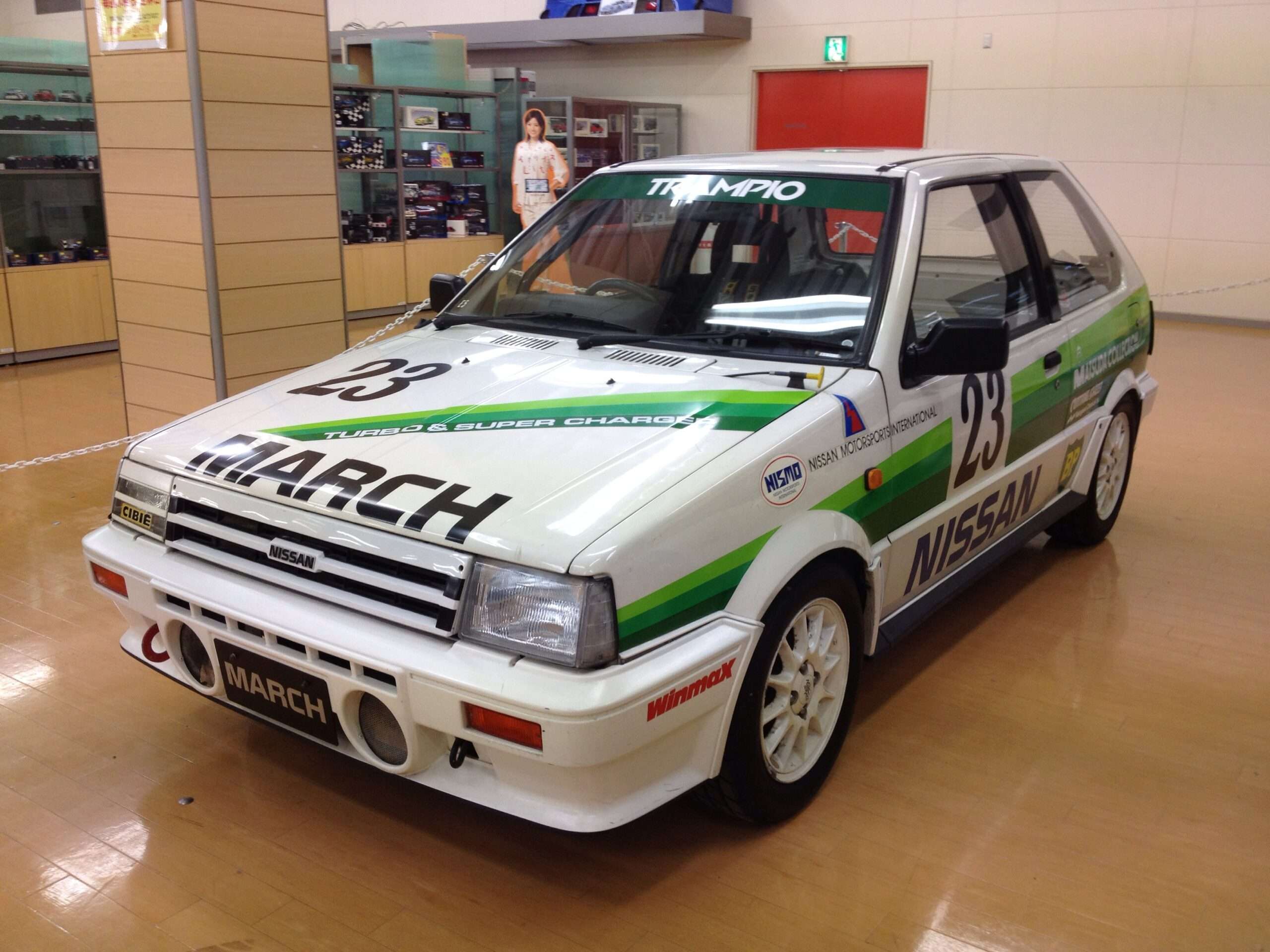
NISMO created K10 rental race cars for the March Little Dynamite Cup, first held in 1987. Nissan’s own Heritage Collection preserves one of these 620kg competition machines.
The production Super Turbo did not simply appear from a marketing brainstorm: it followed a real programme in which Nissan had already explored how much performance could be extracted from the little March.
Love cars you don’t see every day?
Get forgotten cars, surprising motoring stories and the most interesting finds from Unusual Cars by email.
Free to join. No spam. Unsubscribe whenever you like. See our Privacy Policy.
5. The 930cc capacity was chosen with a rulebook in mind
The competition-focused March R arrived before the road-going Super Turbo. Its capacity was reduced from the ordinary MA engine’s 987cc to 930cc so that, after the forced-induction equivalency factor was applied, it fitted the intended motorsport class.
That obscure calculation is the reason the engine is 930cc rather than a neat one litre. It is a number created by racing regulations, not by the marketing department.
6. The showroom version arrived in January 1989
Nissan says the road-going Super Turbo was launched in January 1989 with the same headline engine specification. It turned an extreme competition idea into a usable front-wheel-drive hatchback with a five-speed gearbox.
The result was still a demanding little car, but it had the trim, equipment and road manners expected by a Japanese customer rather than the stripped cabin of a cup racer.

7. It was not simply a turbo Micra with a body kit
A genuine car carries the EK10 identity and the MA09ERT twin-charged engine. It also has model-specific controls, instruments, cooling, induction and exterior details.
Because ordinary K10s are easy to modify, visual similarity is not proof. Import documents, chassis information and the engine itself matter far more than badges when establishing authenticity.
8. Its power delivery was the real party trick
The point was not just the 110PS peak. The supercharger strengthened the bottom and middle of the rev range; the turbo sustained the charge as engine speed rose.
Drivers therefore experienced two forms of forced induction in one acceleration run. The changeover and accompanying noises are central to the car’s character—and a reason tired vacuum pipes or improvised controls can spoil the whole experience.
9. It gained FIA Group A homologation
The FIA Historic Database lists the March Super Turbo under homologation number 5389, effective from May 1989. That formal recognition confirms its competition relevance beyond Nissan’s one-make series.
It also helps explain why so many examples were modified, rallied or consumed for parts. Survival was never going to be high for a cheap performance hatch with genuine motorsport credentials.
10. Its greatest strength is also its greatest ownership risk
A normal K10 is simple. A Super Turbo adds a supercharger, turbocharger, bypass and control hardware, extra heat, more hoses and far more model-specific parts.
When everything works together it is a tiny engineering marvel. When it does not, diagnosing the fault requires patience and knowledge—so condition and originality are more valuable than an enticing purchase price.
Love cars you don’t see every day?
Get forgotten cars, surprising motoring stories and the most interesting finds from Unusual Cars by email.
Free to join. No spam. Unsubscribe whenever you like. See our Privacy Policy.
Research sources
Technical and historical details were checked against Nissan’s Heritage Collection, Nissan’s Japanese Heritage Collection entry and FIA homologation record 5389.