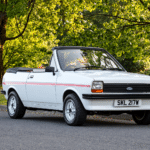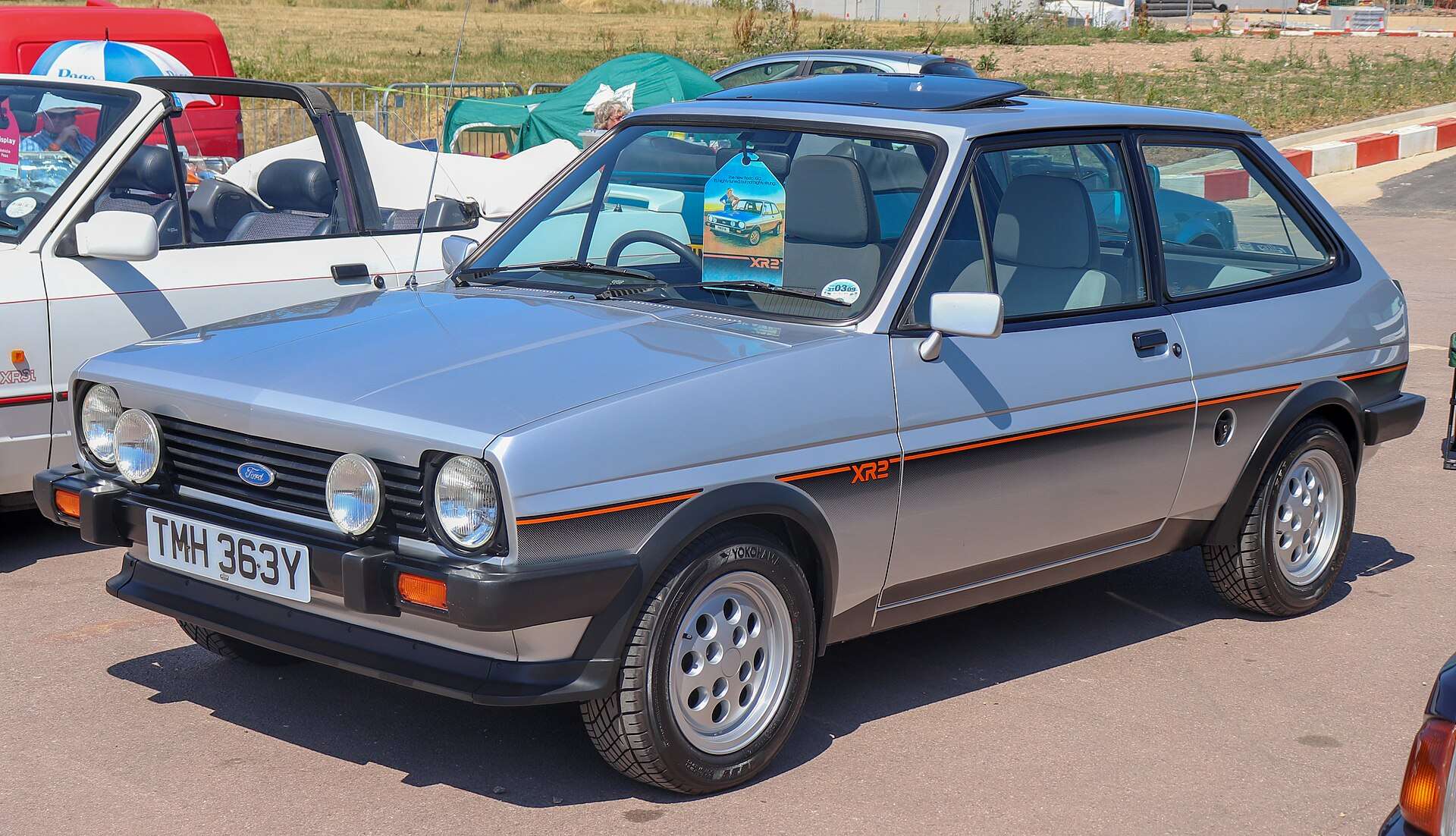
The Mk1 Ford Fiesta XR2 transformed Ford’s smallest European car into an attainable performance icon. It was simple, light, visually unmistakable and sold for only a short period before the original Fiesta disappeared. Here are ten details behind the first XR2—and the car that established the fast-Fiesta formula.
1. The Fiesta itself began as “Project Bobcat”
Ford’s first modern European supermini was developed under the codename Project Bobcat. The programme represented an enormous commitment to a market sector some Ford executives had initially doubted. The Fiesta entered production in 1976 and gave Ford the compact, front-wheel-drive platform from which the XR2 could later be created.
2. The Supersport showed Ford there was demand
Before the XR2, Ford offered the short-lived Fiesta Supersport. Launched in 1980, it combined the 1.3-litre Fiesta S with Series-X wheelarch extensions, spoilers, four-spoke alloy wheels, driving lamps and bold graphics. It provided much of the visual vocabulary—and proved that buyers wanted a more serious sporting Fiesta.
3. Ford’s Special Vehicle Engineering team developed it
The XR2 was not simply assembled from catalogue accessories. Ford’s Special Vehicle Engineering operation developed the production model, giving it a larger engine, revised suspension, stronger brakes and a deliberately distinctive identity. That placed it within Ford’s emerging XR performance family without turning it into a costly RS homologation car.
4. Its engine was an old-school Crossflow, not a CVH
The Mk1 used a 1,598cc Kent-family Crossflow engine related to the unit fitted to the Escort Mexico. With a Weber carburettor it produced approximately 84bhp. The later Mk2 XR2 used the newer overhead-cam CVH, making the two generations mechanically more different than their shared badge suggests.
Love cars you don’t see every day?
Get forgotten cars, surprising motoring stories and the most interesting finds from Unusual Cars by email.
Free to join. No spam. Unsubscribe whenever you like. See our Privacy Policy.
5. It had only four forward gears
Despite being Ford’s fastest Fiesta, the Mk1 XR2 retained a four-speed manual gearbox. That sounds surprising beside the five- and six-speed transmissions of later hot hatches, but the engine’s torque, the car’s low weight and short gearing still produced lively performance. A five-speed gearbox became one of the important improvements made to the Mk2.
6. It was the first production Fiesta capable of 100mph
Ford promoted the XR2 as the first production Fiesta to break the 100mph barrier. Contemporary figures put maximum speed at roughly 105mph and 0–60mph at about 9.3 seconds. Those numbers are modest today, but they were serious in an early-1980s supermini weighing well under a tonne.
7. The round headlamps were part of a substantial transformation
The XR2 replaced the regular Fiesta’s rectangular lamps with round units and added auxiliary lights, black wheelarch extensions, spoilers, distinctive graphics and 6×13-inch alloy wheels. Ventilated front discs helped match the appearance with useful engineering. The result looked far more purposeful than an ordinary Fiesta without requiring an entirely new body.
8. Its cabin received its own dark sporting identity
Ford added Storm-pattern sports trim, a black headlining, a two-spoke steering wheel and model-specific details. The architecture remained recognisably Fiesta, which was central to the XR2’s appeal: it offered ordinary-car familiarity with just enough theatre to feel special every time the driver climbed aboard.
9. Its UK production life was remarkably brief
The Mk1 XR2 reached British showrooms in December 1981 and was discontinued in January 1983 as Ford prepared the second-generation Fiesta. Specialist records quote 20,003 UK sales. Its combination of a short sales window, hard use, theft and corrosion explains why genuinely original survivors now attract so much attention.
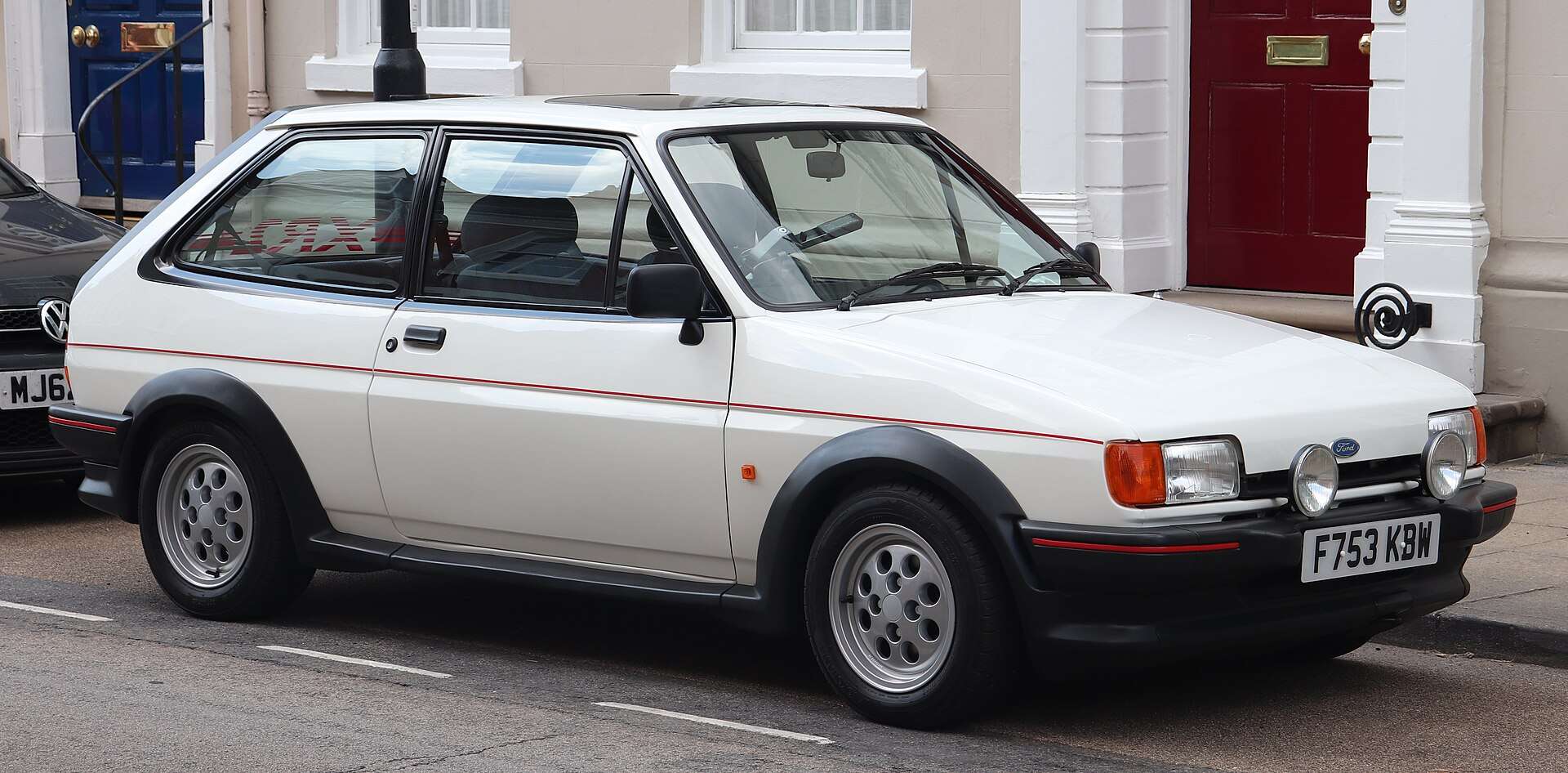
10. The Mk2 was an evolution, but not a mechanical repeat
The 1984 Mk2 XR2 carried the badge forward, yet it replaced the Crossflow with a 1.6-litre CVH engine, added a five-speed gearbox and wrapped the formula in a smoother body. The Mk1 therefore stands as a distinct, short-lived version: the lightest, simplest and most visibly connected to Ford’s original Fiesta.
Love cars you don’t see every day?
Get forgotten cars, surprising motoring stories and the most interesting finds from Unusual Cars by email.
Free to join. No spam. Unsubscribe whenever you like. See our Privacy Policy.
Research sources: Ford Press Office Fiesta history; Ford Heritage material; period specification records; Unusual Cars UK Fiesta XR2 guide.