
Buying Guides / Audi Q7 4L · UK buying advice
A good first-generation Audi Q7 3.0 TDI is a spacious, relaxed family car with the pulling power to make long journeys and towing feel easy. A neglected one can combine diesel-engine repairs, automatic-gearbox work, suspension faults and water-damaged electronics in the same purchase. Buy the maintenance record and the condition underneath before the wheel size, trim badge or advertised mileage.
The buying verdict
Our starting point would be a standard, well-documented later 3.0 TDI with an independently verified cold start, smooth hot and cold transmission behaviour, dry carpets and a clean specialist inspection. Choose steel springs if simplicity matters more than adjustable ride height. A properly maintained air-sprung car can be excellent, but its operation and repair history need checking rather than assuming the system is healthy because the dashboard is clear.
This guide covers the 4L generation sold in the UK from 2006 to 2015, with the 3.0-litre V6 diesel. It does not cover the newer 4M, the V8/V12 diesels or petrol engines. There is no universally safe registration year: production changes, engine codes, emissions equipment and previous repairs matter more than a rule that every facelift car is good or every early car is bad.
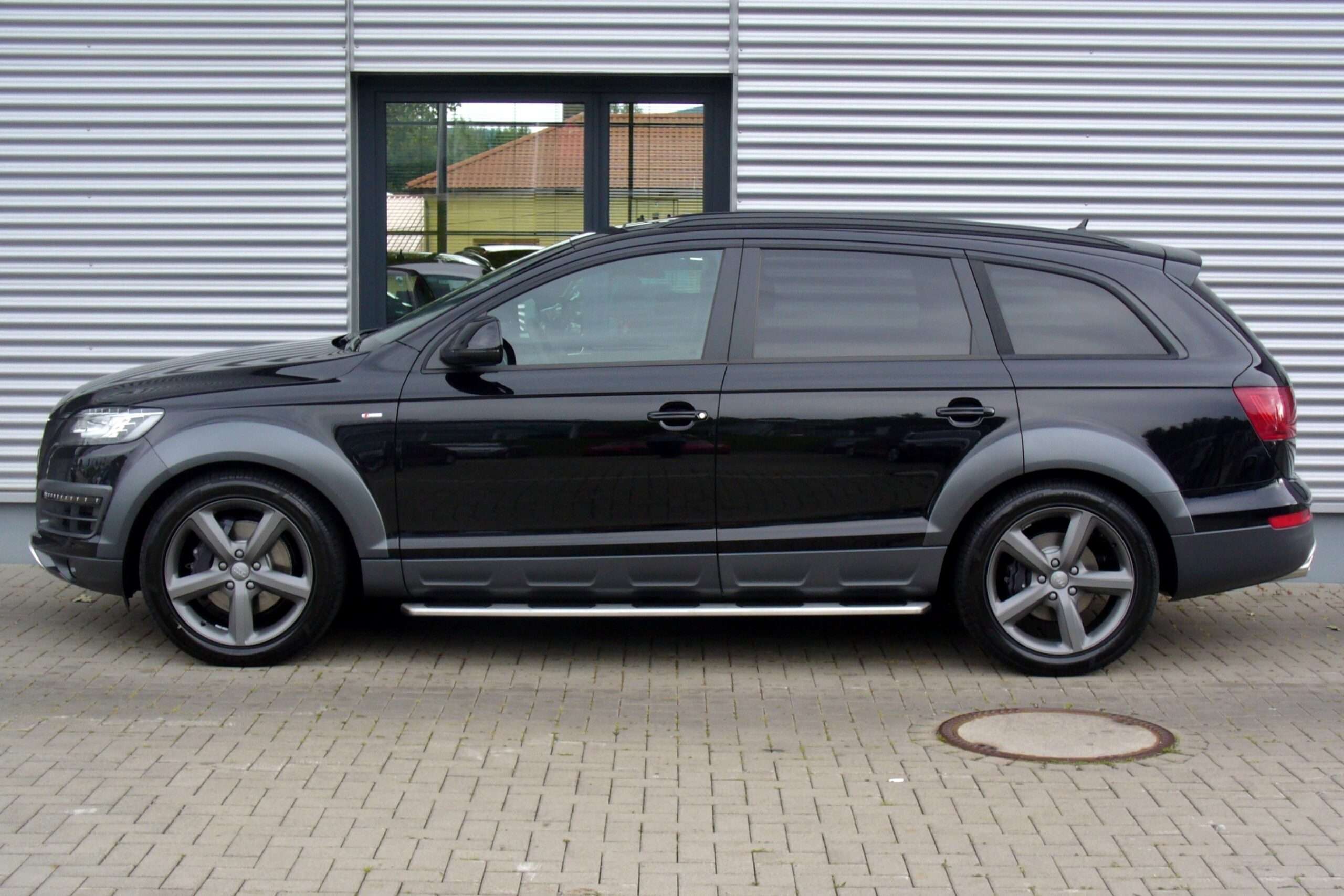
Audi Q7 4L versions: what actually changes?
The 4L is the original large Q7, with permanent quattro four-wheel drive and a conventional torque-converter Tiptronic automatic. It is not an S tronic dual-clutch installation and its central four-wheel-drive system is not the transverse-engine Haldex arrangement found in smaller Audis. This matters when checking service invoices: an invoice for a generic “DSG/Haldex service” needs explanation before you accept it as evidence of the correct work.
The RAC’s period UK review records the March 2006 launch, the spring 2009 facelift and the 2010 change to an eight-speed automatic. It also distinguishes the AdBlue-equipped Clean Diesel version. Those are separate changes; a facelift appearance alone does not identify the gearbox or emissions system. Check the build record, engine and transmission identification and the car itself.
| Version or feature | What it means for a buyer | Evidence to obtain |
|---|---|---|
| Earlier 3.0 TDI / six-speed Tiptronic | Potentially cheaper to buy, with more age-related work to consider. A good example remains preferable to a neglected later car. | Engine code, gearbox-service invoices, cold-start inspection and underbody condition. |
| Later 3.0 TDI / eight-speed Tiptronic | A worthwhile shortlist for long-distance use, without treating extra ratios as protection against poor maintenance. | Build specification and correct transmission-fluid/filter history. |
| Clean Diesel / SCR equipment | Additional emissions equipment needs checking, including any AdBlue warnings or repair history. | Actual emissions classification, equipment and diagnostic results; do not infer compliance from a badge. |
| Steel suspension | Less complex height-control hardware, but springs, dampers, arms and bushes still wear. | Physical inspection and parts invoices; confirm no undocumented conversion. |
| Adaptive air suspension | Useful levelling and ride-height functions, with more components to inspect and budget for. | Leak testing where needed, level-control scan, compressor behaviour and overnight stance. |
SE, S line, S line Plus and special-edition descriptions are useful starting points, not guarantees of equipment. Ask for a build specification and test the fitted options. Replacement bumpers, wheels and retrofitted lamps can blur visual identification. A seller calling a car “fully loaded” should be able to show which features work.
Which specification makes sense?
For regular family transport, prioritise a comfortable wheel-and-tyre package, functioning parking assistance, a complete seating system and effective heating and air conditioning. The largest wheels can make tyres, wheel damage and ride quality more prominent ownership issues. Try the car over the surfaces you actually use and obtain tyre quotes before assuming a sportier-looking car is the better buy.
For towing, the right vehicle is one with documented maintenance, suitable approved towing equipment and healthy cooling, transmission, tyres and brakes. A towbar is evidence to investigate use, not a reason to reject the car automatically. For town-only use, reconsider the diesel proposition before choosing between trims: repeated short journeys are a poor basis for buying a large, ageing diesel simply because the purchase price is attractive.
UK Q7 prices: judge the complete purchase
Live advertisements are asking prices, not completed sales. On 16 November 2026, AutoTrader’s 3.0-litre Q7 page displayed first-generation diesel examples advertised at £2,984, £5,100, £6,450 and £9,999. These are individual listing claims, not cars we have inspected or a statistically representative valuation. The page also contains other generations and powertrains: its overall stock total must not be read as the number of comparable 4L diesels.
Use those examples to establish that cheap entry prices coexist with much dearer cars, then build your own like-for-like shortlist. Record year, engine, transmission, mileage, suspension, seats, service evidence, seller type and disclosed faults. Check whether a low-priced example is damaged, has a gearbox problem, is sold for repair or has an unresolved warning. A cheap advert is not a usable-car valuation until its condition is understood.
Separate the purchase into three sums: the agreed vehicle price; immediate work identified by inspection; and a reserve for faults that remain uncertain. If the first sum consumes the entire budget, choose another car. A Q7 that needs tyres, front brakes and a gearbox diagnosis immediately can be a worse buy than a more expensive example with those items properly addressed.
Questions to ask before travelling
- Can the engine be left completely cold, and can a specialist scan every relevant control module?
- What engine and gearbox are fitted, and when were the correct oil and filters last changed?
- Is the suspension steel or air, and has it sagged overnight or needed repeated compressor work?
- Has there been coolant loss, intake-flap work, DPF/EGR trouble, AdBlue trouble where fitted, or chain-noise investigation?
- Has water entered through the roof, tailgate or cabin, and were the affected electronics inspected?
- How was it used for towing, and are there invoices for transmission and cooling-system maintenance?
Request invoices rather than a photograph of a stamped book alone. Ask for underside and interior photographs, including outer seat bolsters, load floor and accessible carpet edges. A seller who answers clearly and permits inspection reduces uncertainty; it does not remove the need to inspect.
3.0 TDI engine: cold start, leaks and maintenance evidence
Arrange the cold start in advance. Before starting, inspect accessible oil and coolant levels, hose condition and the areas around the engine for fresh oil, dried coolant and makeshift wiring. Do not open a hot cooling system. An unusually clean engine bay is not proof of a leak-free engine; look again after the road test and have the underside examined with the undertrays removed by agreement.
Observe how readily it starts, the quality of the idle, exhaust smoke and any persistent mechanical noise. Brief behaviour must be interpreted in context by someone familiar with the exact engine. Avoid buying a diagnosis from a seller: “just a sensor”, “only a glow plug” and “normal diesel noise” describe opinions, not completed fault-finding.
Timing chains and startup rattle
The V6 diesel uses timing chains rather than a routine cam-belt kit. Haynes identifies tensioner-related startup rattle among the first-generation Q7’s known concerns. Treat repeated, pronounced or unexplained rattle as a specialist-inspection requirement. A quiet start after the car has been warmed up is not an adequate substitute.
Ask what was replaced if the seller says “chains done”: upper tensioners, a complete chain system and unrelated work can all be described loosely. Look for part numbers, mileage, workshop identity, diagnosis and an itemised scope. Ask whether the current noise was present before the work and whether it has recurred. Do not assume a software update or fresh oil settles every mechanical concern.
There is no honest single fitted chain price without identifying the engine and the work required. Access, parts scope, seals, fluids and associated repairs change the bill substantially. Obtain a written quotation from the workshop that will inspect the car. If serious chain noise remains unexplained, the sensible buying response is usually to stop rather than subtract a guessed kit price from the offer.
Oil history, turbo operation and breather concerns
Check invoices for oil approval, quantity and mileage intervals appropriate to the installed engine and service regime. “5W-30” alone does not identify an approved oil. A regular record, with sensible attention to the car’s use, is more persuasive than a recent oil change immediately before sale. Ask about oil consumption and how often topping-up is necessary.
On the drive, build load progressively once the car is warm. It should deliver power consistently without a warning light, repeated limp mode, excessive smoke or unexplained surging. Check intake hoses and connections for leakage and previous repairs. A boost-related code can involve hoses, control, sensors or the turbo itself; replacing a turbo on an assumption is an expensive way to diagnose a car.
Look for oil beneath the engine, around accessible covers and hose joints, then relate the location to the specialist’s report. A small external leak and oil entering the intake or exhaust are different propositions. Ask about exchange surcharges and what caused any previous turbo failure. A replacement unit without a documented root-cause repair should prompt further questions.
Intake manifolds and swirl flaps
Haynes also documents intake-flap and actuator faults. A dashboard warning does not establish that a cheap linkage repair will solve the whole problem. Ask for the fault report, physical inspection of the linkage and assessment of the internal mechanism. Confirm which bank and component are affected before accepting a quotation or buying parts.
During a pre-purchase inspection, ask whether fault codes are current, intermittent or recently cleared, and whether the control system completes its checks. A car with a new linkage can still have internal wear or an actuator fault. Equally, a code alone does not prove both manifolds need replacing. The buying advantage comes from diagnosis, not from assuming either the cheapest or most expensive possible repair.
Cooling system and thermostats
Watch warm-up on a meaningful drive and ask the specialist to compare live temperature readings with expected operation. A dashboard gauge is useful but does not tell the whole story. Investigate unexplained coolant loss, unstable temperature, weak cabin heating or repeated topping-up. The cooling system should be assessed before taking on towing duties.
Ask whether a water-pump or thermostat invoice included coolant, seals and a leak check. Trace any remaining dried residue rather than accepting a claim that it is left over from an old repair. If the engine overheats during the viewing, stop the test and arrange professional assessment. Do not continue driving to see whether the temperature comes back down.
DPF, EGR and AdBlue: buy for the right journeys
A large diesel makes most sense where it can complete appropriate longer journeys. Ask how the car has been used, whether regenerations have been interrupted and whether there have been repeated emissions warnings. A DPF is not refreshed indefinitely by driving faster, and a warning light is not a request to perform an improvised regeneration on a viewing.
Request a specialist scan with an explanation of relevant DPF pressure, temperature-sensor behaviour, regeneration history and soot/ash estimates where available. These are diagnostic inputs, not independent guarantees of remaining life. A failed temperature sensor, poor warm-up or another engine fault may be part of the underlying problem. A quoted DPF clean should specify assessment, removal/refitting if needed and whether the filter is suitable for cleaning.
Check EGR operation and cooler-related concerns where the symptoms or codes justify it. Keep the distinction between investigation and automatic replacement: a code can have more than one cause. Ask for invoices if the emissions equipment has been replaced and establish whether the car remains in its intended specification.
Some 4L Clean Diesel versions have SCR/AdBlue equipment. Do not assume all 3.0 TDIs do, or that an AdBlue filler proves a particular UK clean-air-zone status. Inspect the actual installation and warning messages, including any starting restriction countdown. Never accept an unresolved countdown as a minor inconvenience. Check the registration directly with the zone you intend to enter, especially for imports or cars with uncertain records.
A remap or emissions deletion is not an advantage to price into a road-car purchase. Ask explicitly about modifications, invoices and restoration to compliant operation if anything has been removed. For a modified engine, obtain insurance terms and a complete specification; extra torque also changes the question you should ask about gearbox and driveline history.
Tiptronic gearbox and quattro: test cold and fully warm
The transmission needs a complete road test, not a short circuit of the dealer’s forecourt. Select reverse and drive while stationary with the brake held, observing delays, heavy engagement and warnings. Move away gently, assess low-speed changes, then check normal acceleration and steady cruising once warm. Do not use repeated full-throttle launches or towing as a diagnostic test.
Engine speed should relate consistently to road speed. Investigate shudder, flare between shifts, slipping, harsh downshifts, vibration under light load or erratic behaviour after warming up. Some symptoms can involve engine operation, mounts or driveline components as well as the gearbox. A specialist should reproduce the fault and establish the scope before an offer relies on a repair allowance.
Ask for evidence of fluid and filter work using the correct specification and procedure for the exact gearbox. “Sealed for life” is not proof of current condition, and a fluid change is not a guaranteed cure for an already damaged transmission. An invoice should say what was fitted, when and by whom. Avoid treating a generic flush advertisement as a model-specific maintenance prescription.
Driveline noise and tyres
Listen at different road speeds and on gentle acceleration and overrun. Haynes highlights a centre-propshaft-bearing noise as one possible cause of an underbody whine around 30–40mph. Wheel bearings, differentials, tyres and other components can also make speed-related noise. Have the source confirmed rather than ordering a propshaft because the symptom sounds similar.
Check all tyres for correct sizes, load/speed ratings, condition and a coherent matching arrangement. Tyre choice and rolling-circumference differences deserve specialist assessment on a permanent four-wheel-drive car. Inspect the inner shoulders as well as the visible outer tread. A fresh pair of tyres should not conceal why the previous pair wore unevenly.
On slow manoeuvres, note binding, clunks or judder without deliberately forcing the car against its steering stops. Inspect driveshaft boots, joint play, mounts and visible leaks on a lift. If the car has been remapped or used for heavy towing, ask what inspection and maintenance followed that use. Neither history makes it automatically unsuitable, but both make a documented drivetrain assessment worthwhile.
Suspension, brakes, wheels and steering
A Q7 carries enough mass that worn chassis parts can change the whole driving experience. Check for knocks over broken surfaces, loose steering response, vibration at speed, uneven tyre wear and a car that does not track confidently. A wheel alignment cannot repair worn bushes, damaged wheels or a bent component. Inspect the hardware before accepting an alignment printout as the answer.
Air suspension: check every function
Identify whether air suspension is actually fitted. Look at the car before it has been started and ask whether it was parked overnight on level ground. An uneven stance, a corner that drops, slow height changes, an excessively busy compressor or level-control warnings deserve investigation. Cycle the permitted settings as the handbook describes, with the seller’s agreement, and assess the system again after the drive.
A compressor can be the victim of a leak elsewhere. Replacing it without checking struts, lines, valve block, electrical supply and control faults can leave the original cause unresolved. Ask whether a previous repair included a leak test and what the warranty covers. A used compressor is not equivalent to a new quality unit, and a parts price excludes diagnosis, installation and calibration where required.
Do not work underneath an air-suspended vehicle without the correct support and workshop procedures. During a viewing, leave lifting and depressurisation to the specialist. Treat an undocumented spring conversion as a modification needing inspection, insurance disclosure and an explanation of the warning/control-system arrangements.
Brakes and parking brake
Inspect disc faces and edges, pads where visible, pipes, hoses and caliper condition. During a legal road test, assess smooth, straight stopping with a consistent pedal. Pulsation, pulling, grinding, a hot wheel or an unresolved brake warning needs investigation. The fact that an MOT certificate exists does not establish how much service life remains.
Confirm brake dimensions and vehicle equipment codes before ordering replacement discs or pads. “Fits Q7 3.0 TDI” is too broad for every listing. Ask a fitted quotation to include sensors, fixings, cleaning/inspection, labour and VAT, and to explain what happens if a caliper is seized. Test parking-brake operation on an appropriate safe surface; do not use it to mask a transmission problem.
Steering and wheel condition
Try parking manoeuvres with the assistance working normally and listen for unusual pump noise or knocking. Check for fluid leaks where relevant and investigate variable assistance. Examine wheel rims for cracks, welds and deformation, not only cosmetic kerbing. Have vibration assessed before agreeing that balancing will definitely cure it.

Body, water leaks, electronics and seven-seat practicality
Walk around the car in good light. Look for inconsistent gaps, mismatched finish, overspray, distorted bumper mounts and repairs around the tailgate opening. Inspect the underside for impact damage, damaged exhaust sections, missing shields, corrosion around attachments and signs of poor lifting. The car’s size makes parking knocks easy to acquire and expensive to put right properly.
Check the roof and panoramic-roof installation if fitted. Examine headlining edges, pillars, footwells and accessible carpet backing for dampness or staining. Lift removable load-floor panels with permission. Dry carpet surfaces do not prove that the insulation beneath is dry. Ask whether the battery or electronic modules have been affected by water and whether the source was repaired rather than simply drying the cabin.
Test the roof through its permitted travel, along with the blind and closing function. Do not push probes or high-pressure air into drains during a viewing. A water test, if needed, should be controlled and agreed with the seller or workshop. A seal replacement may not be the whole job if drainage or previous assembly work is involved.
Electrical checks worth doing individually
Work through both keys, central locking, mirrors, windows, lights, washers, wipers, heated screens, seat adjustments and fitted heaters. Check MMI sound, screen, controls, navigation, phone connection and parking sensors/camera as equipped. A menu item is not proof that the hardware works. An aftermarket screen or camera should have a documented installation and functioning original vehicle settings.
Ask the specialist to scan the whole car, not just the engine. Battery condition and low-voltage history can complicate fault reports; equally, dismissing every fault as an old battery is poor diagnosis. Replacement modules may involve coding or component protection. Price the complete repair, including identifying water damage, rather than assuming a used control unit will plug in and solve it.
Make sure the seats suit your family
Fold, slide and latch every relevant seat. Check third-row access, belts, head restraints and the load floor, and confirm the seating configuration in the documentation. If you use child seats, bring them and check the handbook’s permitted positions and anchorage arrangements. Do not assume that every rear position accepts the same seat or attachment method.
Try the boot with the seats in the arrangement you need. A seven-seat car with all seats occupied has a different luggage proposition from its largest brochure capacity. Check whether buggies, mobility equipment, dogs or sports kit actually fit. Test cabin heating and air conditioning in all fitted zones and listen for blower or flap noises.

Q7 3.0 TDI maintenance, UK parts and fitted costs
Affiliate disclosure: the eBay searches below use our affiliate links. We may earn commission from qualifying purchases at no additional cost to you. Results are not a fitment guarantee or an endorsement of every seller. Confirm engine and gearbox codes, equipment numbers, kit contents, seller details and returns before ordering.
Keep three kinds of figure separate: a supplier’s parts-only price, a workshop’s published service price and a quotation for your particular fault. The examples below were checked on 16 November 2026. Prices change and do not establish that the cheapest listing is suitable. A useful workshop quotation separates diagnosis, parts, labour, consumables and VAT.
| Job | Source-backed UK reference | Labour and fitted-cost interpretation |
|---|---|---|
| Oil service | Volksmaster’s Q7 menu: £235. | Published workshop service price, not a loose-parts kit. Confirm oil approval, scope, VAT treatment and applicability to your registration. |
| Oil service and inspection | Volksmaster’s Q7 menu: £335. | Published service total; a separate labour-only component is not disclosed. Ask what filters/checks are included. |
| Fuel-filter service | Volksmaster’s Q7 menu: £115. | Confirm whether additional to the chosen service and what is included; do not add it twice. |
| Air-suspension compressor/relay/valve-block listing | An eBay listing for 2006–2015 Q7 4L equipment displayed £138.99. | Parts-only aftermarket example. No labour included; diagnosis, leaks, installation and setup require a separate quotation. It is not a quality recommendation. |
The original workshop menu provides the service-price evidence. The compressor price was a listing example, not an Audi genuine-part price or a fitted quotation. Ask the workshop to state VAT and additional charges explicitly. We have not invented a labour split where the source does not publish one.
Useful model-specific parts searches
| Part or maintenance job | eBay search | What must match |
|---|---|---|
| Oil and filters | Q7 4L 3.0 TDI service kits | Engine code, approved oil and correct quantity; establish which filters the kit includes. |
| Alternator | Q7 3.0 TDI alternators | Output, mounting, pulley, connections, exchange deposit and warranty. Diagnose charging and battery faults first. |
| Starter | Q7 3.0 TDI starter motors | Installed engine/transmission and exact part number; a no-start can have other causes. |
| Transmission service | Q7 Tiptronic oil/filter kits | Exact six/eight-speed gearbox; fluid specification and workshop fill procedure. |
| Air suspension | Q7 4L air compressors and related parts | Original number, system specification, relay/dryer contents and cause of failure. |
| Brakes | Q7 brake discs and pads | Equipment codes, dimensions, axle and sensors; do not buy only by engine size. |
| Suspension arms | Q7 4L suspension arms | Axle, side, specification, fixings and subsequent alignment. |
| Intake system | Q7 intake manifolds and flap components | Engine code, bank and diagnosed fault; an external linkage is not a complete manifold. |
| Cooling | Q7 water pumps and thermostats | Engine application, housing/seals and correct coolant. Quote labour and bleeding separately. |
| Accessory belt | Q7 auxiliary belts and tensioners | Installed equipment and belt routing. This is not the timing-chain system. |
How to turn a parts price into a useful fitted estimate
Ask the garage to describe the fault and the work, then identify the proposed parts. For an alternator, for example, the fitted bill can include charging-system diagnosis, the correct unit, belt/pulley inspection, removal and refitting, battery checks and an exchange surcharge. Subtracting an internet alternator price from a fitted quote does not reveal an inflated labour bill; the scopes may be different.
For budgeting only, a workshop charging an assumed £100 per hour would charge £200 for a two-hour job before any VAT not already included, parts or extras. This is an arithmetic illustration, not a sourced local hourly rate or a claim that any Q7 repair takes two hours. Obtain the real labour rate, estimated hours and VAT basis from the workshop inspecting your car.
Use the same approach for brakes, cooling repairs and suspension: parts + quoted labour + required consumables/setup + tax where excluded. Avoid double-counting labour when a workshop publishes an inclusive service package. For chain repairs, gearbox faults and water-damaged electronics, insist on diagnosis and a written scope rather than a universal internet fitted price.
Establishing the maintenance baseline
Before the first long journey, resolve tyre/brake defects, fluid leaks, unknown oil history and warning lights. Review gearbox, differential and transfer-system requirements with a specialist for the exact installation. Verify brake-fluid and coolant history against the applicable service information. Treat air-conditioning performance, roof drainage and battery condition as useful ownership maintenance rather than cosmetic extras.
Retain invoices identifying parts and mileage, and ask the workshop to document unresolved findings. A baseline service is an opportunity to establish condition, not to claim that every future fault has been prevented. Use follow-up inspection to distinguish a genuinely resolved leak or noise from a symptom that briefly disappeared.
Hidden ownership costs
The Q7’s purchase price can fall much further than its repair complexity. Build a first-year budget around the actual car, your mileage and the faults found during inspection.
- Tyres and alignment: price a complete suitable set in the fitted size, including fitting and alignment after any necessary suspension repair.
- Body size: check your driveway, garage, parking permits and frequently used car parks. Damage to a bumper, mirror or large wheel can cancel out a cheap purchase.
- Diagnosis and repeat visits: intermittent electrical, emissions and transmission faults may require investigation before a fixed repair scope can be agreed.
- Water damage: fixing a drain or seal does not automatically restore wet insulation, corroded connectors or damaged modules.
- Air suspension: include finding the leak and verifying the complete system, rather than budgeting only for a compressor seen online.
- Emissions and tax: check the actual registration for tax, zone eligibility and any relevant charge. Engine size and registration year are not substitutes.
- Towing equipment: inspect towbar mounting, approval, wiring and operation; include any rectification before using a trailer.
- Exchange parts and downtime: allow for return postage, core deposits, workshop availability and alternative transport.
- Insurance: obtain a quote for the specific vehicle and disclose modifications, including wheels, suspension changes and tuning.
Compare purchase price plus immediate work with the cost of a better-maintained car. If the total depends on every unexplained fault being the cheapest possible cause, the budget is not robust enough. Cosmetic upgrades should follow establishing reliable, safe operation.
Love cars you don’t see every day?
Get forgotten cars, surprising motoring stories and the most interesting finds from Unusual Cars by email.
Free to join. No spam. Unsubscribe whenever you like. See our privacy policy.
Audi Q7 4L 3.0 TDI cars for sale on eBay UK
Compare current asking prices, mileage and service history. Unusual Cars may earn a commission from qualifying purchases through these eBay links.

See more Audi Q7 4L 3.0 TDI cars on eBay UK
Love cars you don’t see every day?
Get forgotten cars, surprising motoring stories and the most interesting finds from Unusual Cars by email.
Free to join. No spam. Unsubscribe whenever you like. See our privacy policy.