
IN-DEPTH BUYING GUIDE · THIRD-GENERATION 8V · 1.4 AND 1.5 TFSI PETROL
The ordinary petrol Audi A3 8V deserves attention in its own right. A healthy 1.4 or 1.5 TFSI can offer the cabin quality, compact dimensions and useful performance people want from an Audi without moving into S3 or RS3 ownership. There is a substantial difference between choosing one for everyday transport and buying the cheapest example carrying an S line badge.
This guide covers the 8V-generation 1.4 TFSI and later 1.5 TFSI, including relevant three-door, Sportback, Saloon and Cabriolet versions, manual and S tronic. It excludes the older 8P, later 8Y, diesel and larger petrol engines, plug-in e-tron and performance S/RS models. Their engine, transmission and maintenance requirements cannot be substituted for this car’s.
Our recommendation is to buy a clearly identified engine and gearbox, supported by invoices, a proper cold-to-hot test and a specialist inspection. That matters more than the trim, a touchscreen upgrade or a claimed recent service. A well-maintained ordinary A3 should be a useful car to own, rather than an expensive badge attached to unresolved work.
The buying verdict
For most buyers: shortlist a well-documented 1.4 manual or a later 1.5 whose cold running is demonstrably clean. S tronic can be a good choice when the exact transmission, history and operation stand up to scrutiny. A Sportback is the practical default for frequent rear-seat use; buy a Cabriolet because you want the open car and have inspected its roof properly.
Pay for: credible oil/timing evidence, stable cooling, good tyres, dry carpets, complete working equipment and an independent report. Have diagnosed before paying: coolant loss, a recurring EPC light, cold surging, persistent misfire, clutch slip, S tronic judder or a reluctant roof. A seller’s confidence is not a repair record.
8V, 1.4, 1.5 and cylinder-on-demand: establish the specification
The A3 name covers different generations. The 8V’s MQB platform and engine applications distinguish it from an older A3 that also happens to have a 1.4 TFSI badge. Begin with VIN, build date, engine code and gearbox code. Check those against invoices and the actual installation before ordering a timing kit or accepting a workshop estimate.
The 1.4 TFSI here belongs to the EA211 belt-driven family. Outputs and cylinder-on-demand availability changed through production. Audi’s original UK CoD release describes a 140 PS version offered alongside a 122 PS 1.4 and explains that manual and S tronic availability developed during the introduction. That is a useful reminder that capacity alone does not describe every version.
Later 1.4 outputs and the 1.5 TFSI need the same discipline. A registration near an engine or facelift changeover is not enough to establish which is fitted. CoD/ACT describes cylinder-management technology; a late numeric badge such as 35 TFSI is not an engine-capacity label. Confirm the actual car rather than inferring its hardware from an advertisement headline.
| Choice | Practical distinction | Inspection priority |
|---|---|---|
| Three-door A3 | Different access and proportions from the Sportback | Front-seat release mechanisms, wide-door parking clearance and rear-seat access. |
| Five-door Sportback | Audi describes a longer wheelbase than the three-door | Try the actual child seat/luggage; inspect load-area wear and folding seats. |
| Saloon | Separate boot opening and body shape | Check that bulky luggage fits the aperture; inspect rear body repairs and boot dryness. |
| Cabriolet | Folding fabric roof and different carrying arrangements | Roof cycle, fabric, seals, drainage, glass alignment and dampness. |
| S line/Black Edition | Equipment/appearance specification varies with date | Confirm wheels, suspension, lights and actual options; it is not an S3. |
| 1.4/1.5 S tronic | Identify the precise transmission and clutch type | Relevant dry-clutch units need their own diagnosis/service scope, not an S3 or longitudinal Audi assumption. |

What cylinder-on-demand should mean to a buyer
Audi’s technical description explains that the system can deactivate the two inner cylinders under suitable load conditions and restore four-cylinder operation when required. It is designed as a normal operating mode. It is not permission to ignore a rough idle, stored misfire or warning lamp.
Ask whether any cylinder-control or camshaft-related work has been carried out, and request the actual diagnosis and invoice. During the drive, observe transitions at light load and normal acceleration. If a change in sound or feel seems abnormal, have a relevant specialist interpret the data instead of treating the system’s name as the explanation.
Some ordinary A3 equipment is expensive to restore. Verify headlamp type, parking aids, climate control, infotainment, seat heating and any adaptive suspension options. An S line badge or a listing template is not a complete build sheet. Make sure the features important to you work on the car, then decide whether the premium is justified.
How to budget for a used petrol A3
Compare cars within the same body style, engine/output group, transmission and broad age range. Separate pre-facelift from facelift and genuine equipment from retrofits. A Saloon’s appeal and a Cabriolet’s roof condition can affect their buying proposition independently of what an apparently similar Sportback costs.
Current UK 1.4 A3 advertisements provide a starting point, but the page includes more than one generation. Filter the actual 8V before using a number in an offer. Dealer/private asking prices, finance presentations and completed sales are different measures. Do not count repeated adverts of the same registration as fresh evidence of demand.
Make a shortlist containing engine code, gearbox, mileage, service dates, major work, tyre condition, body/roof concerns and price. Ask what dealer preparation actually includes and what an advertised warranty excludes. A large previous repair bill is useful when its scope and outcome are clear; it does not automatically add that amount to the car’s value.
Work out the first-year cost before negotiating. A baseline service, timing work, tyres, a second key and air-conditioning diagnosis can be a meaningful share of the purchase price. For a Cabriolet, add a realistic allowance for roof inspection rather than treating the roof as an ordinary piece of trim. Written quotes help distinguish a discount from an unresolved liability.
TFSI engine checks from cold to fully warm
Request a genuinely cold start and ask whether the engine has already been run when you arrive. Inspect oil/coolant levels under safe conditions, look for visible leaks and observe ignition warning lamps. Starting cleanly is one observation; normal behaviour through warm-up and after a hot restart is another.
Use a gentle cold drive to assess pull-away and light-throttle response. On a later 1.5, investigate repeated hesitation or surging in those conditions. Ask about engine-control software and previous attempts to resolve it, but insist on a diagnosis that also considers ignition, fuelling, air/boost control and transmission behaviour. A warm demonstration cannot prove a cold complaint has been fixed.
Review oil invoices for the actual specification, dates and mileage. Ask how frequently the owner tops up and how much is used. Oil wetness around a housing, a breather problem and internal consumption are different issues; a blanket statement that all TFSIs use oil is not a useful assessment of this particular engine.
| What you find | What needs checking | What to agree |
|---|---|---|
| Repeated EPC/engine warning | Stored/current faults and relevant live data; do not rely only on an inexpensive generic reader | A documented diagnosis and successful retest. |
| Misfire under load | Plugs/coils, air/boost leaks, fuelling and compression where indicated | Do not buy on an unverified “only a coil” promise. |
| Coolant drops between services | External leaks, pump/thermostat assembly, connections and further tests if no cause is visible | Find the source before pricing the repair. |
| Hesitation when cold | Reproduce the actual condition and distinguish engine controls from clutch/gearbox operation | Inspect again cold after remedial work. |
| Persistent smoke or unexplained oil use | Leak/consumption assessment and mechanical condition | A realistic allowance based on a confirmed cause, or choose another car. |
Ask the workshop to read relevant control units and interpret results rather than merely list code descriptions. A recently cleared fault history reduces the evidence available. A scan also cannot certify the entire mechanical condition or every hidden component. Explain any specific symptoms before the appointment so the inspection can attempt to reproduce them.
Timing belt and independent cooling-pump drive
The EA211 timing system is one reason to identify the engine correctly. Do not import the older A3 8P’s chain concerns or a larger TFSI engine’s parts into the 1.4/1.5 plan. Obtain current manufacturer inspection/replacement information for the VIN rather than choosing whichever internet mileage sounds most reassuring.
Evidence of a timing job should name the application, parts, date, mileage and additional work. A belt inspection and a complete replacement are not the same service. If history is incomplete, have the workshop advise on immediate work and whether the car is suitable to drive before it is completed.
PSC’s EA211 service description separates the main timing drive from the independently driven cooling pump. This matters both for diagnosis and for budgeting. Do not assume a conventional cambelt-and-pump package renews everything, and do not assume that pump replacement necessarily means the main belt has been renewed.
Inspect for coolant residue, dampness and previous topping-up, then arrange testing as required. A replacement thermostat or pump invoice should relate to a known symptom and outcome. Unexplained loss can require further work; stop a drive if overheating occurs and leave a hot pressurised system closed.
Use kit contents and part numbers, not just the retailer’s category title. One catalogue can display a main camshaft-belt set, an independent pump-drive set and a combined package under similar headings. Ask the installer which belts, pulleys, pump, seals, bolts and fluids the quoted job actually includes.
Love cars you don’t see every day?
Get forgotten cars, surprising motoring stories and the most interesting finds from Unusual Cars by email.
Free to join. No spam. Unsubscribe whenever you like. See our privacy policy.
S tronic: identify the code and test it hot
The relevant smaller petrol A3 commonly uses a seven-speed dry-clutch S tronic from the DQ200 family. The name S tronic also appears on very different transmissions in an S3, an e-tron and longitudinal-engine Audis. Obtain the actual gearbox code before accepting a service invoice or buying fluid.
Audi Specialists’ published menu separately identifies 0AM and 0CW dry-clutch applications. Its prices and no-filter description differ from its wet-clutch DQ250 and other units. This is practical evidence of why one Audi automatic-service price or interval should not be applied across the whole range.
Test the car with both engine and transmission cold, then properly warm. Select drive and reverse while stationary, pull away gently, crawl in traffic and accelerate normally through the gears. Watch for repeatable judder, delay, flare/slip, abrupt engagement or warnings. A dual-clutch design’s operating feel is not permission to dismiss abnormal behaviour.
Ask about clutch packs, mechatronic work, software and adaptation procedures. Request the original fault description, parts and diagnosis, not just an invoice total. A reset may be appropriate within a correctly diagnosed repair, but it cannot prove that worn friction parts or a failing assembly have become healthy.
A relevant scan should be interpreted by someone familiar with the unit. Have the workshop explain the remaining uncertainties and whether further tests are required. Do not assume a routine fluid change will cure a car that is already shuddering or losing drive. The repair should be completed and the outcome demonstrated before purchase.
Manual transmission and clutch
Check pedal travel, take-up, first and reverse selection, and every forward gear. Repeat the assessment after warm-up. Investigate difficult changes rather than assuming a linkage adjustment. Clutch release, mounts, hydraulic operation and internal wear need separating through diagnosis.
During normal acceleration, watch for a rise in engine speed without the expected rise in road speed. Check judder on ordinary take-up, but avoid abusive stall testing or repeated full-load demonstrations. Ask whether a clutch quote includes release components and the relevant flywheel, where fitted. A kit price on its own is not the fitted bill.
Body styles, repairs and water entry
The A3’s doors, glass, roof, rear structure and trim vary by body. Inspect the chosen version rather than treating a three-door checklist as sufficient for a Cabriolet. Compare panel gaps, finish and visible seams, check shut lines and look at the boot floor and underside where accessible.
Assess front-end repairs in relation to headlamps, parking equipment and any driver-assistance hardware. A fresh bumper and straight-looking paint do not establish that mounting points and calibration are correct. Ask for photographs and itemised invoices for significant accident work, and use an independent body/structural assessment when the evidence raises a concern.

Inspect the sills, jacking points, subframes, brake pipes, spring areas and exhaust on a lift. A relatively modern premium badge does not remove corrosion, road damage or lifting damage from the checklist. Repeated MOT advisories deserve a close look at those actual areas.
Check carpets and boot compartments for damp, staining and musty odour. With permission, lift loose mats and inspect accessible areas beneath them. Trace any leak instead of replacing whichever seal happens to be near the wet patch. Drying a carpet without dealing with the cause can leave repeat water entry and electrical damage.
Cabriolet: inspect the roof as a system
Operate the roof through a complete normal cycle under the handbook’s permitted conditions. Check that the fabric folds consistently, the mechanism pauses only as intended, the latches secure and the windows meet their seals correctly. Do not force it or keep cycling a mechanism that makes abnormal noises.
Examine fabric for wear, tears, abrasion at folds and poor repairs. Check the rear glass bond, seals and accessible drains. Look for staining around pillars and rear seating areas and for damp beneath accessible carpets or in lower storage compartments. A recently cleaned interior is not proof of a dry car.
Confirm that boot partitions, covers and relevant switches are present and work. Check the luggage space in the configuration you will use, and inspect window operation after both opening and closing. A roof warning can arise from different mechanical, electrical or sensing faults; obtain diagnosis before accepting a small repair allowance.
Price a diagnosed roof repair separately from routine engine servicing. Labour access, trim work and drying can matter as much as the visible component. If the roof has been repaired, ask what failed and demonstrate repeated normal operation after the work. A low-mileage car stored with a damp cabin can still be an expensive purchase.
Suspension, wheels and brakes
Try the car on a road representative of your normal use. S line wheels and suspension may suit one buyer and feel unnecessarily firm to another. Do not spend extra for a specification you already find uncomfortable. Inspect the actual tyres and wheels, not just the attractive side facing the camera.
Check inner tyre edges, matching sizes/specification, damage and age. Investigate tracking, vibration and a steering wheel that does not sit correctly. Have bushes, joints, dampers, springs and bearings examined before paying for alignment as a universal remedy.
Brake progressively and safely, checking consistency, straight stopping and judder. Inspect discs, pads, pipes and hoses, and confirm the parking brake behaves properly. Part numbers and PR codes matter: an S3 brake package and an ordinary 1.4’s brakes are not interchangeable price references.
Optional adaptive equipment requires its own assessment. A standard damper price is not a reliable budget for an electronic system. Ask what is fitted and what the warning/fault scan says. Check any modified ride height, wheels or spacers for documentation, installation quality and insurance implications.
MMI, cabin equipment and the details that add up
Test the retracting MMI screen where fitted, the controller, every display area and the audio outputs. A working radio station does not establish that navigation, Bluetooth, USB and phone integration all work. Try your own phone and confirm whether a claimed feature is genuinely enabled.
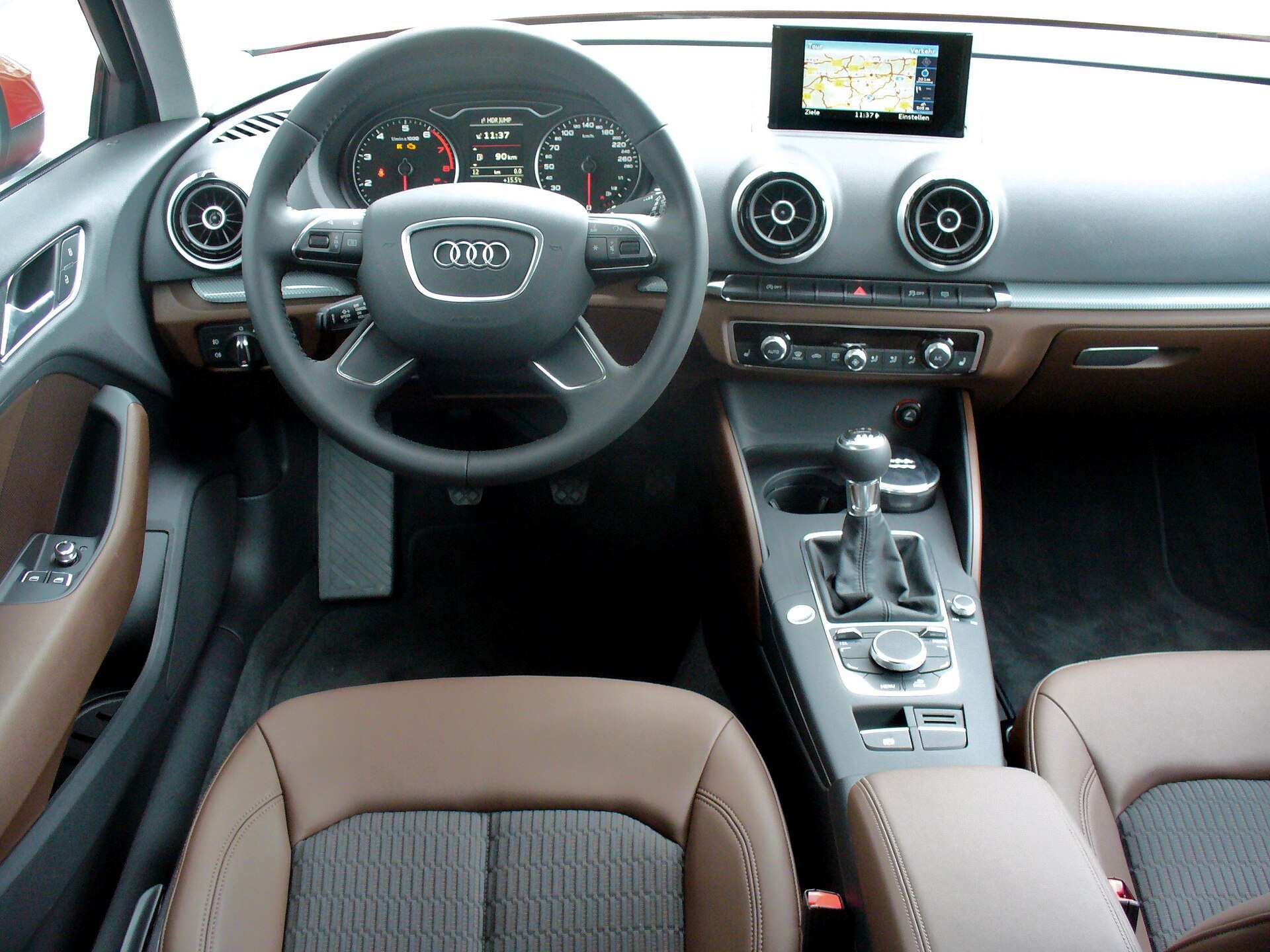
Ask about replacement screens, amplifiers, control modules and retrofits. Some work may require correct coding or component-authorisation procedures. Obtain evidence that the installed equipment functions fully, rather than valuing a visually impressive screen as an automatic upgrade.
Check both keys, locks, windows, mirrors, lights, washers, heater speeds, demisters, climate control and heated seats where present. Assess air conditioning over a proper running period. A recharge price is not an estimate for a diagnosed compressor, condenser or leak repair.
Inspect seat adjusters, folding mechanisms, belt operation, rear-seat access and trim completeness. A Sportback’s extra practicality is worth testing with your actual passengers and luggage; a Saloon’s boot aperture can matter more than its quoted volume. For a three-door, make sure the front seats release and return as intended.
UK service and repair costs
The figures below are published UK references observed in November 2026. They are not firm quotes for every 8V, nor are the parts-only examples eBay prices. Obtain a written VIN-specific quotation with VAT, labour, fluids, coding and additional work clearly stated.
| Job/reference | Parts-only evidence | Fitted/menu reference | Qualification |
|---|---|---|---|
| Main belt kit, 1.4 TFSI 125 PS catalogue application | INA 530 0592 11: £61.49 including 20% VAT, excluding delivery | Audi Specialists A3 petrol cambelt-kit menu: £562 | Catalogue lists main belt, tensioner and deflection pulley. Check engine code and workshop’s exact included work. |
| Separate pump/drive reference | INA 530 0742 30: £148.99 including VAT, excluding delivery | Provider quotes depend on actual pump/thermostat arrangement | 87-tooth pump drive is distinct from the main timing belt; do not combine unlike quotes. |
| 10K service, A3 menu | Not separately broken down | £223 | Ask for the actual items and final VAT-inclusive quotation. |
| 20K basic inspection service, A3 menu | Not separately broken down | £326 | A menu name is not a guarantee that every due plug/fluid/filter item is included. |
| Platinum-tipped plugs, fitted | Included in provider’s menu job | £135 in the A3 column | Confirm suitability for the engine and final inclusive amount. |
| Front discs and pads, fitted | Not separately broken down | £308 in the A3 column | Actual brake/PR-code specification may change the quote. |
| Manual petrol clutch/DMF menu, where used | Scope must be confirmed | £1,151 in the A3 column | Not a DSG clutch/mechatronic price; verify which flywheel and release parts apply. |
| 0AM/0CW dry-clutch gearbox oil-menu entry | No separate breakdown | £114 plus VAT = £136.80 at 20% | Code-specific maintenance menu, not a judder repair or a universal service interval. |
Sources: Audi Specialists service menu, its gearbox-code menu, and AUTODOC’s A3 Sportback 1.4 TFSI 125 PS catalogue. The gearbox table explicitly states plus VAT and calls itself a general guide. The service-menu figures are reproduced as displayed; confirm their VAT treatment and exact application with the provider. They are not guaranteed 1.5 quotes.
Labour is included in fitted menu jobs but not separately priced or timed there. Do not subtract a retail kit from another provider’s fitted figure to claim an hourly rate. Ask the chosen workshop for hours and scope where that matters. For timing work, compare its quotation with PSC’s engine/ACT-specific service description, including the separate pump drive.
Build a useful maintenance record
Read service dates and mileage together with the oil approval, filters, plugs, brake-fluid and timing evidence. A dashboard reset or digital stamp is not an itemised record. Where the car has a gap, agree a baseline inspection/service and a preventive plan for the actual engine and gearbox.
Keep work separate: oil servicing does not prove timing work, a gearbox-fluid invoice does not prove clutch replacement and a coolant change does not prove the leak was repaired. After purchase, retain invoices with part details and the original symptom where a repair was needed. That improves both ownership and the next buyer’s confidence.
eBay service-parts table: 1.4 and 1.5 TFSI
Affiliate disclosure: we may earn a commission from qualifying purchases through these model-specific searches at no extra cost to you. Campaign 5339238906 is used. Search results can contain incorrect applications, so verify codes, dimensions, part numbers and installer requirements.
| Part | Choose engine/application | Before ordering |
|---|---|---|
| Oil/filter service kit | 1.4 TFSI · 1.5 TFSI | Use the exact oil approval and engine-code application. |
| Air filter | 1.4 TFSI · 1.5 TFSI | Match the housing and production date. |
| Cabin filter | 1.4 TFSI · 1.5 TFSI | Check size and filter type. |
| Spark plugs | 1.4 TFSI · 1.5 TFSI | Correct heat range, specification and quantity. |
| Ignition coils | 1.4 TFSI · 1.5 TFSI | Diagnose the misfire; confirm connector and part number. |
| Main timing-belt kit | 1.4 TFSI · 1.5 TFSI | Distinguish the camshaft belt from the pump-drive belt. |
| Pump/thermostat assembly | 1.4 TFSI · 1.5 TFSI | Check assembly, housing and separate drive requirements. |
| Auxiliary belt/tensioner | 1.4 TFSI · 1.5 TFSI | Confirm actual accessory layout. |
| Manual clutch kit | 1.4 TFSI · 1.5 TFSI | Use gearbox code and check release/flywheel scope. |
| Front discs/pads | 1.4 TFSI · 1.5 TFSI | Verify brake/PR code and dimensions. |
| Battery | 1.4 TFSI · 1.5 TFSI | Confirm technology, capacity and registration/coding needs. |
| Alternator | 1.4 TFSI · 1.5 TFSI | Match output, pulley and electrical connections. |
For 1.4 timing kits and 1.5 timing kits, compare the contents against the agreed job. For 1.4 alternators or 1.5 alternators, confirm output, connections, pulley and exchange/core terms after charging-system diagnosis.
Agree parts supply with the workshop. A correct component, an accountable installer and a clear warranty may offer better value than a small saving on an uncertain listing. Delivery, returns, missing bolts, fluids and calibration can alter the total. Do not buy an expensive gearbox assembly to experiment with an undiagnosed symptom.
Hidden ownership costs
Premium equipment: headlamps, MMI electronics, adaptive components and Cabriolet roof work can cost more than the routine service that made the car appear affordable. Budget the actual specification.
First-year catch-up: a second key, matched tyres, overdue fluid/plugs and an independently assessed timing drive can accumulate. A recently valeted car is not necessarily a recently maintained one.
Insurance and tax: obtain quotes for the exact registration, disclose changes and check the current recorded tax position. Historic low-emissions brochure figures are not a current bill for your individual car.
Diagnosis and downtime: roof or transmission investigation may require workshop time before a repair price is reliable. If this is your only car, discuss transport and the practical terms of any seller warranty.
The viewing checklist
- Before travelling: request registration, VIN, engine/gearbox details, invoices and disclosure of warnings, coolant loss, gearbox and roof concerns.
- Check history: compare MOT mileage and recurring advisories with service documents. Clarify accident work and modifications.
- Inspect cold: fluid evidence, warning lamps, starting, idle and gentle pull-away. Do not accept a warm engine as the only demonstration.
- Inspect the body: repairs, sills, tyres, boot compartments and dampness. Arrange lift access for areas that decide the purchase.
- Drive fully warm: all gears, normal acceleration, braking, tracking, low-speed S tronic manoeuvres and a hot restart.
- Use every feature: MMI, climate, keys, seats, windows, assistance equipment and the luggage/access arrangement.
- For Cabriolet: a normal full roof cycle, fabric/glass/seal inspection and checks for water entry.
- Before paying: obtain diagnosis and quotes for material defects, then reassess the all-in cost.
Reject a car whose seller prevents a reasonable independent assessment or cannot explain significant identity or structural concerns. If a workshop cannot confirm the cause of a material running fault within the inspection’s scope, treat that uncertainty honestly. The next A3 may be the better purchase.
Frequently asked questions
Is S line an S3?
No. It is a trim/equipment description. Confirm the engine and drivetrain rather than reading performance hardware into the badge.
Does the 8V 1.4 use the older A3’s timing chain?
This guide covers the belt-driven EA211 application. Identify the actual engine before adopting another generation’s timing advice.
Is cylinder-on-demand a fault?
No, it is an operating feature on relevant versions. Persistent roughness, a warning or stored misfires still need diagnosis.
Does every S tronic use the same oil service?
No. Establish the transmission code, clutch type and applicable procedure. A generic Audi automatic menu is insufficient.
Is a 1.5 always better than a 1.4?
No. History, operation and total cost decide. Test the later engine cold and do not trade a known healthy car for an unresolved symptom just to buy a newer badge.
What makes a Cabriolet worth extra inspection?
The roof, glass, seals, drainage and sensors operate as a system. A single quick opening or a dry-looking fabric surface does not establish its condition.
Our recommendation
Buy the version that suits your use, then make engine identity, cooling, timing history and transmission behaviour the deciding evidence. Test expensive equipment and body-specific systems carefully. The right ordinary A3 combines a useful everyday specification with a maintenance record that answers questions before they become bills.

Love cars you don’t see every day?
Get forgotten cars, surprising motoring stories and the most interesting finds from Unusual Cars by email.
Free to join. No spam. Unsubscribe whenever you like. See our privacy policy.