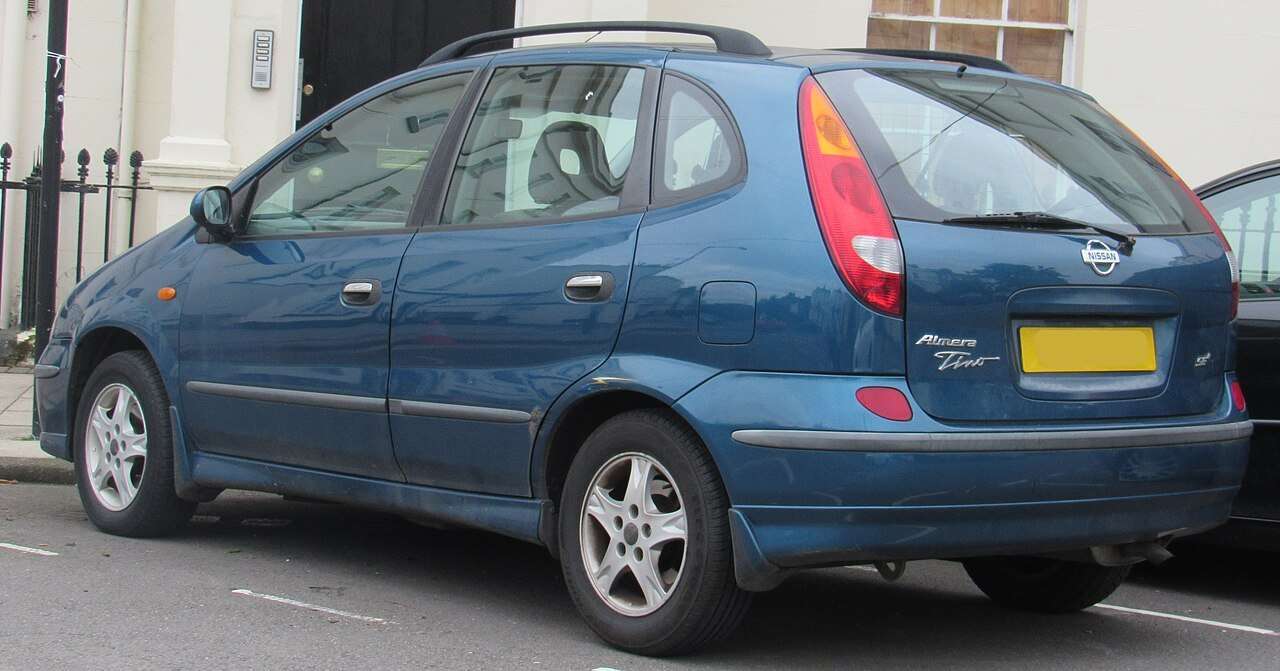
The Almera Tino gave Nissan a practical people carrier with removable seats, secret baskets and, eventually, a reversing camera. It had much more going on inside than its familiar badge suggests.
1. The European car was a joint design job
Nissan credits both its Atsugi engineering team in Japan and its European technical centre at Cranfield. The brief was to combine a people carrier’s interior with handling a hatchback owner would recognise. Britain helped shape the result.
2. European production took place in Barcelona
Nissan built the Almera Tino at its Barcelona plant. The European development story crossed three countries. That is useful context for a people carrier that looked like a particular British showroom staple.

3. The prototype appeared at Geneva in 1999
Nissan took a European-specification prototype to the show before the 2000 launch. The early announcement already centred on seats and storage. That tells you what the company wanted visitors to remember.
4. Nissan counted 24 rear-seat arrangements
The three separate rear seats could fold and be adjusted independently. Removing seats led to still more combinations. The point was to give buyers several useful arrangements between a full complement of passengers and a completely cleared load area.
Love cars you don’t see every day?
Get forgotten cars, surprising motoring stories and the most interesting finds from Unusual Cars by email.
Free to join. No spam. Unsubscribe whenever you like. See our Privacy Policy.
5. The rear footwells hid removable baskets
The lids in the rear floor opened to lift-out baskets. Children could carry toys out with them and put the whole basket back later. It is one of the few items in a brochure storage count that is genuinely memorable on its own.
6. Nissan advertised 20 storage spaces
The launch count went beyond obvious items like door pockets and a glovebox. Nissan could also offer folding tables on the rear of the front seats in SE form. That part of the Tino story rings true for anyone who has tidied a family car.
7. The rear suspension had its own Nissan terminology
Nissan described a multi-link QT rear axle with MacPherson struts at the front. The press material devoted time to the way the tall family car drove. The clever cabin was only one side of its pitch.
8. The 2003 refresh could show you what was behind
Nissan introduced an available rear parking camera, listed on SE in the UK equipment guide. The same refresh made DVD navigation available. On an early-2000s family car, a screen showing the space behind was still a notable feature.
9. Japan called its version simply Tino
Nissan used a shorter name at home. The company’s own Red Dot announcement distinguishes Almera Tino from Tino when it discusses the design award. A Japanese reference is useful, provided the specification is identified separately.
10. The centre seat could become a table
The UK brochure shows the centre backrest folding to create a space between the outer rear passengers. That adds something useful when the rear seat is only partly occupied. It is an easier way to understand the Tino than trying to memorise all 24 configurations.
Read about the Nissan Micra 1.3 Super S (K11).
Explore more 10 Things articles
Browse the Unusual Cars 10 Things hub.
Sources and further reading
- Nissan’s 2000 European Almera Tino launch release
- Nissan’s 1999 Geneva prototype announcement
- Nissan UK 2003 model update
- Original UK Almera Tino brochure
Featured image: 2002 Nissan Almera Tino 2.2. Photo by Vauxford via Wikimedia Commons (CC BY-SA 4.0, resized).
Join the Unusual Cars Club
Get more forgotten performance cars, surprising motoring stories and new 10 Things articles by email.
Free to join. No spam. Unsubscribe whenever you like. See our Privacy Policy.