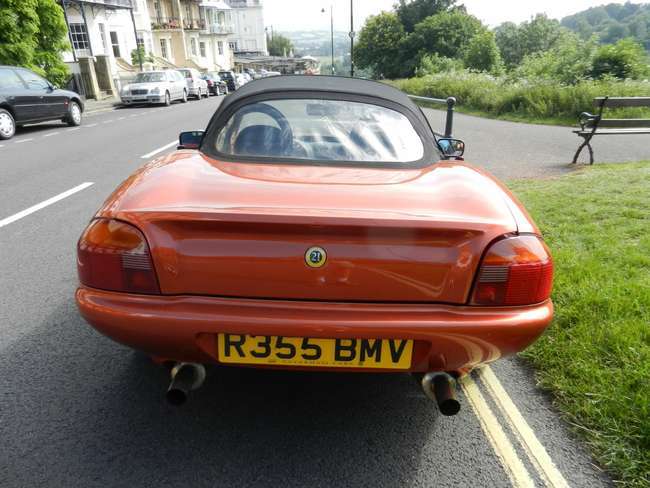
The Caterham 21 was the company’s bold attempt to turn Seven engineering into a more conventional British roadster. Unveiled at the 1994 Birmingham Motor Show, it gained a curving two-seat body, doors and a windscreen while retaining a lightweight chassis and much of the Seven’s mechanical character.

Beyond the Seven
By the early 1990s Caterham was closely identified with one shape. The 21 was intended to show that the company could make a complete sports car rather than only evolve the Lotus-derived Seven. Its name marked Caterham’s 21st anniversary, and its body brought integrated wings, a proper boot and greater weather protection.
The structure still relied on a steel spaceframe, but the bodywork was mostly glassfibre. Two cars were reportedly built with aluminium bodies. The result was compact and distinctive: softer than a Seven, yet narrow and purposeful beside contemporary roadsters.
Rover K-series engines
Most Caterham 21s used Rover K-series engines. The range included 1.6-litre units with approximately 113 or 131bhp and 1.8-litre versions producing around 122 or 138bhp. With a kerb weight quoted at about 658kg, even the less powerful cars had strong performance.
The base model was capable of around 0–60mph in 6.4 seconds and approximately 118mph. Two particularly rare Supersport R examples were built with about 190bhp, illustrating how much performance the light chassis could accept.

A difficult market
The 21 arrived just as a new generation of affordable roadsters was gathering strength. Buyers could choose the Mazda MX-5, while the Lotus Elise appeared soon afterwards with a striking bonded-aluminium chassis and a strong brand identity. Caterham’s small production operation also meant the 21 could never compete on price or volume.
Its hand-built nature was part of the appeal, but it limited exposure and made production slow. Only 49 examples were completed, turning what was meant to broaden the company into one of its rarest production cars.
Specifications
| Production | 1994–2000 |
|---|---|
| Body | Two-seat roadster; mainly glassfibre |
| Engines | 1.6- and 1.8-litre Rover K-series |
| Power | Approximately 113–138bhp; 190bhp Supersport R |
| Weight | About 658kg |
| 0–60mph | About 6.4sec in base form |
| Number built | 49 |
Why the Caterham 21 matters
The 21 was not a failure of imagination. It was a well-judged idea launched into a fiercely competitive moment. It proved that Caterham’s lightweight values could work beneath a fully enclosed body and offered an appealing mixture of delicacy, rarity and British craftsmanship.
Its tiny production total has made it far less familiar than the Seven, but that is precisely why it deserves attention. The 21 is the roadster Caterham might have developed into a second model line—and a fascinating snapshot of the company thinking beyond its defining car.
Enjoy unusual British performance cars?
Join the Unusual Cars newsletter for new model histories, forgotten-car features and specialist guides.
Frequently asked questions
How many Caterham 21s were made?
Only 49 production cars were completed.
Was the Caterham 21 sold in the UK?
Yes. It was unveiled in Birmingham and sold as a British-built roadster.
Is the Caterham 21 based on a Seven?
It shares Caterham’s lightweight spaceframe philosophy and components, but uses a distinct roadster body and more practical cabin.
Research sources include Caterham’s 50-at-50 archive and Hagerty’s model history.