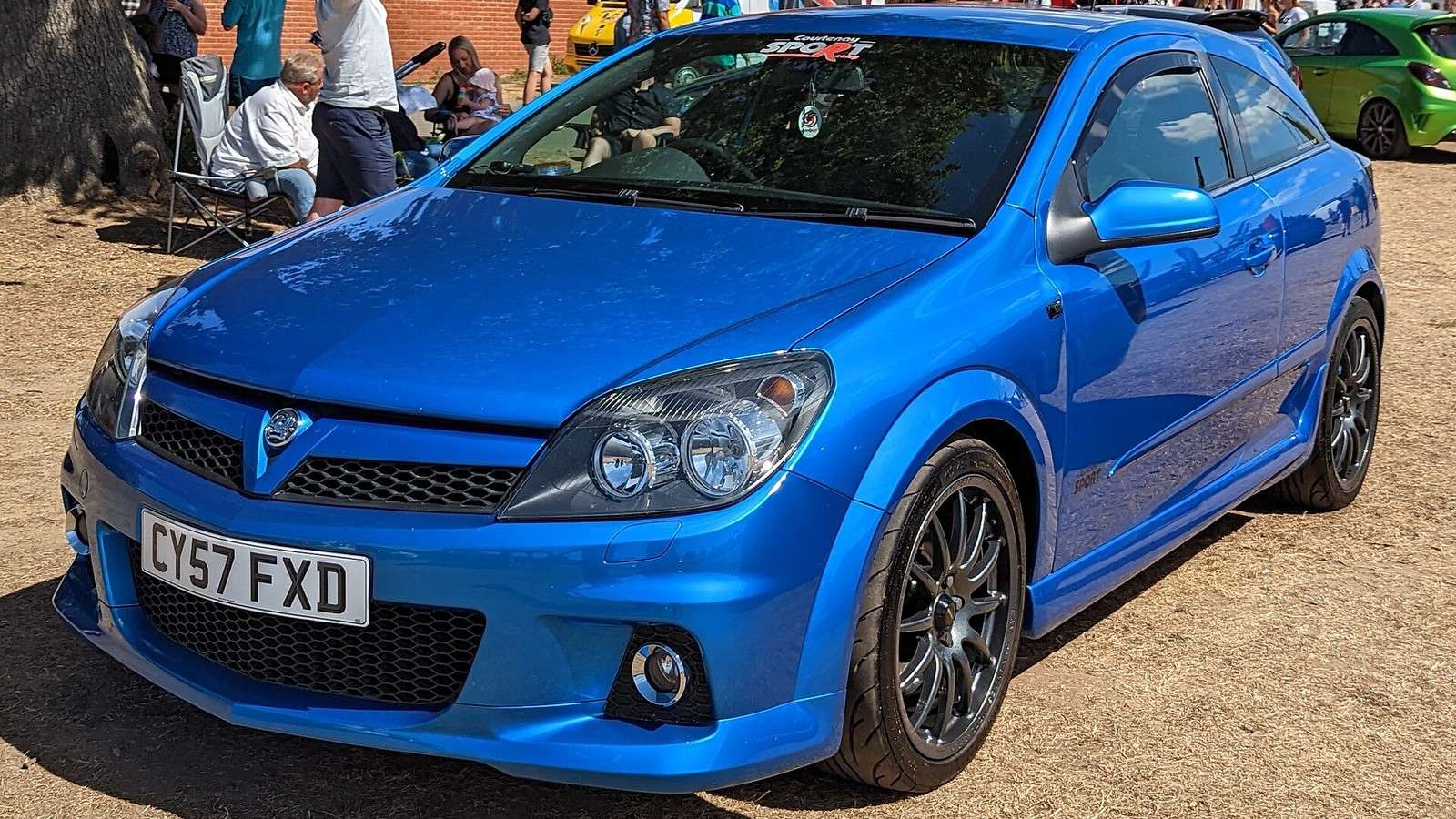
The Mk5 Astra VXR condensed the early VXR philosophy into one very blue, very fast three-door hatchback. Its 240PS turbo engine made it a performance bargain, while its fierce front-wheel-drive personality ensured nobody confused it with an ordinary Astra Sport Hatch.
Here are ten things you probably didn’t know about the Mk5 Vauxhall Astra VXR.
1. On the continent it was an Opel Astra OPC
VXR was Vauxhall’s British performance identity, but the same basic car wore Opel Performance Center badges across much of Europe. That is why brochures, replacement parts and Nürburgring records often refer to the Astra H OPC. The mechanical relationship is close, although equipment and special-edition details could vary between national markets.
2. Its engine was a strengthened Z20LET relative
The 1,998cc Z20LEH evolved from the turbocharged Family II engine used in earlier fast Astras. A larger turbocharger, stronger internals, revised cooling and different management helped it produce 240PS and 320Nm. A six-speed manual sent everything to the front wheels, with no factory mechanical limited-slip differential in the standard car.

3. It was one of the fastest front-wheel-drive cars of its day
Vauxhall quoted 0–60mph in approximately 6.2 seconds and a maximum of 152mph. Those figures placed the Astra beside far more expensive machinery in 2005. The delivery was memorable because peak torque arrived hard through the front tyres, making the steering wheel part of the experience rather than an isolated control.
4. The three-door body was more than a five-door with fewer openings
The VXR used the Astra Sport Hatch, known as the GTC in Opel markets. Its lower roof, longer doors, different rear quarters and wraparound rear glass gave it coupé-like proportions distinct from the regular five-door. The dramatic body therefore came from a dedicated derivative rather than a simple body kit fitted to the family hatch.
Join the Unusual Cars Club free
Get forgotten cars, surprising motoring stories and the most interesting finds from Unusual Cars by email.
Free to join. No spam. Unsubscribe whenever you like. See our Privacy Policy.
5. IDSPlus allowed the dampers to change character
The chassis combined lowered sports suspension with Vauxhall’s IDSPlus electronic control system. Pressing the SportSwitch sharpened throttle response and steering assistance while changing the continuously controlled damping strategy. It could not disguise the car’s weight or torque steer, but it gave the Astra a wider operating range than a fixed, aggressively stiff setup.
6. It set a Nürburgring class record in 2005
Former DTM champion Manuel Reuter drove an Astra OPC around the Nordschleife in 8 minutes 35.93 seconds. Opel described it as a class record and used the achievement heavily in advertising. The lap gave the car a credible motorsport-flavoured identity at a time when Nürburgring development was becoming a powerful performance-car selling point.
7. The Nürburgring Edition’s production number encoded the lap time
The white Nürburgring Edition was limited to 835 cars—a deliberate reference to the 8:35 lap. It wore chequered graphics, white wheels and numbered plaques, while Vauxhall’s brochure retained the same 240PS output. The special edition celebrated the chassis and record rather than claiming a dramatic engine increase.

8. The optional seats came from Recaro
Deep Recaro front seats, a flat-bottom steering wheel, blue instrumentation and alloy pedals created one of the most theatrical hot-hatch cabins of the period. Correct seats and trim matter now because damaged bolsters are common and replacement interiors have often been mixed between standard, Nürburgring and later modified cars.
9. Its unruly reputation was part engineering and part expectation
Contemporary tests frequently criticised torque steer and traction on rough roads. Those traits were real, but the VXR was also being compared with increasingly sophisticated rivals. With good tyres, sound suspension and correct geometry, it is more capable than the folklore suggests—just far less filtered than a modern electronically managed hot hatch.
10. Standard examples are becoming harder to find
The robust tuning scene produced many remapped cars with larger intercoolers, exhausts and boost changes. Modified power can expose the M32 gearbox, clutch, cooling system and front tyres to greater stress. A complete unmodified VXR with its original wheels, seats, trim and documented cambelt servicing now tells the period story better than a heavily altered example.
Why it matters
The Mk5 Astra VXR matters because it captures the loudest moment of Britain’s 2000s hot-hatch battle. It was affordable, genuinely rapid and imperfect in ways that made every full-throttle journey memorable.
Enjoyed this one?
Join the Unusual Cars Club free for more forgotten performance cars, surprising motoring stories and new 10 Things articles.
Free to join. No spam. Unsubscribe whenever you like. See our Privacy Policy.
Explore every 10 Things article in the Unusual Cars hub →