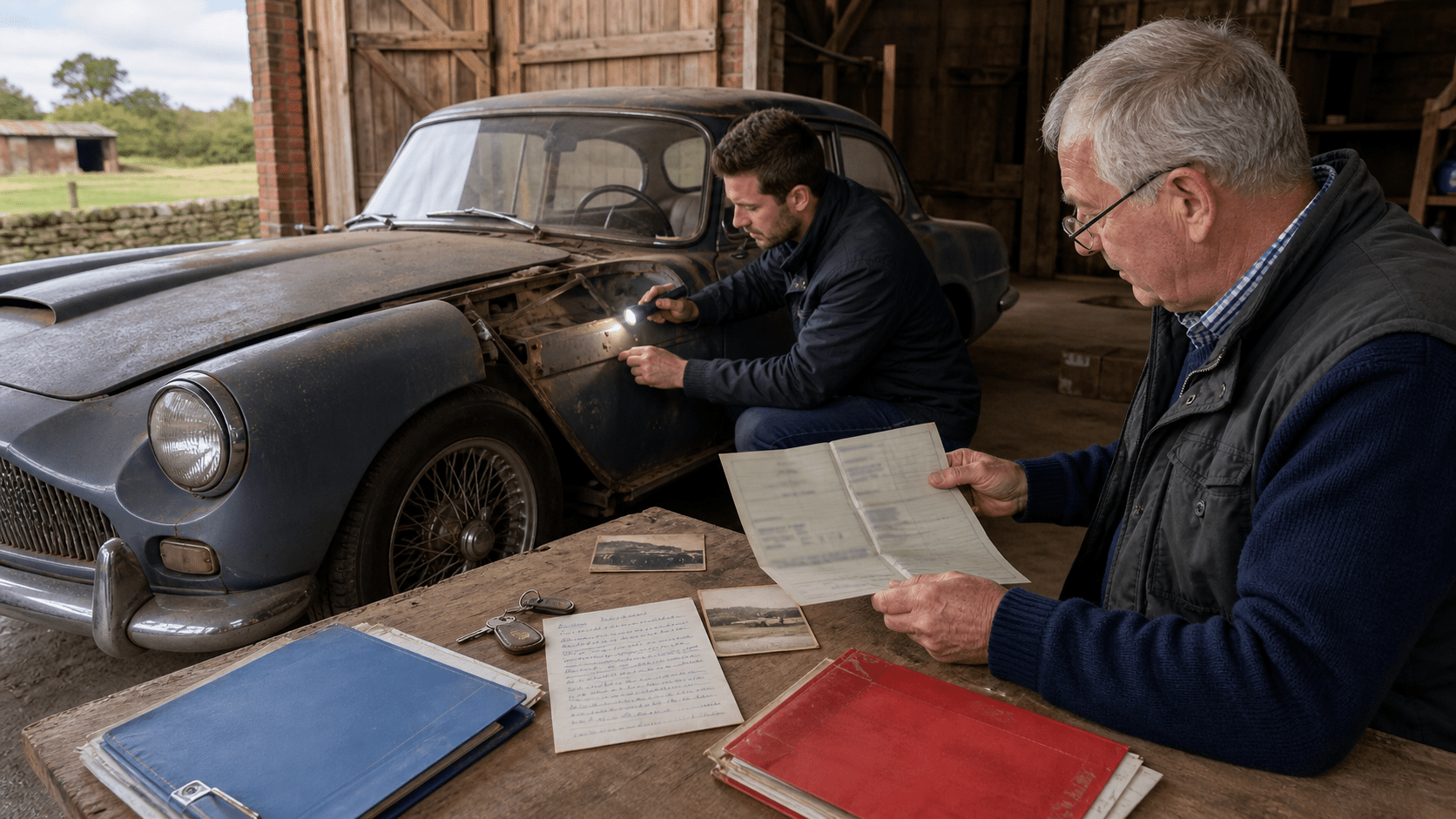
A dusty logbook, an old number plate and permission to enter a barn do not automatically prove that somebody can sell the vehicle inside. Before paying for a long-stored car, establish three separate things: the physical vehicle’s identity, the seller’s legal authority to transfer it and the route by which its keeper and registration records can be updated.
Separate identity, ownership and keeper records
Vehicle identity
The physical car: VIN or chassis number, registration, engine number, make, model, specification and age. These details must form one consistent identity.
Legal ownership
The person or organisation entitled to sell or transfer the vehicle. Evidence may include purchase receipts, invoices, contracts, estate papers and a credible chain of possession.
Registered keeper
The person recorded by DVLA as responsible for registering and taxing the vehicle. The keeper is often the owner, but the two are not necessarily the same.
A V5C is important—but not proof of ownership
The V5C vehicle registration certificate records the vehicle and registered keeper. The document itself states that it is not proof of ownership. GOV.UK technical guidance likewise explains that the registered keeper is responsible for registration and tax but is not necessarily the owner.
See the original document where possible. Check its registration, VIN, make, model, colour, body type, engine capacity and recorded engine number against the vehicle. Look for the current security features and follow GOV.UK’s used-vehicle buying checks.
A correct V5C supports the identity and keeper history. It does not by itself resolve a disputed sale, outstanding finance, an estate’s ownership or a vehicle left on somebody else’s property.
Check every identity mark carefully
Locate the VIN or chassis number using manufacturer or owners-club information. Older vehicles may use a stamped chassis or body number rather than a modern 17-character VIN. Compare all original locations, plates and documents.
- Consistency: numbers on the car should agree with the V5C, historic logbook, factory records and old invoices.
- Originality: inspect stamping style, surrounding metal, rivets, paint layers and welds for disturbance.
- Engine: confirm whether the recorded engine remains fitted and whether any replacement is documented.
- Registration plates: treat plates as clues, not proof that the registration belongs to the shell.
- Loose identities: never combine a document or VIN plate from one car with another shell.
If a number is difficult to read, do not grind, restamp or remove it. Photograph it in varied light and seek help from a recognised owners’ club or marque specialist. Contact the police if you suspect theft, cloning or tampering.
Establish the seller’s authority
Ask the seller to explain how and when they acquired the vehicle. Request purchase receipts, correspondence, storage agreements, probate or estate authority, business records or other evidence appropriate to that story. Names, addresses, dates, VIN and registration details should align.
Meet a private seller at the property where the car is stored where practical, verify their identity and record their permanent address. If somebody is acting for the owner, require clear written authority and verify it directly with the owner or authorised estate representative.
Barn finds from a deceased estate
Establish who is authorised to deal with the estate and whether the vehicle forms part of it. Ask for suitable evidence of that authority and ensure the receipt identifies the estate or authorised seller correctly. Do not rely on informal family agreement when executors, administrators or beneficiaries may have competing interests.
The terminology and procedure differ across UK jurisdictions. Where probate, confirmation, ownership or family consent is unclear, the estate should obtain legal advice before sale. The buyer should not attempt to solve an unresolved estate by applying for a V5C.
A car left in a barn or purchased property
A vehicle remaining after a tenancy, storage arrangement or property purchase creates an ownership problem, not a free car. Review the property contract, inventory, correspondence and any storage terms. The vehicle may belong to a previous occupier, customer, finance company, estate or insurer.
Do not remove, sell, scrap or apply parts to another car until the relevant owner has transferred it or a lawful process has established authority. Because rules and remedies depend on circumstances and jurisdiction, obtain legal advice rather than copying an online “abandoned vehicle” template.
Run history, theft, finance and write-off checks
Use DVLA vehicle enquiry and MOT history, then consider a reputable paid history check for theft, outstanding finance, insurance write-off and mileage records. Match the information to the physical car rather than entering only the registration displayed on it.
Outstanding finance can mean that a lender retains rights. An insurance write-off can affect whether a vehicle or shell may return to the road. Category A vehicles must be crushed; Category B body shells must be crushed. Category S and N vehicles require proper repair to a roadworthy condition before road use.
What if there is no V5C?
No V5C does not automatically mean that a vehicle is stolen or impossible to register, but it increases the need for identity and ownership evidence. A current keeper can use the V62 application to request a V5C, subject to DVLA’s process and fee where applicable.
Applying for a V5C does not create legal ownership or cure an unauthorised sale. Complete the purchase only when the seller’s title and the vehicle identity are credible. Keep copies of the advert, receipt and supporting records.
Old cars missing from DVLA records
A classic vehicle that has not been taxed since 1983 may not be registered on DVLA’s computerised record. GOV.UK’s old-vehicle registration guidance explains that an original registration may sometimes be recovered using form V765, evidence linking the vehicle to the number and endorsement by an approved owners’ club.
Useful evidence can include an old logbook, archive records, tax discs, MOT certificates, dated invoices and photographs that clearly connect the registration to the physical vehicle. A loose number plate or handwritten note is weak evidence on its own.
Unregistered and reconstructed classics
A vehicle assembled from period components or lacking an established identity may follow a different route from restoration of a known registered car. Current DVLA INF318 guidance covers repaired, restored, radically altered, kit-built, kit-converted and reconstructed classic vehicles.
Age-related or Q registration, inspection and vehicle approval may become relevant depending on components and construction. Do not buy a pile of parts on the assumption that an old registration can simply be attached later. Seek an appropriate club and DVLA guidance before building.
Engine, body and colour changes
Compare the current car with the V5C and historical evidence. DVLA must be informed of changes that affect V5C details, including relevant engine, colour, body or structural changes. Evidence such as receipts, dating information or inspection may be requested.
An undocumented modification is not only an administrative detail: it may affect registration, MOT exemption, insurance and the accuracy of the vehicle’s identity. Resolve it before investing in restoration.
What the purchase receipt should record
- Date, time and agreed price
- Buyer and seller names, addresses and signatures
- Vehicle make, model, registration and VIN or chassis number
- Recorded engine number where relevant
- Whether a V5C and new-keeper slip were supplied
- Known write-off, finance, registration or identity issues disclosed
- Major loose components, keys and documents included
- Seller’s statement that they own the vehicle or are authorised to sell it
- Any agreed collection deadline and responsibility for storage or removal
A receipt records the transaction; it cannot make a false identity or unauthorised sale valid. Pay by a traceable method to the named seller and retain the advert, correspondence and photographs.
Use the correct keeper-transfer process
When a current V5C exists, follow the current GOV.UK process for selling or transferring a vehicle and retain the green new-keeper slip where applicable. Ensure DVLA is notified rather than relying solely on a handwritten receipt.
Do not share photographs of the complete V5C or its document reference number publicly. Those details can be misused to obtain fraudulent documents or facilitate vehicle cloning.
Red flags that should stop the purchase
- The VIN is missing, altered, welded around or inconsistent with the documents.
- The V5C belongs to a different body, model or specification.
- The seller refuses to identify themselves or explain how they acquired the car.
- A property owner is selling a former occupier’s vehicle without evidence of authority.
- An estate sale proceeds without an identifiable authorised representative.
- The registration is advertised as especially valuable but cannot be linked to the vehicle.
- The seller asks for an untraceable deposit before identity and history checks.
- Major components or documents appear to come from several different vehicles.
Printable barn-find paperwork checklist
Vehicle identity
- Registration checked with DVLA
- VIN or chassis number located
- All identity marks compared
- Engine number checked
- MOT and vehicle history reviewed
- Theft, finance and write-off checks considered
Seller authority
- Seller’s identity and address verified
- Ownership chain explained
- Purchase, estate or authority evidence reviewed
- Third-party interests resolved
- Jurisdiction-specific advice obtained where needed
Documents and transfer
- Original V5C examined where available
- V5C details matched to physical vehicle
- Old logbooks, invoices and photographs preserved
- V62 or V765 route researched if relevant
- Modifications and registration implications checked
- Detailed receipt signed
- DVLA keeper-transfer process completed
Inspect the physical car, arrange safe recovery and calculate the complete restoration commitment.
Inspection checklistTransport & recoveryBarn-find costsBarn Finds hub