The Peugeot 405 was one of the defining European family cars of its era. It combined an elegant, restrained shape with comfort, space and unusually satisfying road manners, then stretched from modest fleet saloons and hard-working diesel estates to the Mi16, Mi16x4 and rare turbocharged T16.
Why the Peugeot 405 mattered
The 405 arrived when the Ford Sierra and Vauxhall Cavalier dominated British company-car thinking. Peugeot gave buyers a conventional three-box saloon that looked modern without being eccentric, but its real distinction was the way it rode and handled. Peugeot’s own heritage account highlights its interior space, visibility, comfort and large boot, while the 1988 Car of the Year jury placed it first with remarkable unanimity.
The range also helped Peugeot become a serious UK fleet contender. British-market cars were assembled at Ryton near Coventry, and economical XUD diesels became central to the model’s success. More than five million 405s were ultimately sold worldwide, although European production represents only part of its unusually long global story.
Peugeot 405 timeline
| Year | Development |
|---|---|
| 1987 | 405 saloon unveiled in June; continental sales begin later in the year. |
| 1988 | UK launch in January; European Car of the Year; Mi16 and diesel range established; estates join the range. |
| 1989–90 | Mi16x4 adds permanent four-wheel drive; the range expands and receives continuing equipment revisions. |
| 1992–93 | Major Phase 2 redesign brings a new dashboard, revised rear structure, lower boot opening, new rear lamps and updated engines. |
| 1993 | The 405 T16 becomes the turbocharged four-wheel-drive road-car flagship in continental Europe. |
| 1995–96 | The 406 replaces the European 405 saloon; late UK editions include Executive and Quasar derivatives. |
| 1997 | European estate production ends as the 406 estate arrives. |
Phase 1 and Phase 2 explained
Phase 1: 1987–1992
The original 405 has the clean early body design, higher boot opening and first-generation dashboard. UK specifications changed repeatedly, so a registration year alone does not define every item of trim or equipment.
Phase 2: 1992–1997
The facelift was more substantial than a change of lamps. Peugeot revised the rear body and boot access, installed a new dashboard and updated the engine and equipment range. Later cars gradually gained power steering, air conditioning, remote locking and a driver’s airbag across more versions.
Saloon and estate body styles
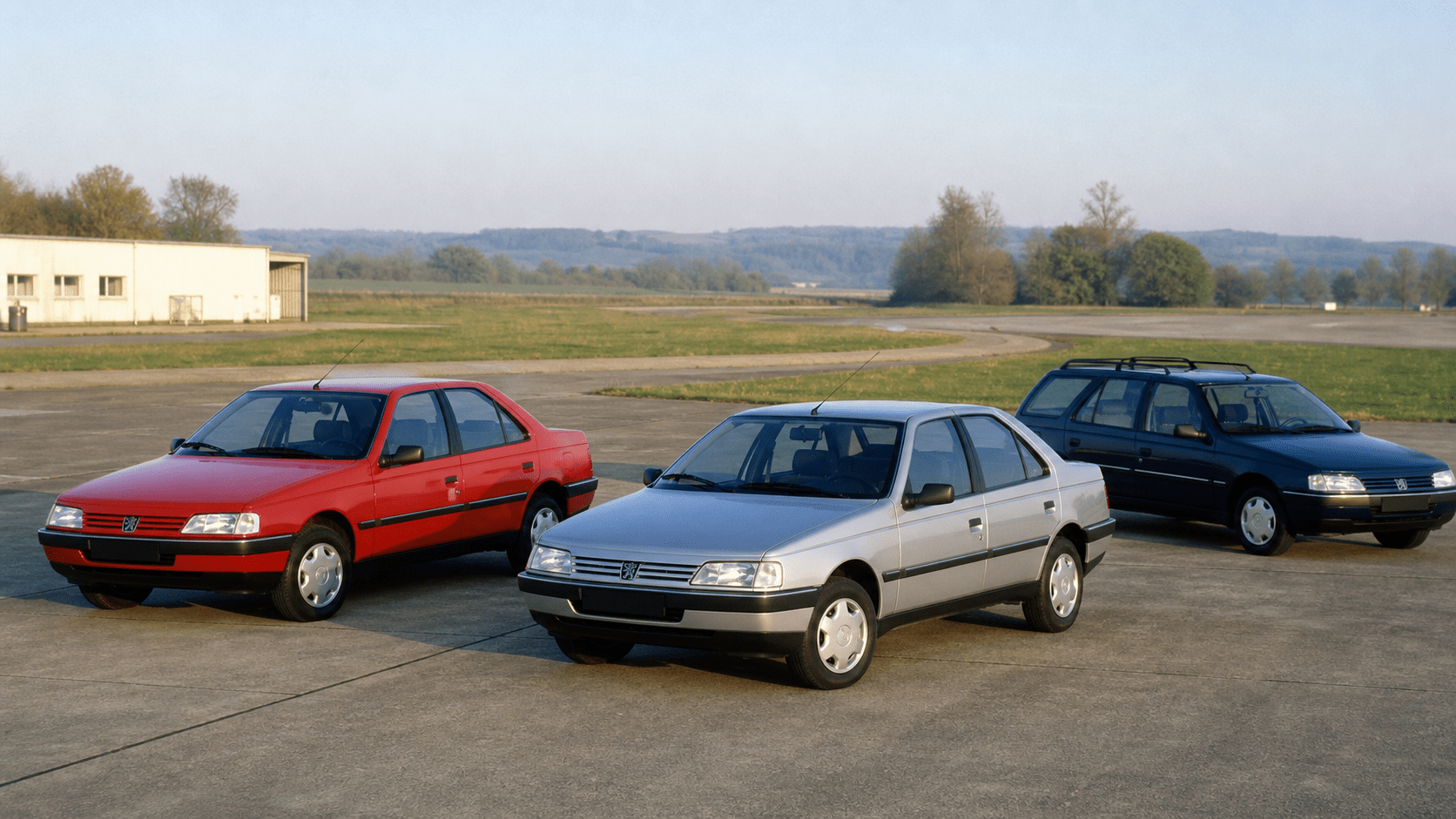
405 saloon
The four-door saloon is the shape most closely associated with the model. Its low waistline, generous glass area and crisp proportions gave excellent visibility and made it look lighter than many rivals. Phase 2 cars are easily distinguished from the rear by their revised lamps and boot opening.
405 estate
The estate arrived during 1988 and gave the 405 a large, useful load area without abandoning the saloon’s road manners. It became especially popular with diesel buyers. European estates outlived the saloon because Peugeot needed them until the 406 estate was ready.
Peugeot 405 engines
The exact engine range varied by country, trim and year. European cars used PSA’s TU and XU-family petrol engines and XUD diesels. UK buyers encountered capacities from 1.4 to 2.0 litres across the model’s life, but it is safer to identify an individual car from its VIN and engine code than from a broad online list.
Petrol range
Entry and mid-range cars used carburettor or fuel-injected four-cylinder engines, with later Phase 2 versions moving towards catalysed 1.8- and 2.0-litre units. Outputs and induction systems differ substantially by year.
XUD diesels
Naturally aspirated and turbocharged diesels made the 405 an important high-mileage fleet and estate car. The turbo-diesel’s useful torque and economy became a defining part of the UK range long before modern common-rail diesels.
UK trim levels and special editions
The British range used a long list of familiar Peugeot grades and market-specific editions. Depending on period, these included GE, GL, GR, SR, GTX and later Style, LX, GLX, Executive and Quasar versions, with D or DT suffixes marking diesel derivatives. Equipment could include power steering, electric windows, central locking, sunroof, air conditioning, ABS and eventually a driver’s airbag.
Special-edition names do not always indicate a different engine. When documenting a survivor, use its original sales invoice, handbook pack, VIN information and a correct dated brochure. Cars were often rebadged, retrimmed or fitted with higher-specification wheels during their low-value years.
The Peugeot 405 performance family
Peugeot 405 Mi16
Launched with a 1.9-litre 16-valve engine producing about 160hp in its early European form, the Mi16 became a benchmark sports saloon. Phase 2 cars adopted a catalysed 2.0-litre engine and a different character. Read our full Peugeot 405 Mi16 guide.
Peugeot 405 Mi16x4
The Mi16x4 combined the 16-valve engine with permanent four-wheel drive and a self-levelling hydraulic rear suspension. Its engineering made it fascinating but also more complex. See the dedicated Mi16x4 history and buying guide.
Peugeot 405 T16
The Phase 2 T16 used a turbocharged 2.0-litre engine, permanent four-wheel drive and temporary overboost that raised output from 196hp to 220hp. Peugeot states that only 1,046 road cars were made. Explore the complete Peugeot 405 T16 guide.
Competition history: what was—and was not—a road-going 405
Peugeot used the 405 name for spectacular rally-raid and Pikes Peak competition cars. Ari Vatanen won the Paris-Dakar in 1989 and 1990 and achieved famous Pikes Peak victories. These purpose-built machines drew heavily on Peugeot’s competition programme and were not mechanically equivalent to a family saloon or the later road-going T16. Their achievements strengthened the 405 name, but competition specifications should never be applied to a production car.
Global production after Europe
The European 405 story ended in the 1990s, but licensed and derivative production continued elsewhere, most notably in Iran. This creates confusing online production dates and specifications. A late overseas-built 405-family derivative may share the basic platform while differing in body panels, engines, equipment and homologation from a European Phase 2 car.
Frequently asked questions
Who designed the Peugeot 405?
Peugeot describes the 405’s elegant shape as strongly associated with Pininfarina, with development also involving Peugeot’s own styling organisation.
When was the Peugeot 405 made?
European saloon production ran from 1987 into the mid-1990s and the estate continued into 1997. Related licensed production continued much longer in other markets.
Was the Peugeot 405 built in Britain?
Yes. Right-hand-drive cars for the UK were assembled at Peugeot’s Ryton plant near Coventry.
What is the difference between an Mi16 and T16?
The Mi16 is the naturally aspirated 16-valve sports saloon. The much rarer Phase 2 T16 added turbocharging, overboost and permanent four-wheel drive.
How many Peugeot 405s were sold?
Peugeot’s heritage material states that more than five million were sold worldwide.
Research note: dates, awards, production context and performance-family facts were checked against Peugeot and Stellantis heritage material. UK range chronology was cross-checked against contemporary and established used-car references. Specifications varied by market and model year, so verify individual cars from original documentation.