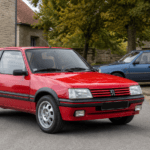
The Peugeot 205 Rallye pursued speed through simplicity. Rather than adding luxury and ever larger engines, Peugeot removed equipment, reduced weight and created a small-capacity car that rewarded momentum and commitment.
What made the Peugeot 205 Rallye special?
The Rallye was conceived as an affordable, competition-minded derivative rather than a more luxurious GTI. Weight-saving measures, modest trim and steel wheels were part of the point. Its appeal comes from immediacy: a responsive engine, short gearing and low mass encourage the driver to preserve momentum.
White paint, Peugeot Talbot Sport-style striping and a purposeful cabin made the original European car distinctive. Yet details varied by market and later restorations frequently mix genuine components with reproduction graphics, GTI parts or modern upgrades.
Peugeot 205 Rallye specifications
| Launch | 1988 |
|---|---|
| European engine | 1,294cc four-cylinder petrol with twin carburettors |
| Transmission | Close-ratio five-speed manual |
| Layout | Front engine, front-wheel drive |
| Character | Low weight, minimal equipment and rev-hungry delivery |
Figures quoted online often combine French, UK, German and other-market cars. Treat the specification above as a guide to the celebrated European form, then verify an individual car using its chassis number, engine, original market and documentation.
Rallye versus GTI
205 Rallye
Smaller engine, less equipment, steel wheels and a rawer competition-inspired character. Its identity depends on lightness and originality.
205 GTI
More torque, broader everyday usability and a richer specification. The GTI is not simply a superior Rallye; the two cars answer different briefs.
How to identify a genuine 205 Rallye
- Confirm the VIN and original market before judging the car by paint or stickers.
- Check the engine type, carburettor installation and gearbox against market-specific records.
- Look for evidence of original lightweight trim rather than a converted base-model shell.
- Inspect period paperwork, service history, old photographs and competition documents.
- Be cautious when a car combines Rallye graphics with GTI seats, wheels and running gear.
What to check before buying
Begin with the shell. Inspect sills, floors, inner wings, suspension mounting areas, boot floor and previous repairs. Rallyes were often driven hard or used in competition, so look for historic accident damage, fatigue and poorly executed strengthening or roll-cage work.
Twin carburettors need correct setup. Hesitation, difficult hot starting or uneven idle may reflect wear, air leaks, poor balancing or ignition problems rather than an inherent flaw. Check the cooling system, timing-belt evidence where applicable, gearbox synchros and driveshafts. Rear wheels leaning inward can indicate wear in the rear beam.
Original lightweight interior pieces, wheels, graphics and engine components matter because restoring a modified car accurately can cost more than buying the best available example. For a competition car, verify the exact build standard and whether safety equipment remains in date.
Frequently asked questions
Is a Peugeot 205 Rallye faster than a GTI?
Not necessarily in a straight line. The Rallye’s appeal is low weight, gearing and response; the GTI offers more torque and easier everyday performance.
Were all 205 Rallyes 1.3 litres?
No. Market-specific versions existed, so origin and chassis identity must be checked before declaring a car genuine.
Can a 205 Rallye be used every day?
It can, but its noise, sparse equipment, carburettor behaviour and scarcity make a well-maintained mainstream 205 or GTI easier for many owners.
Research note: launch chronology was checked against Peugeot heritage material. Rallye specifications varied by country; verify an individual car from its VIN and original market documentation.