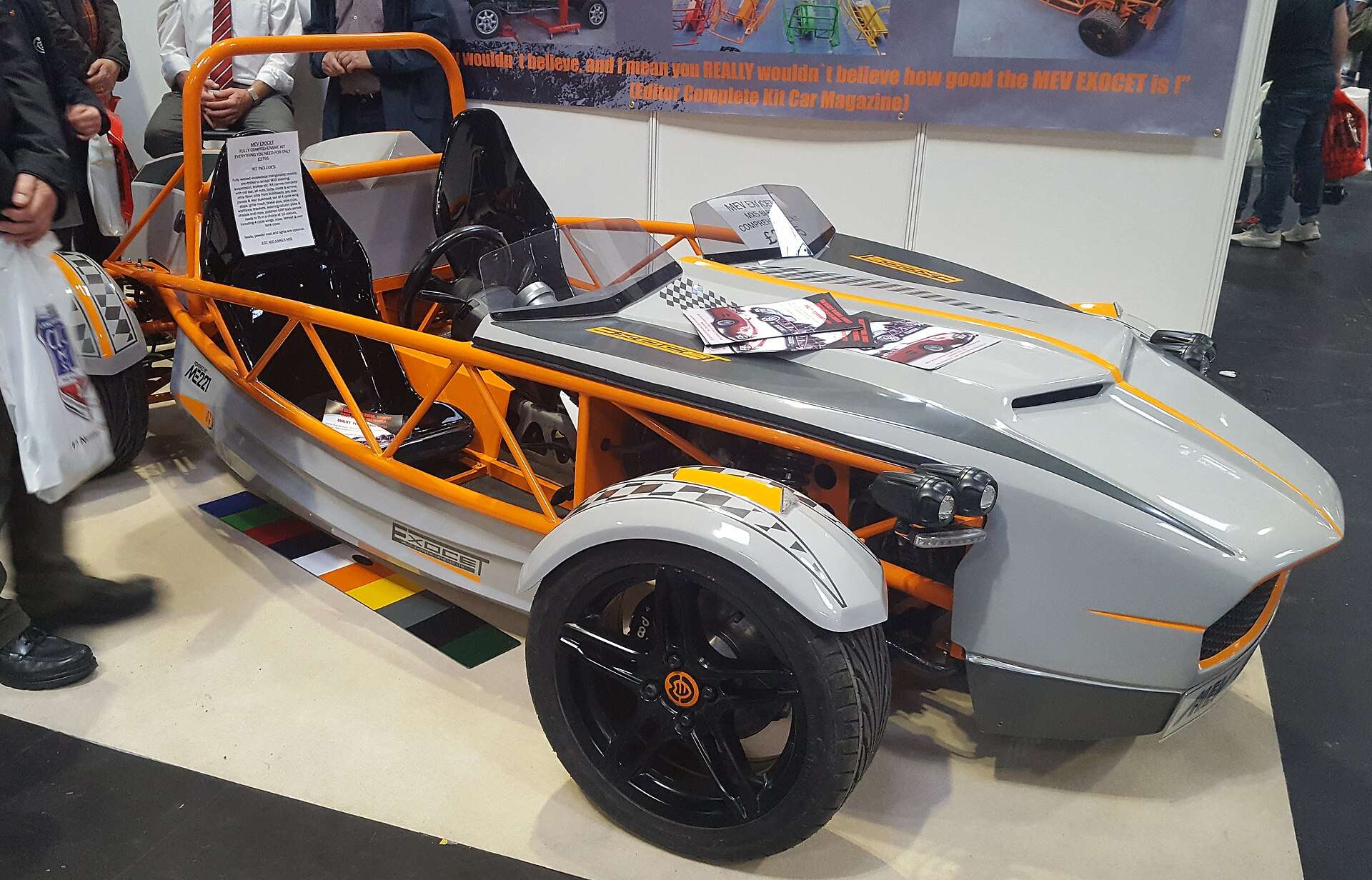
The MEV Exocet strips the sports-car idea back to an exposed structure and essential body panels. Its visual drama is matched by a practical attraction: familiar Mazda MX-5 mechanical components provide the foundation. For a buyer, the challenge is to judge both the donor hardware and the quality of the conversion.
Why the donor matters
MEV’s documentation describes extensive reuse of MX-5 parts, including major drivetrain, suspension and electrical components. This creates useful continuity with a widely understood production car, but it does not make every MX-5 donor suitable for every Exocet kit. Confirm the precise donor generation and chassis compatibility before purchasing either.
A rusty bodyshell may be the reason an MX-5 becomes a donor, but usable mechanical condition must be established separately. Inspect retained subframes and suspension parts, and assess engine health before dismantling. A cheap donor needing a full mechanical rebuild can defeat the apparent saving.
The Exocet idea: retain the Mazda, replace the structure
MEV’s early build guide dates the Exocet’s launch to 2010. Its defining idea was to make extensive use of a complete MX-5 rather than ask the builder to assemble unrelated suspension and drivetrain components. The original shell is removed, and a new exposed frame provides the basis for a much more stripped-back sports car. The familiar front-engine, rear-wheel-drive layout remains central to the experience.
This explains both its appeal and its limitations. Much of the mechanical knowledge needed to maintain it comes from the Mazda donor, while the conversion introduces its own structure, panel work and installation details. It is neither a standard MX-5 with cosmetic changes nor a clean-sheet car in which every component is new. A sensible inspection treats the retained mechanical assemblies and the conversion work as two connected areas.
The visual openness is a deliberate choice. A conventional Seven-style roadster hides more of its structure beneath panels; an Exocet makes the frame part of its appearance. That can make some components easier to inspect, but it does not make every critical mounting visible from above. Take time to examine the underside, cockpit attachments and areas concealed by the small amount of bodywork.
NA, NB and NC donors: establish the right version
MEV publishes separate guides for the earlier Mk1/Mk2/Mk2.5 donors and the Mk3. In Mazda generation terms, the earlier cars are NA and NB, while the Mk3 is the NC. The NC-based Exocet was announced for launch at Autosport in January 2019, with a new chassis and the later Mazda’s different mechanical package. Similar-looking completed cars can therefore have substantially different parts requirements.
The NC launch announcement described a 2.0-litre engine and retained electronic features in its example. That should not be turned into a promise about every NC-based car. Confirm the engine, gearbox, differential and functioning electronic systems on the vehicle you are considering. Builders may choose different specifications or subsequently modify the installation.
Before buying a kit or donor, obtain confirmation that the two belong together. A seller’s statement that the chassis is “for an MX-5” is insufficient when several generations are involved. Request the kit invoice, chassis identification and appropriate manual. If the car has been built from a mixture of donors, list the components individually and establish how the combination was made to work.
Understanding the rolling donor assembly
The early conversion guide describes removing the bodyshell while retaining the major running assemblies connected by Mazda’s power plant frame, commonly discussed by builders as the rolling “skate”. This is the core of the original construction method. It reduces the need to invent a completely new relationship between the engine, gearbox and differential, while leaving refurbishment choices to the builder.
For a used car, ask how far that assembly was dismantled during construction. Was it simply cleaned and transferred, or were bearings, bushes, seals and brake components inspected and renewed? Neither a new frame nor a fresh coat of paint resets the age of the donor parts. A detailed build file should distinguish actual refurbishment from cosmetic preparation.
Examine retained subframes for corrosion and previous repairs, particularly around mounts and areas where dirt can collect. Check the condition of accessible joints and fixings and look for evidence of components contacting the new structure. If the vehicle has suffered an impact, establish which parts were replaced and how alignment was checked. An exposed layout does not remove the need for a proper structural assessment.
Choosing an engine specification you can maintain
The earlier donor route includes 1.6- and 1.8-litre Mazda engines, while the later NC conversion is a separate proposition. Do not assign one universal power figure to each capacity: donor year, market, engine version and modifications can matter. Record the engine identity and ask for evidence of its condition before making performance comparisons.
A standard or mildly modified engine can be an attractive choice because the installation is easier to understand and fewer supporting changes need to be evaluated. Check cold starting, idle stability, cooling and hot restarting. Ask about service history before and after the conversion. If the donor’s mileage is unknown, treat that as uncertainty rather than assuming the completed kit’s odometer tells the whole story.
On a turbocharged or supercharged example, request the specification of the fuel system, engine management, cooling and drivetrain as well as the conversion itself. A power graph should relate to the current installation and clearly identify what was measured. A successful upgrade is a coordinated package; a large turbo and a headline number do not demonstrate that the car is dependable in ordinary use.

Wiring: simplifying the donor needs care
The original build guide cautions that removing apparently redundant loom sections can interrupt circuits that are still needed. That is a useful inspection clue. A reduced loom can be tidy and effective, but ask for a diagram or a clear record of what was removed and altered. A bundle of unused plugs is not necessarily a fault; unexplained cuts and unsupported connections deserve more attention.
Test the fitted lights, instruments and warning indications individually. Check that useful diagnostic access remains available for the actual management system. Where the engine or ECU has changed, ask how starting authorisation and other associated functions were handled. A car that runs is not necessarily a car whose electrical conversion is finished.
Because more of the installation is exposed, inspect connector protection, fuse and relay locations, battery restraint and cable routing. Look for abrasion where wiring crosses panels and for clearance from exhaust heat and moving suspension. Ask how the car is cleaned and stored, and whether water-related faults have occurred. Accessibility is an advantage only if it is accompanied by secure, durable installation.
Fuel, cooling and exhaust details
MEV’s donor information includes reuse of the Mazda tank, pump, radiator and associated components in the relevant build. Identify what has actually survived on the example you are viewing. Replacement tanks, relocated filters or altered pipework may be perfectly reasonable, but they change the inspection and maintenance questions. Ask for the specification of any replacement hoses and the reasons for changes.
Check that the fuel installation is secure and that its routes avoid sharp edges, heat and moving parts. Look for deterioration around old hose connections and evidence of leaks. Fuel-system concerns should be resolved before use, rather than treated as an inexpensive job to leave for later. Do not disturb pressurised connections during a casual viewing.
Assess cooling after the engine has warmed fully. Watch the instruments, confirm fan operation and ask about previous overheating. An exposed engine does not guarantee adequate radiator airflow or a correctly arranged cooling system. Inspect the radiator mounts, hoses and clearance to nearby panels. Check the exhaust for secure support, body contact and appropriate protection near occupants and access points.
Enjoy cars you don’t see every day?
Get unusual car stories, kit-car guides and interesting finds from Unusual Cars by email.
Free to join. Unsubscribe whenever you like. Read our privacy policy.
Suspension and tyres after the weight reduction
The donor’s suspension provides a useful starting point, but the finished car has a different mass and body arrangement. Ask which springs and dampers are fitted and who recommended them for the build. A set that worked acceptably on the MX-5 should not automatically be assumed ideal after conversion. Equally, fitting the stiffest available components is not a substitute for choosing a balanced setup.
Check ride height and remaining suspension travel, then inspect for contact marks on tyres, wings and nearby components. Wheel offset and any spacers should be understood as part of the installation. A different wheel can change clearance and steering behaviour even if its diameter looks appropriate. Confirm the fastening and component compatibility with suitable technical advice where needed.
Ask for alignment records that identify the car’s configuration at the time. A later change of engine, tyres, springs or ride height can make an old setup less relevant. During a permitted road test, assess ordinary cornering and uneven surfaces rather than concentrating on acceleration. The car should feel coherent and predictable; unexplained instability needs diagnosis before purchase.
Brakes and steering: verify retained functions
Inspect the brake system as fitted rather than assuming it is unchanged from the donor. Determine whether servo assistance, ABS and any related controls have been retained, altered or omitted. Different build generations and individual decisions can produce different results. A donor’s original equipment list does not prove the completed Exocet still has those functions.
Check pedal feel, consistent braking and the handbrake’s operation. Look at visible pipe routing, hose condition and clearance through suspension movement. If the seller reports a recent conversion or upgrade, ask what testing followed it. Painted calipers and fresh discs say little about the condition of cylinders, hoses or the quality of the installation elsewhere.
For steering, identify the rack and the treatment of any original assistance system. Assess the column mounting, joints and movement from lock to lock. Avoid interpreting unusual effort or poor return to centre as simply part of the lightweight-car experience. The cause should be established, especially where components have been modified during construction.
Seats, restraints and the exposed cockpit
The donor-component approach can extend to seats and belts, while other builds use lightweight seats and harnesses. These choices affect comfort, access and mounting requirements. Sit in the actual car, adjust the position and fasten the restraints before judging whether it fits. Reach the controls without stretching away from the seat and check that the steering wheel does not interfere with your legs.
Look at how seats, runners and restraints attach to the structure. A competition-style seat or multi-point harness is not automatically an improvement if the installation is unsuitable. Ask for the relevant product information and have questionable arrangements assessed. For track use, confirm the intended organiser’s requirements rather than relying on the appearance of the rollover structure.
Consider where bags, phones and loose items will be carried. An open cockpit needs secure storage that cannot interfere with pedals, steering or hot components. Check mirrors and rearward visibility from your own seating position. Small usability issues become much more noticeable once the novelty of the exposed frame has worn off.

Building costs: the donor is only part of the total
MEV describes selling unused donor panels and trim as one way to reduce the overall cost. Treat that as a possible contribution, not guaranteed income. Saleability depends on condition, demand, storage and the time required to remove and dispatch parts. Do not use historic example prices as a current budget without checking what equivalent parts actually sell for.
Separate the budget into kit, donor, refurbishment, completion items and outside services. Include fluids, consumables, transport, tools and the work required to resolve faults discovered during dismantling. If the project has stalled, establish whether its apparent completeness hides missing small components. A collection of major assemblies may still need considerable expenditure before it becomes a dependable car.
Make an inventory against the correct manual and preserve receipts and photographs as work progresses. Mark parts that are new, reconditioned or reused without overhaul. That distinction helps you prioritise future maintenance and gives a later buyer a fair understanding of the car. A clear record adds practical value beyond simply documenting how much was spent.
A practical first-season maintenance plan
Begin ownership by recording the fitted donor components and establishing a service baseline. Note tyre age, fluid changes, brake condition and the dates of any known belt or cooling-system work appropriate to the engine. Keep photographs of the electrical installation and accessible identification marks. This makes later parts orders more reliable than relying on the kit’s registration year.
After the first journeys, investigate new rattles or changes in behaviour rather than assuming exposed cars are inherently noisy. Check accessible panel and wing attachments as part of routine inspection, and keep the car clean enough to spot leaks or chafing. Make optional changes one at a time once the basic car is dependable. The Exocet’s simplicity is most rewarding when its maintenance history is equally easy to understand.
Registration: use current guidance, not an old promise
The manufacturer’s older FAQ includes broad statements about registration outcomes and references to procedures that have changed. For a current donor-based project, use DVLA’s kit-converted vehicle guidance and confirm the route for the actual build. Component provenance, the new structure and the relevant approval requirements matter; an MX-5 V5C alone does not guarantee a particular registration number.
On a completed car, compare the physical chassis identity with the documents and investigate discrepancies before buying. Ask for approval and registration records where available, together with evidence supporting any later engine change. If the seller cannot explain the vehicle’s identity, resolve that uncertainty before treating it as a straightforward road-car purchase.
The most appealing Exocet is one whose specification suits the journeys you will actually make. A well-sorted, moderately powered road build can be more useful than an extreme track project requiring extensive changes. Buy for the exposed driving experience, then judge the individual car on the quality of its donor hardware, conversion and maintenance history.
What to check on a completed Exocet
Inspect the new frame, its joints and the attachment of retained assemblies. Examine the underside rather than relying on photographs of painted tubes. Check floor panels, seats and belt mountings, together with body-panel and wing security.
Look closely at exposed wiring and pipes. The open layout makes routing and weather protection particularly important. Components need secure mounting and protection from heat, abrasion and road debris. The car should remain serviceable without dismantling unrelated systems to reach routine items.
Ask which Mazda electronics were retained, which were replaced and how the engine management was integrated. Check instrument operation, warning lights and starting from cold and hot. A working engine alone does not prove that the electrical conversion is complete or well documented.
Road manners and weather
The Exocet’s openness is a central part of the experience. Think about clothing, eye protection, storage and the conditions in which you will actually use it. Do not assume that reducing bodywork creates an all-weather commuter with the convenience of the donor car.
On a road test, assess braking balance, steering response and suspension control over bumps. Check ground clearance and look for contact marks. Modified springs, wheels and tyres should be considered as a system rather than a collection of upgrades.
Build times and paperwork
Manufacturer build-time estimates are planning aids, not promises. Donor corrosion, seized fasteners, replacement parts and your working time can change the schedule substantially. Keep photographs and receipts from the outset.
Some older online guidance uses outdated registration procedures or makes broad promises about number plates. Establish the current route directly from official guidance for the actual build; the donor’s paperwork alone is not a guarantee of a particular registration outcome.
The Exocet makes most sense when you want the exposed-car experience itself. Buy a sound, documented conversion and familiar Mazda hardware can be an advantage. Buy a neglected donor wrapped in fresh paint and the work still lies ahead.
Sources and further reading
MEV model overview and build-guide links; donor-component information; NC-based Exocet launch announcement; earlier-donor build guide; current DVLA kit-converted guidance.
Featured photo: Vauxford, CC BY-SA 4.0, resized. Images illustrate individual builds, not a universal specification.
Further references: MEV overview; MEV component and build information. Historical administrative statements on the FAQ should be checked against GOV.UK.
More buying and building advice
Explore our Kit Cars hub, donor-vehicle guide, used-car inspection checklist and UK registration and IVA guide.
Kit cars for sale on eBay UK
Browse kit cars from different makers, from unfinished projects to road-going builds.

Browse more kit cars on eBay UK
Enjoy cars you don’t see every day?
Get unusual car stories, kit-car guides and interesting finds from Unusual Cars by email.
Free to join. Unsubscribe whenever you like. Read our privacy policy.