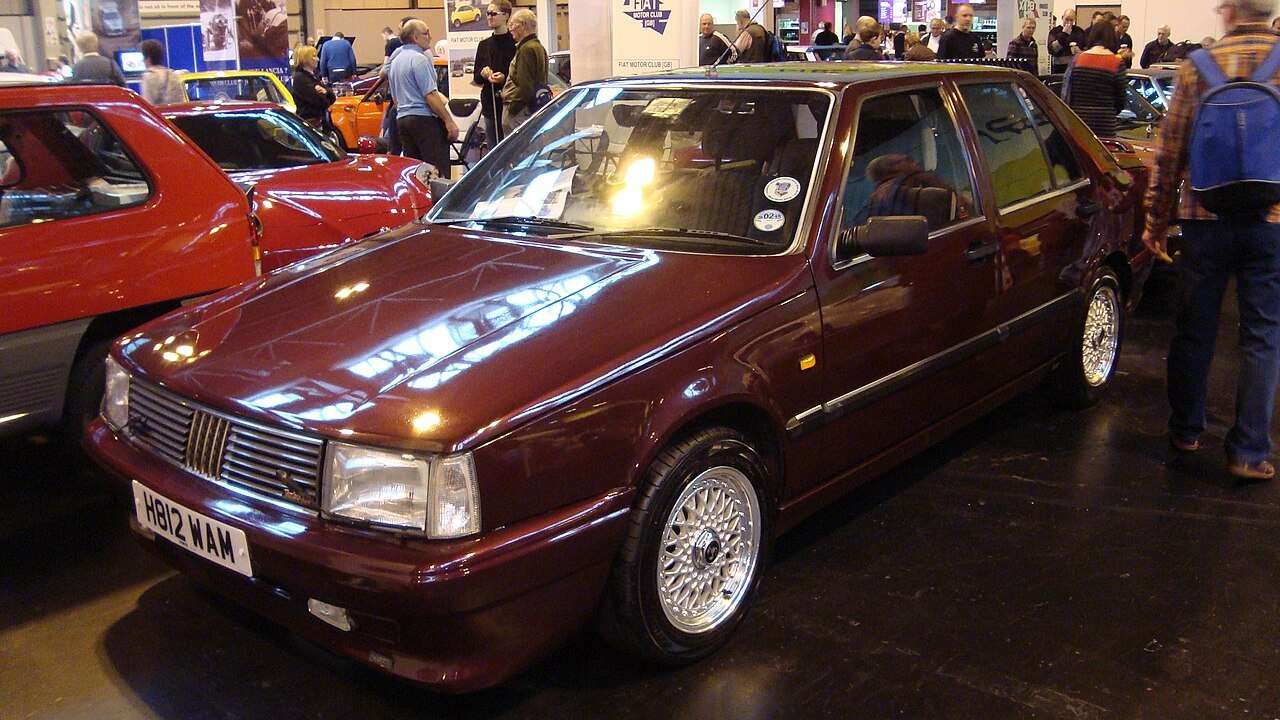
The first Fiat Croma hid a useful hatchback under executive-car styling. Add the Turbo i.e. badge and it also hid a 155 PS petrol engine, in a car related to some unexpected European rivals.
1. It was part of Type Four
Fiat joined the shared platform programme that also yielded the Lancia Thema, Saab 9000 and Alfa Romeo 164. The point was to split development costs while letting each brand build a distinct car.
2. The Fiat kept a liftback
The Croma’s outline suggests a saloon, but the rear glass rose with the tailgate. That gave Fiat’s big car useful carrying capacity without making it look like an estate.

3. The turbo was a two-litre petrol
Period Fiat literature lists a 1,995 cc four-cylinder. The i.e. badge signified electronic injection, so the full name gives a useful clue to what sits under the bonnet.
4. The brochure quoted 155 PS
A 1986 brochure gives 155 ch DIN, equivalent to 114 kW, for the Turbo i.e. The naturally aspirated 2.0 i.e. in the same brochure was rated at 120 ch, making the difference visible without comparing cars from different years.
Love cars you don’t see every day?
Get forgotten cars, surprising motoring stories and the most interesting finds from Unusual Cars by email.
Free to join. No spam. Unsubscribe whenever you like. See our Privacy Policy.
5. The engine sat sideways
Fiat installed the four-cylinder transversely and drove the front wheels. It was the approach used to keep the cabin and luggage space competitive in a large family car.
6. There was another important Croma Turbo
Fiat’s corporate history singles out the Turbo D i.d. diesel for its direct injection. It belongs to the same family but represents a separate engineering story from the 155 PS petrol car.
7. The body was styled to hide its practicality
The tailgate had a pronounced lower section that made the side profile look more like a three-box car. The effect explains why people often remember the Croma as a saloon.
8. It made it into the British motoring press
Motor Sport tested the petrol Turbo i.e. in October 1986. That contemporary British account provides a useful comparison with the continental brochures rather than relying on stories about the type decades later.
9. The facelift kept the badge in play
Later publications still list a Turbo i.e. despite changes to the nose and range. A period specification should be matched to the year and market, particularly when looking at catalyst-equipped examples.
10. The platform was only the starting point
The Thema, 9000 and 164 each took Type Four in a different direction. The Croma’s combination of a liftback and a strong petrol turbo is the part that makes it interesting on its own.
10 Things You Probably Didn’t Know About the Saab 9000 Aero.
Explore more 10 Things articles
Browse the Unusual Cars 10 Things hub.
Sources and further reading
- Fiat heritage retrospective on the first Croma
- 1986 Fiat Croma brochure catalogue entry
- Motor Sport’s Croma Turbo i.e. road test, October 1986
Featured image: Facelifted 1994 Fiat Croma Turbo i.e.. Photo by Calreyn88 via Wikimedia Commons (CC BY-SA 4.0, resized).
Join the Unusual Cars Club
Get more forgotten performance cars, surprising motoring stories and new 10 Things articles by email.
Free to join. No spam. Unsubscribe whenever you like. See our Privacy Policy.