
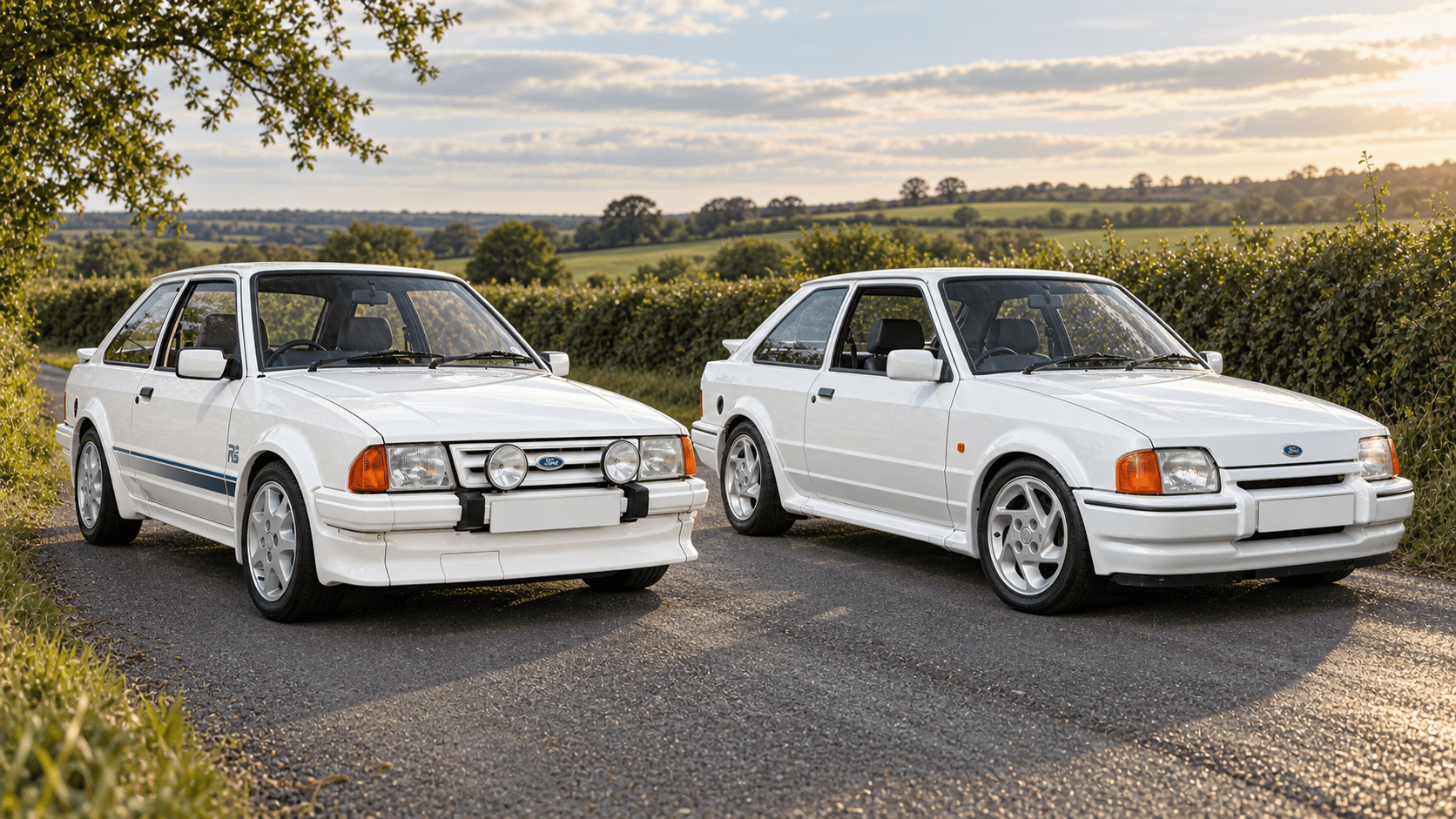
The Ford Escort RS Turbo is one of the definitive British hot hatches of the 1980s: a front-wheel-drive Escort with a turbocharged CVH engine, unmistakable styling and a reputation shaped as much by modification culture as by its original specification.
This guide explains the difference between Series 1 and Series 2 cars, what to check before buying and why originality matters more than ever.

Series 1 versus Series 2
| Model | What distinguishes it | Buying emphasis |
|---|---|---|
| Series 1 | Original Mk3-era RS Turbo with its distinctive period identity | Correct trim, body kit, wheels and genuine-car provenance |
| Series 2 | Later Mk4-based RS Turbo with revised appearance and specification | Condition, modifications and evidence of sensible maintenance |
The Series 1 and Series 2 are often treated as one model, but they should be researched separately. A good buyer confirms exactly which version is being offered before judging originality, parts compatibility or value.

Why the Escort RS Turbo still matters
The RS Turbo brought turbocharged performance into a practical Escort package and became an enduring part of Britain’s fast-Ford culture. It deserves to be understood beyond the stereotypes: a correct, well-maintained car is a very different prospect from a tired, heavily modified one with uncertain history.
How to choose the right RS Turbo
The first decision is not simply Series 1 or Series 2; it is whether the car’s condition and story justify its price. The Series 1 has the stronger visual identity and is the harder car to find in credible factory-style form. A Series 2 may be more realistic for regular road use, but it deserves exactly the same scrutiny. Both are cars where a strong shell, documented work and a believable specification matter more than a long list of claimed performance upgrades.
Many examples were changed when values were low. That does not automatically make them undesirable, but it does mean that a seller should be able to explain the engine, turbo, fuelling, suspension, wheels, brakes and interior rather than simply calling the car “modified”. A carefully assembled fast-road car can be enjoyable; it should not be valued as an untouched survivor.
Before you travel to view one
Ask for current photographs of the underside, inner wings, strut tops, sills, floor, rear arches and boot floor. Request pictures of any restoration before it was covered by paint or underseal. Ask for a cold-start video and establish who carried out mechanical work. Old MOT records, invoices, previous photographs and a consistent ownership history are far more persuasive than a recent repaint or a folder that begins only shortly before sale.
For a car described as standard, compare its engine bay, wheels, trim and cabin with reliable period images. This is not about rejecting every replacement part; it is about separating sympathetic maintenance from a car built from mixed components. Check that the vehicle identification, V5C details and any model-specific paperwork correspond with the car in front of you.
Inspection sequence: shell before speed
1. Assess the structure
Start with the bodyshell. Inspect the inner wings, strut tops, sills, jacking points, floor, rear arches, boot floor and suspension mounting areas. Look for uneven seams, overspray, fresh underseal hiding older repairs, awkward panel gaps or welding that does not match the surrounding metal. A sound car with a few cosmetic marks is generally a better purchase than a freshly presented one with uncertain structural repairs.
2. Treat the CVH turbo as a complete system
On a cold engine, listen for excessive mechanical noise and watch the idle. Check for smoke after start-up and on the overrun, leaks around the turbo and oil system, brittle hoses, damaged wiring, improvised boost plumbing and signs of overheating. The turbocharger, cooling, fuelling and ignition all need to work together. A claimed power output matters much less than evidence of proper maintenance and sensible calibration.
3. Test-drive methodically
Begin gently. The Escort should track straight, steer predictably, select gears cleanly and brake without pulling. Once fully warm, acceleration should be progressive rather than accompanied by severe hesitation, smoke, detonation-like noises or a sudden loss of power. Modified cars may show some torque steer, but a seller should be able to account for the specification and recent work. Strong boost alone is not proof of a healthy car.
After purchase: protect the good car
Budget for preventative maintenance and a specialist inspection even after a successful viewing. A current MOT is useful but does not replace a close assessment of hidden corrosion, past repairs or the turbocharged engine’s health. Retain invoices, photographs and original parts where possible. That care makes the car easier to understand, enjoy and eventually sell on honestly.
Buying guide: the important checks
1. Start with the shell
Inspect sills, floorpan, inner wings, wheelarches, suspension mounting points, bulkhead areas and the rear end. Look for evidence of accident damage, poor repairs or hidden corrosion. A smart paint finish is not proof of a sound Escort underneath.
2. Turbocharged CVH engine
Check cold starting, idle, boost delivery, oil leaks, smoke, cooling-system condition and service history. Non-standard boost or fuelling work should be documented and supported by appropriate maintenance, not explained away with vague claims.
3. Gearbox, driveshafts and suspension
Test every gear, listen for transmission noise and make sure the car tracks straight under acceleration and braking. A period hot hatch needs sound tyres, bushes, dampers and brakes before it can safely show its intended character.
4. Modifications and originality
Many cars have been altered. Some are well executed, but correct factory details, body panels, wheels, badging and interior trim increasingly matter. Ask for photographs, invoices and a clear explanation of any changes.
5. Identity and paperwork
Confirm the V5C, chassis number and declared model. A comprehensive history file and specialist inspection are worthwhile where originality or restoration quality is uncertain.
Explore related 1980s performance guides
Compare the Escort’s turbocharged Ford character with the Ford Sierra XR4i, or explore the Renault 5 GT Turbo and Fiat Uno Turbo i.e. in the Forgotten 1980s Performance Cars collection.
Image credits
Escort RS Turbo Series 1: kitmasterbloke, CC BY 4.0. 1990 Escort RS Turbo: CC BY 2.0. Both via Wikimedia Commons.



.jpg)