THE STRANGEST GROUP B HOMOLOGATION SPECIAL
Citroën BX 4TC guide: history, specs, Group B and buying advice
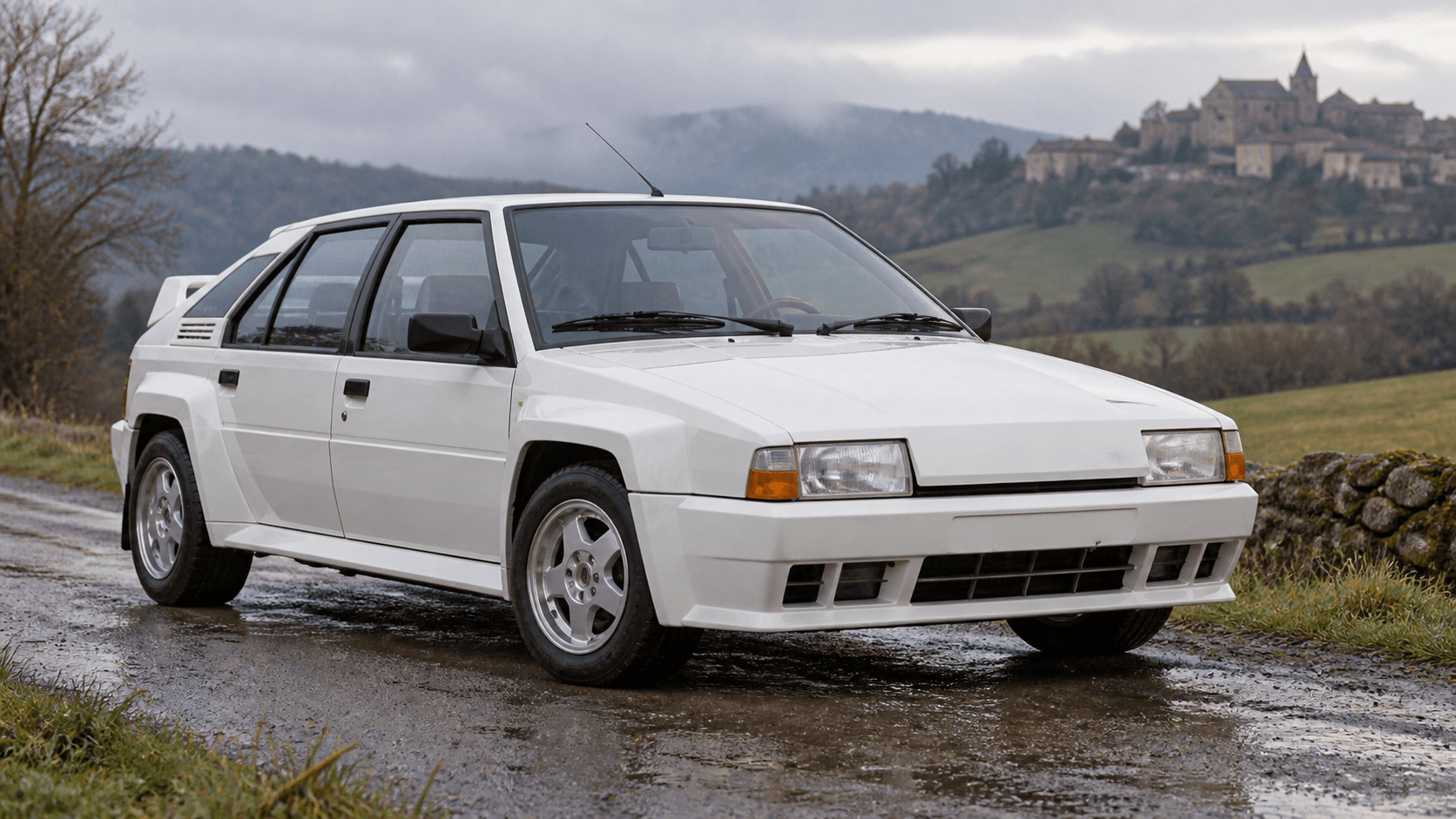
The Citroën BX 4TC is one of the most unusual cars to wear Group B homologation papers: a wide-bodied, front-engined, four-wheel-drive version of an angular family hatchback, built just as the category was ending.
Why the BX 4TC matters
The 4TC proves that Group B was not only about mid-engined four-wheel-drive hatchbacks. Citroën chose a very different route: retain the BX’s basic identity, fit a longitudinal turbo engine ahead of the front axle, widen the body substantially and add four-wheel drive. The result looked familiar at first glance but was mechanically far removed from the ordinary BX.
Its brief competition career and difficult commercial afterlife have created a reputation larger than its results. The 4TC is now valuable precisely because it is such an odd, uncompromising answer to the Group B question.
BX 4TC specifications at a glance
| Feature | BX 4TC road car | Group B context |
|---|---|---|
| Engine layout | Front-mounted longitudinal turbocharged inline four | Unlike the mid-engined 205 T16, Delta S4 and RS200 |
| Capacity | 2,141.5cc physical capacity | FIA turbo equivalence: 2,998cc |
| Drive | Four-wheel drive | FIA homologation B-279 |
| Road-car output | 200hp quoted by Citroën heritage material | Competition specifications varied by development stage |
| Top speed | 220km/h quoted by Citroën | Not a substitute for chassis-specific evidence |
| Homologation series | 200 road cars stated by Citroën | Homologated 2 January 1986 |
Identity warning: sources differ over final production, sales and cars later bought back or destroyed. Establish the identity of the individual car rather than treating one headline number as proof of survival or originality.
How Citroën created a Group B BX
The regular BX was a successful, lightweight and technically distinctive family car designed by Bertone. Its hydropneumatic suspension and sharp geometric styling made it a very Citroën answer to a conventional class. The 4TC adaptation made the proportions more extreme: extended front bodywork, broad wheel arches and a large rear spoiler accommodated its altered mechanical package.
The FIA homologation form records the engine as front-mounted, longitudinal and inclined 15 degrees to the right. That packaging left the 4TC with a long nose and a very different weight distribution from the mature Group B benchmark set by Peugeot.

Why the BX 4TC struggled in Group B
The 4TC entered World Rally Championship competition during 1986, the final Group B season. By then the category’s leading teams had years of intensive development behind them. The BX was competing against purpose-built machines with compact mid-engine layouts, established works programmes and more development time.
It is too simple to call the BX 4TC a failure because it did not win. It was a late programme in a rapidly escalating formula. But the underlying packaging, the weight it carried and the limited time available made its task extremely difficult. Group B ended after 1986, removing the opportunity for the long development cycle that might have changed the story.
Road car versus rally car
Road homologation car
A rare road-legal BX 4TC with 200hp quoted by Citroën. It should be assessed as a scarce 1980s turbocharged road car, not assumed to be a rally car.
Competition car
Built and developed for Group B. Competition identity depends on chassis history, period records and original technical specification.
Replica or modified BX
Wide arches, a turbo engine or 4WD components do not make a standard BX a 4TC. The seller should state the base car and build history honestly.

Buying a Citroën BX 4TC: essential checks
Chassis identity and provenance
Start with the chassis number, original plates, registration history and specialist records. Reconcile these with invoices, dated photographs and prior ownership. A claimed competition history needs entry lists, event evidence and continuous documentation.
Structure and bodywork
Inspect the adapted front structure, suspension pick-up points, wide arches, rear spoiler, floor and corrosion-prone areas. Original 4TC-specific panels and trim are more important than fresh cosmetic paint.
Engine, turbo and drivetrain
Verify engine identity, turbocharger condition, fuel system, cooling, gearbox, transfer components and driveshafts. Ask for rebuild evidence. A road car that has been standing can require substantial recommissioning.
Hydropneumatic suspension
Confirm correct ride-height behaviour, hydraulic condition, pipework and specialist support. A pre-purchase inspection should separate ordinary BX maintenance needs from model-specific four-wheel-drive and 4TC components.

Frequently asked questions
How many BX 4TCs were made?
Citroën heritage material says a limited series of 200 road cars was offered for the Group B competition car. Surviving-car and sales figures are more complicated; establish the identity of the individual car rather than relying on one headline total.
Was the BX 4TC mid-engined?
No. The FIA homologation form records a front-mounted longitudinal engine. That is one reason it was such an unusual Group B design.
Was the BX 4TC four-wheel drive?
Yes. The FIA Historic Database lists four-wheel drive and Group B homologation B-279.
Is a normal BX 4×4 the same as a 4TC?
No. A regular BX 4×4 and the 4TC share a model family but are mechanically and historically different cars.
Explore more Group B cars
Return to the complete Group B rally cars guide, then compare the Renault 5 Turbo, Lancia Delta S4, Peugeot 205 T16 and MG Metro 6R4.
Research basis: FIA Historic Database homologation B-279 and Citroën/Stellantis heritage material. Figures vary among road cars, competition cars and later rebuilds; verify chassis-specific claims independently.