In this article
- What does GTi mean on a Peugeot?
- The important Peugeot GTi chapters
- 205 GTi: the car that made the badge matter
- 309 GTi: the less obvious alternative
- 106 GTi: small car, serious engine
- 306 GTi-6: the gearbox was part of the point
- 206 GTi 180: do not lose the suffix
- 207 GTi: turbocharging changes the recipe
- 208 GTi: the 30th Anniversary was more than a paint scheme
- 308 GTi by Peugeot Sport: not every version had the same differential
- E-208 GTi: a new power source, a familiar argument
- Frequently asked questions
- Why the history still matters
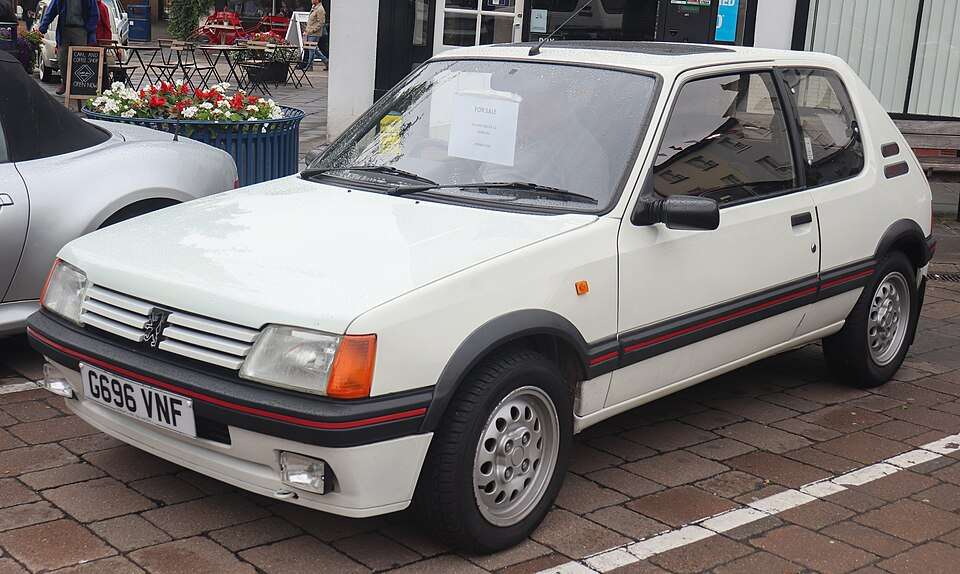
Ask someone to picture a Peugeot GTi and there is a good chance they will imagine a 205: compact body, red trim and just enough attitude. Yet the badge first appeared on something much less obvious. Peugeot’s first GTi was the 604, a large V6 executive saloon introduced in GTi form in 1983. The famous hatchback followed in 1984. [1]
That unexpected beginning suits a badge whose history is more varied than its reputation suggests. Peugeot GTis have been naturally aspirated and turbocharged, stripped back and generously equipped, small enough for a narrow country lane and practical enough for everyday family use. The electric E-208 GTi, revealed in 2025, adds another change of direction. [2]
The interesting question is not simply which one has the biggest power figure. It is what Peugeot changed to make each generation worthy of the name.
What does GTi mean on a Peugeot?
Peugeot expands GTi as Grand Touring Injection. Historically, the badge identified sporting derivatives, with the 205 doing most to establish the association with lightweight hot hatchbacks. It is not the name of a separate company in the way that BMW M is, nor does it guarantee a particular engine capacity or transmission. [1]
It also helps to distinguish three things that often become mixed together: a GTi model, a GT trim level and a car developed by Peugeot Sport. A sporting trim name is not proof that a car has the drivetrain and chassis of a GTi. Equally, Peugeot Sport’s work extends beyond cars carrying those three letters.
The electric model illustrates how the meaning has evolved. Fuel injection is no longer a literal description of the powertrain; GTi has become an identity that Peugeot intends to preserve through a different technology. Whether that feels convincing is a matter for the driving experience, not the acronym alone.
The important Peugeot GTi chapters
| Model | Why it belongs in the story |
|---|---|
| 604 GTi | The 1983 V6 saloon that wore the badge before the 205. [1] |
| 205 GTi | The small hatchback that established the reputation, in 1.6- and 1.9-litre forms. [3] [2] |
| 309 GTi and GTi 16 | A larger alternative; the 16-valve version was a distinct continental-market development. [4] |
| 106 GTi | The compact 16-valve performance model, known as S16 in other markets. [5] |
| 306 GTi-6 | The six-speed, naturally aspirated 2.0-litre chapter. [6] |
| 206 GTi 180 | A more powerful 206 derivative, rather than a new name for every 206 GTi. [7] |
| 207 GTi | The move to a 1.6-litre turbocharged engine. [8] |
| 208 GTi | The basis for the more focused 30th Anniversary and Peugeot Sport derivatives. [9] |
| 308 GTi by Peugeot Sport | A bigger hot hatch with important differences between its launch specifications. [10] |
| E-208 GTi | The electric reinterpretation revealed at Le Mans in 2025. [2] |
This is a guide to the defining model families, not a catalogue of every national-market derivative.
205 GTi: the car that made the badge matter
The 205 range arrived in 1983; the GTi followed in 1984. The first performance model used a 1.6-litre injected engine, with the 1.9-litre version joining in 1986. Those dates matter because the larger-engined car did not launch the dynasty. [3] [2]
The appeal was the relationship between the engine and the car around it. A compact body, modest mass and a manual gearbox created a different proposition from a large performance saloon. The 205 did not need an enormous engine to make the sporting model feel significant.
Nor should the 1.6 be treated simply as a failed attempt at a 1.9. They are distinct versions of the same idea, and the original engine, specification and condition matter more than a badge transplanted onto the tailgate. Over the life of the model, output and equipment also changed; one universal “205 GTi specification” cannot accurately describe every car.
The 205 GTi Griffe: green, distinctive and often misunderstood
The Griffe is one of the most recognisable special editions. Its Fluorite Green paint and contrasting dark details give it a very different character from the familiar red-trimmed hot hatch. Peugeot presented it in 1990, with its history also identifying the car with the 1991 sales period. Those are different milestones, not necessarily contradictory dates. [11] [3]
Production figures require more care. An announced limited run is not automatically the same as the number eventually completed. The appearance is the easy part of a Griffe identification; original build evidence, national-market specification and the history of a particular car are the more useful tests.
The 205 Turbo 16 belongs alongside this history, but not inside the ordinary GTi family. Peugeot’s mid-engined, four-wheel-drive homologation car used a fundamentally different layout. Similar outline and competition associations do not make a front-engined GTi a road-going T16. [11]
309 GTi: the less obvious alternative
The 309 GTi arrived in 1987. Peugeot later developed the GTi 16, introduced in 1989 with a 16-valve engine. The latter is especially important in a UK-focused history because it was not a normal right-hand-drive British showroom model. [4]
That market distinction explains why contemporary British memories of the 309 can differ from continental accounts. Someone discussing the ordinary UK GTi and someone describing a continental GTi 16 may both be talking accurately about a 309, while referring to quite different specifications.
The car also broadens the meaning of the badge. Peugeot did not reserve it for its smallest hatchback. The 309 offered an alternative interpretation rather than simply waiting for the 205 to disappear.
106 GTi: small car, serious engine
Peugeot introduced the 106 in 1991, followed by the Rallye in 1993 and the 16-valve S16 in 1996. The latter is the model British enthusiasts know as the 106 GTi. Its 1.6-litre engine produced 120 PS, approximately 118 bhp. [5]
Those two numbers are often repeated as though they represent different tunes. They are usually different units for essentially the same output. A useful specification should say which unit it uses.
The Rallye and GTi also need to remain separate. Both belong in a history of sporting Peugeots, but the Rallye name does not simply mean “GTi with different stickers”. Their relationship deserves its own explanation, particularly when discussing cars that have subsequently received engine swaps.
The 106’s importance is that it maintained a genuinely small-car branch of the performance range. As the larger hatchbacks evolved, Peugeot still had a car whose appeal began with compact dimensions rather than a large engine.
306 GTi-6: the gearbox was part of the point
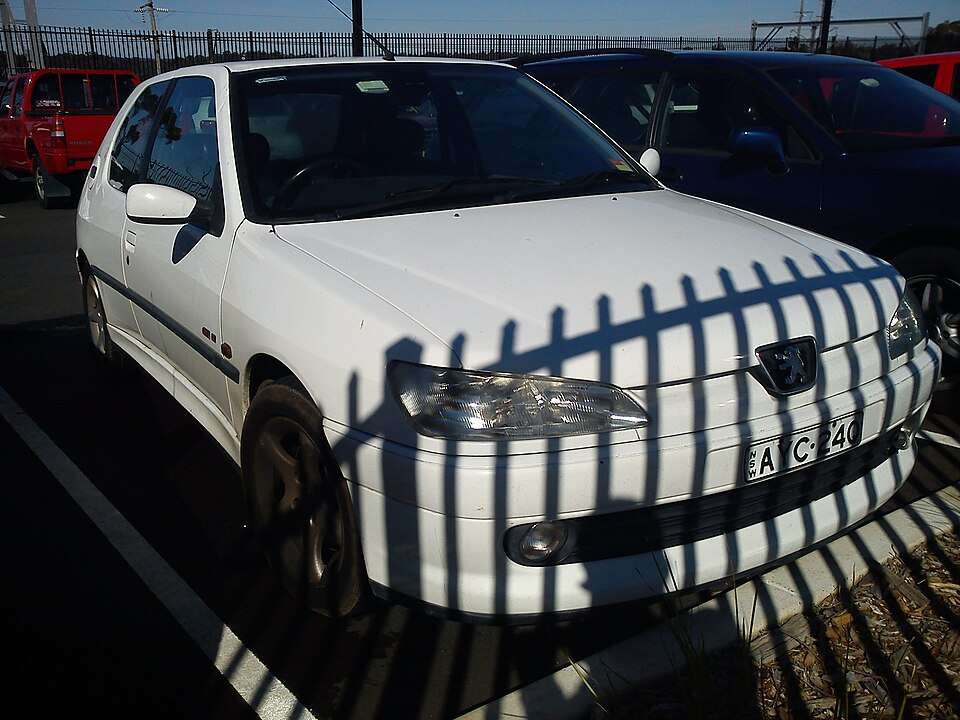
The 306 range began in 1993, but the GTi-6 arrived in 1996. Dating the performance version from the launch of the whole range makes it several years too old. The owners’ club chronology and a contemporary Motor Sport road test distinguish the later model clearly. [12] [6]
Its defining feature was a six-speed manual gearbox paired with a naturally aspirated 2.0-litre 16-valve engine. A sixth gear was sufficiently unusual in this class to become part of the model’s name. It was not a reference to six cylinders. [6]
The later 306 Rallye took a different approach to the same basic performance package, reducing equipment and weight. The model-specific club records its arrival in 1998 and identifies it as a limited UK derivative. [12]
This generation makes an important point about a good performance car: a close relationship between engine, gearing and chassis can be more interesting than a large increase in peak output. The gearbox is not merely an item on a specification sheet; it changes how the engine’s performance is used.
206 GTi 180: do not lose the suffix
The 206 GTi 180 was a specific derivative, not a new description for every GTi in the 206 range. Peugeot’s September 2003 UK brochure describes its variable valve timing, intake-system changes, distinctive sports seats and twin exhaust outlets. [7]
That makes the suffix important when reading an advert or comparing specifications. A regular GTi and a GTi 180 should not be merged into one model because the badge on the boot is similar.
It also shows the range becoming more equipment-rich. Climate control, stability control and a more elaborate cabin were part of the factory proposition. The GTi idea was adapting to a different period, rather than attempting to recreate the original 205 without alteration. [7]
Love cars you don’t see every day?
Get forgotten cars, surprising motoring stories and the most interesting finds from Unusual Cars by email.
Free to join. No spam. Unsubscribe whenever you like. See our privacy policy.
207 GTi: turbocharging changes the recipe
With the 207 GTi, Peugeot moved to a 1.6-litre turbocharged engine and a five-speed manual gearbox. The contemporary UK brochure identifies the engine as THP 175 and describes the car’s electronic stability systems, including a steering-assistance function intended to help during braking on uneven-grip surfaces. [8]
That combination is a useful marker of how far the category had moved. The sporting model was no longer defined mainly by a rev-hungry naturally aspirated engine and a small body. Turbocharged torque, electronic control and everyday equipment had become central to its character.
For enthusiasts, this also makes the 207 more than an inconvenient gap between the better-known 206 and 208. It is the point at which the engine philosophy changed.
208 GTi: the 30th Anniversary was more than a paint scheme

The first-generation 208 revived the GTi name in the early 2010s. Its 30th Anniversary derivative, unveiled in 2014 to mark three decades of the 205 GTi, made the most interesting changes underneath. Peugeot specified a 208 PS turbocharged engine, a six-speed manual gearbox and a Torsen limited-slip differential, accompanied by substantial chassis and braking revisions. [9]
A limited-slip differential helps manage how the driven wheels share torque. That makes it more consequential than an anniversary plaque: it can change how effectively the car uses its power when accelerating out of a bend.
The later GTi by Peugeot Sport carried the more focused approach forward. It should therefore be distinguished from the ordinary 208 GTi when comparing cars. A familiar engine size or a similar advertised power figure does not tell the whole story. [1]
This is one of the best examples of why special editions deserve more than a list of colours. The engineering tells you what the edition was trying to achieve.
308 GTi by Peugeot Sport: not every version had the same differential
The 308 GTi by Peugeot Sport launched in 2015 with 250 PS and 270 PS versions of its 1.6-litre turbocharged engine. Crucially, the more powerful launch model also received the Torsen differential and larger front brakes. It was not simply the same mechanical package with a different software setting. [10]
That distinction matters when reading an international advert or a comparison using a different market’s specification. “308 GTi” identifies the family, but the exact version establishes what is fitted.
The car also shows Peugeot applying its hot-hatch formula to a larger five-door body. The important continuity is the attention to the complete package: engine, traction, braking and chassis, not a requirement that every GTi have the same dimensions as a 205.
E-208 GTi: a new power source, a familiar argument
Peugeot revealed the E-208 GTi at Le Mans on 13 June 2025. Its announced specification included a 280 PS electric motor, a limited-slip differential, wider tracks, a lowered body and 355 mm front brake discs. The claimed 0–62 mph time was 5.7 seconds. These are announcement specifications, not a claim about the availability of a particular UK car. [2]
For a badge originally tied to fuel injection, the change is substantial. But the underlying question remains familiar: has the manufacturer changed enough of the car to make it a convincing performance derivative?
The launch specification suggests an attempt to answer through hardware rather than acceleration alone. How successfully it delivers the character enthusiasts expect is a judgement to make from the finished car, not from nostalgia or a launch headline.
Frequently asked questions
Was the 205 Peugeot’s first GTi?
No. The 604 GTi executive saloon appeared in 1983; the 205 GTi followed in 1984. The 205 made the badge famous, but it did not introduce it. [1]
What does the 6 in 306 GTi-6 mean?
It refers to the six-speed manual gearbox. The engine was a four-cylinder 2.0-litre unit, not a six-cylinder. [6]
Is a 208 GTi by Peugeot Sport the same as a normal 208 GTi?
No. The more focused derivatives involved chassis, braking and differential changes, not merely special paint. Identify the exact factory version rather than relying on a broad GTi description. [9]
Is every Peugeot GTi a petrol car?
No. Peugeot revealed the all-electric E-208 GTi in 2025, explicitly carrying the badge into a different powertrain era. [2]
Why the history still matters
The 205 remains the obvious centre of the Peugeot GTi story, but treating everything else as a footnote misses the point. The 306 made its gearbox part of its identity; the 207 changed the engine formula; the Peugeot Sport versions showed how much a differential and chassis could add; and the electric model asks whether the character can survive another fundamental change.
The best way to understand a Peugeot GTi is therefore not to stop at the badge. Look at what changed beneath it. That is where the interesting history begins.
Love cars you don’t see every day?
Get forgotten cars, surprising motoring stories and the most interesting finds from Unusual Cars by email.
Free to join. No spam. Unsubscribe whenever you like. See our privacy policy.
Sources and further reading
- Peugeot: GTi through the years (2026)Manufacturer retrospective; its 306 GTi-6 date heading is not repeated.
- Peugeot: E-208 GTi reveal (2025)Manufacturer reveal and technical specifications.
- Peugeot: 205 anniversary and heritage (2023)Manufacturer historical press information.
- Peugeot: ten generations of the 300 seriesManufacturer history; model-name typographical error not repeated.
- Peugeot: 30 years of the 106 (2021)Manufacturer history.
- Motor Sport: Peugeot 306 GTi-6 road test (February 1997)Original contemporary road test.
- Peugeot: UK 206 GTi 180 brochure (2003)Original manufacturer brochure preserved by an archive; PDF.
- Peugeot: UK 207 GTi brochureOriginal manufacturer brochure printed June 2007; archive filename says 2008. PDF.
- Peugeot: 208 GTi 30th anniversary (2014)Manufacturer technical announcement.
- Peugeot: 308 GTi by Peugeot Sport (2015)Manufacturer launch information distinguishing the 250 and 270 versions.
- Peugeot: GTi heritage at Rétromobile (2026)Manufacturer heritage record; Griffe announcement and intended run are distinguished from final output.
- 306 GTi-6 and Rallye Owners Club: model historySpecialist owners’ club chronology, corroborated by a contemporary road test.