In this article
- Before Aero: the turbocharged foundation
- The defining cars at a glance
- Classic 900 Aero: one idea, several market names
- 9000 Aero: performance without abandoning the executive car
- 9-3 Viggen: the name was a statement
- 9-5 Aero: the fast family-car interpretation
- 9-3 Aero V6: the engine formula changes
- Turbo X: all-wheel drive, not just black paint
- The unusual Aero branches: Japan and a V8 SUV
- Aero X: keep the concept separate
- Frequently asked questions
- Why the fast Saabs remain interesting

Saab’s performance history is not a simple ladder of increasingly powerful engines. It includes a turbocharged hatchback with an aircraft-inspired identity, a long-legged executive car, a front-wheel-drive special developed with TWR, an all-wheel-drive V6 and even a V8 SUV. The names Aero and Viggen connect parts of that story, but they do not describe one mechanical formula. [1] [2] [3]
That variety is what makes the subject worth exploring. A fast Saab could be practical, restrained in appearance and technically unusual without following the same route as a BMW M car or a Mercedes-AMG.
The first thing to understand is the badge itself. Aero was a performance-model designation, not a separate tuning company. Viggen was a specific high-performance 9-3 derivative, not a replacement name for every Aero. [2]
Before Aero: the turbocharged foundation
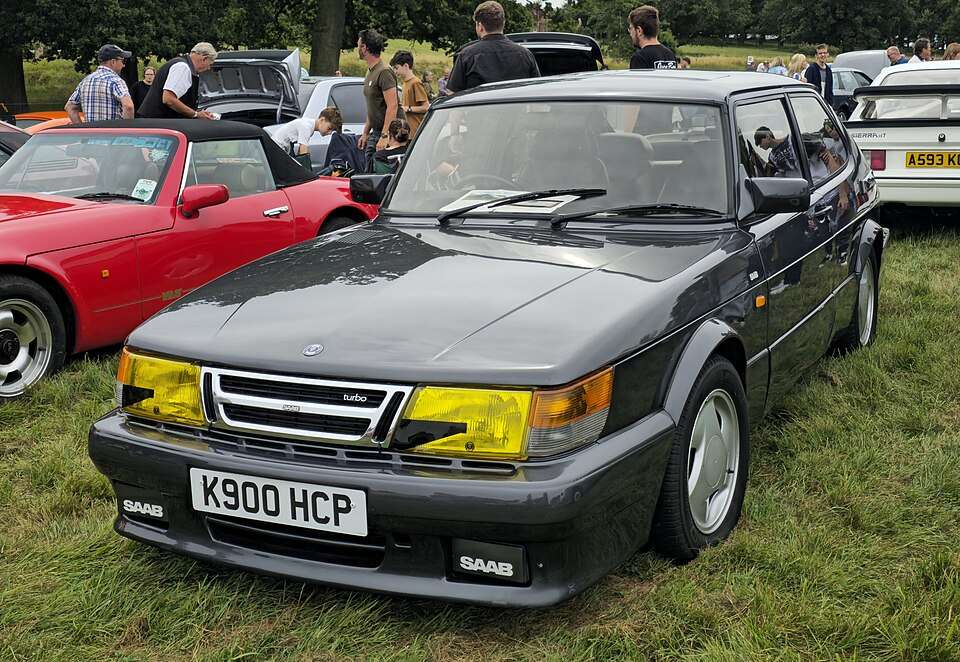
The Saab Car Museum dates the 99 Turbo’s public premiere to the Frankfurt motor show in September 1977. The 900 followed in 1978, entering sale as a 1979-model-year car. [1]
This matters because Saab’s performance identity was already taking shape before Aero became the familiar name. Turbocharging offered a way to increase the performance of an everyday car without simply fitting a much larger engine.
It also established a useful distinction between a car’s original role and later mythology. Not every Saab with a turbo was an Aero, and a turbocharged engine alone does not identify one of the flagship derivatives. The model name, market and year all matter.
The defining cars at a glance
| Car | What makes it significant |
|---|---|
| Classic 900 Turbo 16 Aero | The 1984 16-valve turbo chapter; related performance versions carried different names in different markets. [1] |
| 9000 Aero | A larger executive-car interpretation, introduced for the 1993 model year. [4] |
| 9-3 Viggen | The 1999 high-performance special, using a 2.3-litre turbocharged four-cylinder engine. [2] |
| 9-5 Aero | The performance saloon and estate introduced for the 2000 model year. [5] |
| 9-3 Aero V6 | A 2.8-litre turbocharged V6 joined the Aero story for the 2006 model year. [6] |
| 9-3 Turbo X | The black, all-wheel-drive 2008 special with a V6 and electronically controlled rear differential. [7] |
| 9-2X Aero | A Japanese-built, Subaru-related North American model. [8] [9] |
| 9-7X Aero | A North American SUV with a naturally aspirated 6.0-litre V8. [3] |
A model year is not always the calendar year of first presentation. A car announced in the autumn can legitimately belong to the following year’s range.
Classic 900 Aero: one idea, several market names
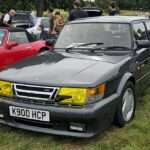
The 900 Turbo 16 Aero appeared in 1984. The Saab Car Museum explicitly identifies SPG as the corresponding US-market name. British histories also use Turbo 16S or T16S, illustrating why the same broad family can appear under different descriptions. [1] [10]
The combination of a 16-valve turbo engine and a distinctive sporting body treatment gave the classic 900 a recognisable performance identity. It was not an attempt to disguise the car as a low-slung coupé. Its unusual profile remained part of its appeal.
For a British reader, the naming is the important trap. An American SPG article is not automatically a specification guide for a UK T16S. Equipment, emissions-related engine differences and model-year changes must be checked against the car’s original market, rather than combined into one supposedly universal Aero specification.
The same caution applies to cars wearing later bodywork. A full set of Aero-style panels tells you how a car looks now, not necessarily how it left the factory.
9000 Aero: performance without abandoning the executive car
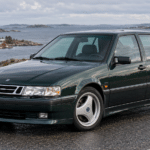
The 9000 Aero arrived for the 1993 model year, following an October 1992 introduction. It moved the idea into a larger car rather than simply repeating the classic 900’s character. [4]
That is the key to understanding its place in the range. The 9000 Aero was not important only because it was fast; it represented a performance flagship that still belonged to the executive-car world. The buyer did not have to choose a small, overtly sporting body to obtain Saab’s more ambitious turbocharged package.
It also helped establish a recurring theme: the engine’s usable delivery mattered as much as the headline output. A quick road car can feel distinctive through its response in ordinary driving, not just its maximum speed.
Aero histories sometimes blur the 9000 into earlier Turbo or Carlsson versions. Those names deserve their own chapters. Being related performance Saabs does not make them interchangeable factory identities.
9-3 Viggen: the name was a statement
The Viggen joined the first-generation 9-3 range in 1999. Its name honoured Saab’s fighter aircraft, and the road car used a 2.3-litre turbocharged four-cylinder engine driving the front wheels. Saab’s Special Vehicle Operations team developed it with TWR, the British engineering organisation associated with Tom Walkinshaw. [2]
That partnership is one of the most interesting details in the story. The aircraft references were marketing, but the development programme involved identifiable engineering work. Saab documented changes to the springs, dampers, anti-roll bars and steering-rack mounts, alongside larger brakes. [2]
The power figures need context. Contemporary launch accounts describe the early car at 225 hp, while Saab’s announcement for the 2000-model-year range quoted 230 hp. Treating those as interchangeable claims about every Viggen loses the chronology. [11] [12]
Why the Viggen’s torque mattered
The harder question was how to use that output through the front tyres. Saab’s own technical description records electronically restricted torque in the lower gears. That is a revealing detail: even the factory did not treat maximum available torque as something that should be delivered indiscriminately in every situation. [2]
It explains why a peak-output comparison alone cannot capture the car’s character. The Viggen was a system of engine delivery, traction, suspension and steering, not simply a powerful engine dropped into an otherwise unchanged hatchback.
Nor was every Viggen a three-door. Saab expanded the line with a five-door and a convertible for the 2000 model year. The different bodies belong in the history rather than being treated as unofficial conversions. [12]
The Viggen therefore deserves its own identity. Calling it merely an Aero with an aircraft badge misses the specific development programme and its position within the original 9-3 range.
9-5 Aero: the fast family-car interpretation
The first-generation 9-5 Aero was introduced for the 2000 model year, with contemporary UK information published in September 1999. It paired a 2.3-litre turbocharged engine with a lowered sporting chassis, 17-inch wheels and distinctive body treatment. Both saloon and estate were offered. [5]
This is an especially natural expression of the Aero idea: a car that could serve as everyday family transport while carrying a much more serious performance specification than its shape might suggest.
It also shows why historical comparisons need a model year. The original launch figure does not describe every later 9-5 Aero. The range evolved, and using one early specification as though it applied throughout production creates misleading adverts and inaccurate retrospective articles.
The estate is not an incidental footnote. It makes the central appeal obvious: performance did not require abandoning luggage space or an otherwise useful body. That balance is a more interesting part of the Saab story than pretending every flagship had to be a track-focused special.
Love cars you don’t see every day?
Get forgotten cars, surprising motoring stories and the most interesting finds from Unusual Cars by email.
Free to join. No spam. Unsubscribe whenever you like. See our privacy policy.
9-3 Aero V6: the engine formula changes
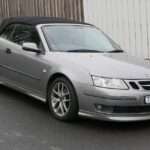
For the 2006 model year, the newer 9-3 Aero gained a turbocharged 2.8-litre V6. Saab’s contemporary announcement described the development of the engine and its installation in the performance range. [6]
The change matters because Aero did not mean “the famous Saab turbo four” forever. It was the performance designation, and the engine architecture could change beneath it.
It also means an advert that says only “9-3 Aero” is incomplete. First establish which generation, model year, engine, gearbox and bodystyle is being discussed. A first-generation car and a later V6 may share a badge while delivering quite different experiences.
The V6 chapter leads naturally to a special edition whose most important change was not just its engine.
Turbo X: all-wheel drive, not just black paint
The Turbo X was introduced for the 2008 model year to celebrate Saab’s turbocharging heritage. Available as a Sport Sedan or SportCombi estate, it combined a 2.8-litre turbocharged V6 with Saab’s XWD all-wheel-drive system and an electronically controlled rear limited-slip differential. [7]
The differential is important. Distributing torque between the axles is one task; managing its distribution across the rear axle is another. The Turbo X’s hardware gave the special edition a substantial engineering identity beyond its black paint and distinctive wheels.
Its production numbers also illustrate a familiar research problem. Saab’s US announcement specified 600 cars for the United States. That is a market allocation, not the total number built worldwide. Repeating it as a global production figure would make the car appear rarer than that source establishes. [7]
The Turbo X is related to the Aero story, but it should retain its own name. It represents a particular limited edition, not a generic term for any black 9-3 with an uprated engine.
The unusual Aero branches: Japan and a V8 SUV
9-2X Aero: the Subaru connection was real
The 9-2X was jointly developed by Saab and Fuji Heavy Industries, Subaru’s manufacturer, under the contemporary GM alliance. FHI’s own announcement records production beginning at its Gunma Yajima plant in Japan in March 2004. The car was intended for North America. [8]
The Aero version used a turbocharged engine and all-wheel drive. Saab’s launch pricing announcement identified a 2.0-litre turbocharged Aero alongside the non-turbocharged entry model. [9]
That makes it a genuine, if unusual, branch of the Aero family—not a modified Subaru with aftermarket Saab badges. At the same time, its shared origins should not be concealed to make the history seem tidier. The collaboration is what makes it interesting.
9-7X Aero: not every Aero was turbocharged
For the 2008 model year, Saab introduced an Aero version of the 9-7X SUV with a naturally aspirated LS2 6.0-litre V8. The US release quoted 390 hp and described revised brakes, suspension, wheels and all-wheel drive. [3]
Few cars demonstrate the flexibility of the badge more clearly. A large V8 SUV is very different from a classic 900 Turbo 16, yet it was a factory Aero model.
It also provides a decisive answer to a common assumption: Aero did not always mean turbocharged four-cylinder power. The correct specification follows the model, not a rule inferred from the best-known Saabs.
Aero X: keep the concept separate
The Aero X shown in 2006 was a concept car, not another production Aero derivative. Its dramatic canopy-style access and two-seat layout made the aircraft connection unusually literal. [13]
It belongs in the story as an expression of what the Aero name could suggest. It should not appear in a list of production cars without that qualification, or be confused with the later Turbo X.
The names are similar; the roles are not.
Frequently asked questions
Was Saab Aero a separate company?
No. Aero was used as a sporting-model designation within Saab’s range. It did not operate as a separate manufacturer or independent tuning business.
Is a Viggen the same as an Aero?
No. The Viggen was a specific high-performance version of the first-generation 9-3, developed with TWR. Aero was used across several model families. [2]
Were all Aero models front-wheel drive?
No. The 9-2X Aero and 9-7X Aero provide clear factory examples with all-wheel drive. A badge alone cannot establish the drivetrain. [9] [3]
Were all Viggens three-door hatchbacks?
No. The range also included five-door and convertible versions. The announcement of the 2000 model-year range records those additions. [12]
Why the fast Saabs remain interesting
The appeal is not that every Aero or Viggen followed one pure formula. They did not. The history is interesting because the formula kept changing: compact turbocharged hatchback, executive car, TWR-developed special, practical estate, all-wheel-drive V6 and unexpected North American offshoots.
What connects them is a willingness to make a useful car more distinctive without necessarily making it look like everyone else’s performance flagship. Understanding the differences makes the badge more interesting, not less.
Love cars you don’t see every day?
Get forgotten cars, surprising motoring stories and the most interesting finds from Unusual Cars by email.
Free to join. No spam. Unsubscribe whenever you like. See our privacy policy.
Sources and further reading
- Saab Car Museum, Trollhättan: Saab historyOfficial museum history.
- Saab: 2001 9-3 Viggen technical informationOriginal manufacturer press information preserved by Saabnet.
- Saab: 9-7X Aero announcement (2007)Original manufacturer announcement preserved by Saabnet.
- The Saab Museum archive: 9000 model yearsIndependent enthusiast history, not the official Trollhättan museum.
- Saab: 9-5 Aero model information (September 1999)Manufacturer launch information preserved by Car Enthusiast.
- Saab: 2.8 V6 Turbo in the 9-3 AeroOriginal Saab Automobile press release preserved by SaabWorld; archive access may be restricted.
- Saab: Turbo X press information (2007)Original manufacturer release preserved by Saabnet.
- Fuji Heavy Industries: Saab 9-2X production begins (2004)Original production-partner announcement.
- Saab: 9-2X launch information (April 2004)Manufacturer release preserved by Automotive Intelligence.
- The Saab Museum archive: 900 model yearsIndependent enthusiast history, not the official Trollhättan museum.
- Car and Driver: original 1999 Saab 9-3 Viggen testContemporary test republished in the magazine’s archive; used for the early output figure.
- Saab: 2000-model-year range announcement (1999)Original manufacturer release preserved by The Auto Channel.
- Saab: Aero X concept press information (2006)Original manufacturer concept description reproduced by NetCarShow.