In this article
- What does Renaultsport mean?
- Clio Williams: the important predecessor
- Spider: the first road car to wear the Renault Sport name
- Clio 172 and 182: the compact hot-hatch formula
- Clio 197 and 200: a new generation, not just a higher number
- Clio V6: a different car beneath a familiar outline
- Twingo Renaultsport 133: the smaller, overlooked branch
- Mégane R.S.: from the original turbo car to the R26.R
- Mégane III: Trophy and Trophy-R are not synonyms
- Mégane IV: 4CONTROL means four-wheel steering
- Clio 200 EDC and 220 Trophy: a deliberate change of character
- Ultime, R.S. Line and the end of the badge
- Renaultsport questions answered
- Why these cars deserve the attention
Few performance-car stories make as much of a relatively ordinary hatchback as Renaultsport’s. A compact Clio could become a carefully developed driver’s car, a Mégane could lose its rear seats in pursuit of a circuit lap, and a car still wearing a Clio-shaped body could have a V6 where the passengers ought to be.
Those were not three versions of the same idea. They were different ways of making a road car more involving. To understand Renaultsport properly, it helps to separate the company, the R.S. production models, the Cup chassis options and the special editions that pushed the formula further. [1] [2] [3]
What does Renaultsport mean?
Renaultsport, also written Renault Sport, was Renault’s specialist performance and competition operation. The company dates its foundation to 1976. On road cars, R.S. identifies a performance model; it should not be confused with the later R.S. Line equipment specification. [4] [5]
The final Renault Sport-badged model was the Mégane R.S. Ultime, announced in 2023. Its planned run of 1,976 numbered cars deliberately referenced the foundation year. Renault explained that Alpine would carry the group’s subsequent performance-car development forward. [4]
That gives the badge a clear historical arc, but the story of fast Renaults is older. Gordini, the Renault 5 Turbo and the Clio Williams belong to the wider background rather than being interchangeable names for the later R.S. range. [1] [6]
Clio Williams: the important predecessor
The Clio Williams arrived in 1993, using a 2.0-litre engine and a distinctive blue-and-gold identity. Renault’s own museum places it among the defining sporting models of the period. It helped establish the enthusiasm that the subsequent Renault Sport road-car programme could build on. [6]
It is worth keeping its identity intact. A Williams is not simply an early Clio 172, and a later Renaultsport Clio is not a Williams edition. The name, generation and development context all matter.
The wider lesson is that a successful performance badge rarely appears from nowhere. Buyers need a reason to trust that the manufacturer understands the difference between a faster small car and a genuinely well-developed one. The Williams was an important part of Renault earning that trust.
Spider: the first road car to wear the Renault Sport name
The first road-going model to bear the Renault Sport name was the Spider, unveiled at Geneva in 1995. Its aluminium chassis, two-seat layout and mid-rear engine made it a dedicated sports car rather than a warmed-over hatchback. It was assembled at the Alpine factory in Dieppe. [1]
That starting point is easy to overlook because the later Clios and Méganes became so familiar. Yet it changes how the story reads. Renaultsport did not begin by adding a few trim pieces to a mass-market car. Its first named road model was deliberately specialised.
The Spider also establishes the relevance of Dieppe. The factory’s sporting history was part of the programme, although it would be wrong to assume that every subsequent Renaultsport road car was built there. The Twingo, for example, came from a different production location. [7]
Clio 172 and 182: the compact hot-hatch formula

The Clio Renaultsport 172 arrived in 2000, using a naturally aspirated 2.0-litre engine in the second-generation Clio body. The later 182 developed that same broad formula. Renault’s launch material for the final Trophy edition described Britain as an especially important market for these cars. [8]
The attraction was not just a headline power figure. A compact body and a coordinated performance specification offered something distinct from a larger, heavier car with more power. That is why these Clios deserve to be considered as complete packages rather than ranked solely by their badges’ numbers.
“Cup” also needs care. Across Renaultsport history it can identify a specific derivative or a chassis specification, depending on the model and year. Establish which is being described before assuming that two advertised cars have the same equipment. [8] [9]
Clio 182 Trophy: the dampers are the point
The 2005 Clio 182 Trophy is a particularly good example of an edition whose importance is not captured by its peak power figure. Its defining feature was bespoke Sachs suspension, alongside its focused equipment specification, Capsicum Red paint and special-edition identity. Renault allocated 500 cars to the UK. [10]
For a surviving example, the correct dampers and evidence of their care are more revealing than a Trophy sticker. The model makes a useful argument against judging a special edition by the number on the engine specification alone: where the money and development effort went can matter more than whether the power figure rose.
Clio 197 and 200: a new generation, not just a higher number
The Clio 197 followed in 2006, based on the larger third-generation Clio. Renault’s contemporary announcement described substantial model-specific work, including its chassis and braking package, rather than a simple engine transplant into the ordinary car. [11]
The subsequent 200 developed this generation further. Its arrival in the 2009 range is recorded in Renault’s contemporary launch material. Both belong to the naturally aspirated chapter, which should be distinguished from the later turbocharged Clio 200. [12]
That repeated “200” is a genuine source of confusion. An older three-door, manually shifted car and the later five-door turbo model can both be described using the same power-based model number. The generation is therefore essential information, not optional enthusiast jargon.
Clio V6: a different car beneath a familiar outline
The Clio V6 was not an ordinary front-wheel-drive Clio with two extra cylinders added under the bonnet. Renault’s museum describes a mid-rear 3.0-litre V6 and rear-wheel drive, with the engine occupying the space that would normally accommodate rear passengers. A later version increased output to 255 PS. [3]
Its wide body was a clue to the transformation, not the transformation itself. This is one of the most important distinctions in the whole Renaultsport history: the V6 belongs beside the hot hatchbacks in a family story, but it should not be treated as the next rung up their normal mechanical ladder.
For the same reason, a V6-style body conversion does not reproduce the production car’s identity. The engine position and drivetrain define the project far more than the arches.
Twingo Renaultsport 133: the smaller, overlooked branch
The Twingo Renaultsport arrived in the UK in 2008 with a naturally aspirated 1.6-litre engine producing 133 metric horsepower. Renault offered a Cup chassis option, and its original UK release identified Slovenia as the production location. [7]
The Twingo matters because it shows the programme working at a smaller scale. Renaultsport was not only chasing the most powerful possible Mégane. It was also applying its approach to a compact car with a very different place in the range.
For a badge history, leaving it out would distort the picture. For a buyer, treating every Twingo as though it has the same chassis specification would be equally unhelpful. The engine badge and the chassis option answer different questions.
Love cars you don’t see every day?
Get forgotten cars, surprising motoring stories and the most interesting finds from Unusual Cars by email.
Free to join. No spam. Unsubscribe whenever you like. See our privacy policy.
Mégane R.S.: from the original turbo car to the R26.R
The first Mégane R.S. was presented in 2003, with the road-car launch following in 2004. The unusual-looking second-generation Mégane became the foundation for a much more serious performance programme, including the F1 Team R26 and the stripped-back R26.R. [4] [9]
The R26.R, announced in 2008, demonstrates what Renaultsport considered worth changing. Renault retained the R26’s engine output, transmission and limited-slip differential, then removed 123 kg and revised the chassis package. The new car’s purpose was not simply to win a power-figure contest. [2]
Removing equipment and mass changes the trade-off. A car can become more focused while becoming less useful as ordinary family transport. That is not a flaw in the R26.R’s logic; it is the logic. The important thing is not to confuse it with a normal R26 or describe the deleted seats as an incidental detail.
Mégane III: Trophy and Trophy-R are not synonyms
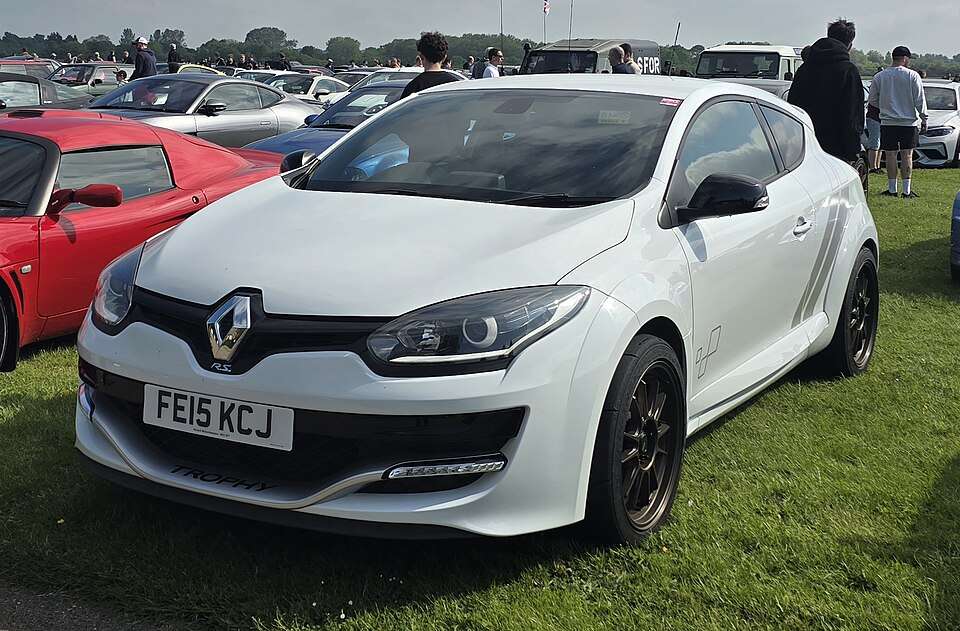
The third-generation Mégane R.S. developed the front-wheel-drive performance programme through increasingly focused derivatives, including the 275 Trophy. Renault’s retrospective highlights the 2011 Trophy and the 2014 Trophy-R as significant points in its Nürburgring development story. [13] [1]
For the 2014 275 Trophy-R, Renault removed the rear seats and specified a Cup chassis, limited-slip differential, Öhlins dampers and an Akrapovič exhaust. The announced run was 250 cars. Its stated 101 kg weight saving helps explain why this was more than a Trophy with another letter attached. [14]
“Trophy” and “Trophy-R” should therefore not be collapsed into one label. The extra letter can indicate a much more specialised car, with different equipment and a different balance between road use and circuit focus.
Lap times also need context. A manufacturer’s record applies to a particular car, specification, circuit configuration and date. It is not a permanent guarantee that every example carrying a related badge will reproduce that result. The interesting part is what Renault changed to make the attempt possible.
Mégane IV: 4CONTROL means four-wheel steering
The fourth-generation Mégane R.S. was revealed in 2017 ahead of UK introduction in 2018. Renault offered a 1.8-litre turbo engine, manual or EDC dual-clutch transmission, and its 4CONTROL system. The launch specification distinguished Sport and Cup chassis versions, with a limited-slip differential associated with the Cup package. [9]
4CONTROL is four-wheel steering, not four-wheel drive. It changes the angle of the rear wheels to influence the car’s response. It should not be used in an advert as shorthand for an all-wheel-drive drivetrain. [9]
The 2019 Trophy-R took another route. Renault announced a 500-car numbered series with 300 PS and up to 130 kg removed relative to the Trophy, depending on specification. It used a dedicated lightweight rear arrangement rather than retaining the ordinary car’s four-wheel-steering hardware. [15] [16]
That is a particularly revealing detail. The more focused car did not simply add every available technology. Renault removed or changed systems where that better suited the intended result.
Clio 200 EDC and 220 Trophy: a deliberate change of character
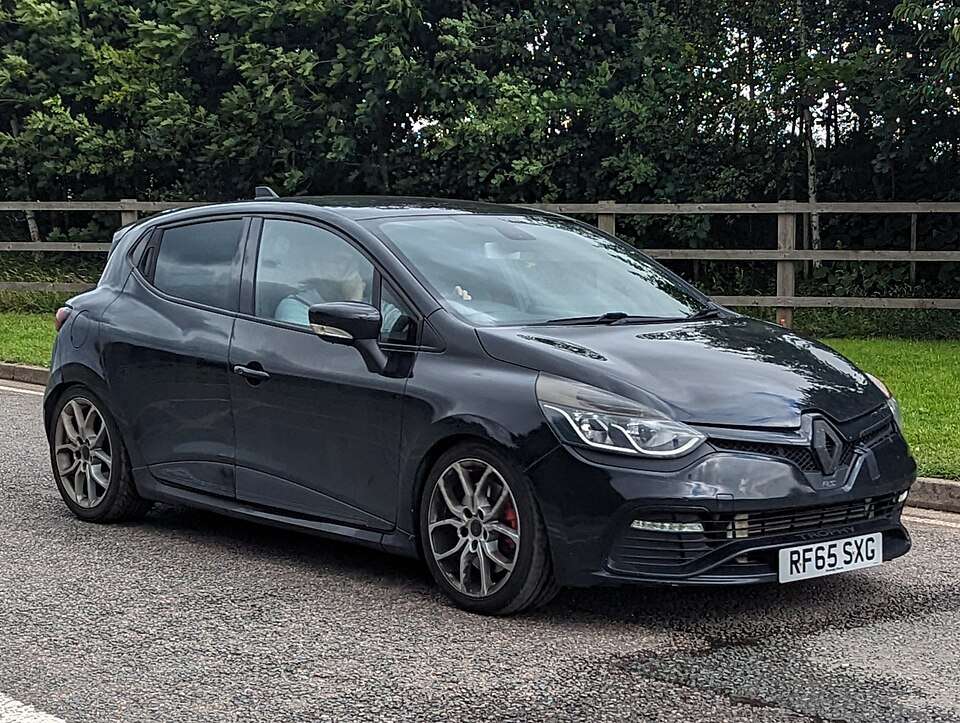
The fourth-generation Clio R.S. moved to a turbocharged 1.6-litre engine, five-door body and EDC dual-clutch transmission. The 220 Trophy, introduced in 2015, developed the package with more performance and revised transmission and chassis settings. [17]
It is reasonable for an enthusiast to prefer the earlier naturally aspirated cars, but a history should explain the change rather than pretend the newer model was simply the same car with different styling. The powertrain and transmission altered how the performance was delivered.
It also reinforces the need to read the complete name. A Clio 200 from the earlier generation and a Clio 200 EDC are not equivalent starting points for a buying decision.
Ultime, R.S. Line and the end of the badge
The Mégane R.S. Ultime of 2023 closed the Renault Sport-badged production-car story. Its numbered run and commemorative detailing were a farewell built around an established performance car, not a new standalone generation. [4]
R.S. Line is a different matter. Renault’s description of the 2019 Clio placed it among the car’s styling and equipment choices. A Clio R.S. Line should not be advertised or understood as though it were the successor to the Clio R.S. 220 Trophy. [5]
That distinction is essential to the legacy. A badge history should show readers where the engineering programme ended and where a visually related trim name continued.
Renaultsport questions answered
Was the Clio the first Renault Sport road car?
No. Renault identifies the Spider, unveiled in 1995, as the first road-going model to bear the Renault Sport name. [1]
Is a Renault R.S. Line a full Renaultsport model?
No. It is a sporting equipment specification, not proof of the drivetrain and chassis package used by an R.S. performance model. [5]
Does 4CONTROL mean a Mégane R.S. is four-wheel drive?
No. It refers to four-wheel steering. [9]
Are Trophy and Trophy-R the same?
No. The exact differences depend on the generation, but Trophy-R identifies a more specialised programme. Verify the actual model rather than treating the final letter as optional. [15] [16]
Why these cars deserve the attention
Renaultsport’s most interesting cars make a persuasive case that performance is about choices, not merely accumulation. Better dampers, a different differential or less weight can matter as much as another increase in power. Its history is at its best when it explains those choices—and the unusual cars they produced.
Love cars you don’t see every day?
Get forgotten cars, surprising motoring stories and the most interesting finds from Unusual Cars by email.
Free to join. No spam. Unsubscribe whenever you like. See our privacy policy.
Sources and further reading
- Renault Group: the iconic Renault Sport road carsManufacturer retrospective with development-team testimony.
- Renault Sport: Mégane R26.R announcement (2008)Original Renault release retained in the Alpine media archive.
- The Originals Renault: Clio V6Manufacturer museum record.
- Renault: Mégane R.S. Ultime announcement (2023)Manufacturer announcement; planned numbered run distinguished from audited production.
- Renault: new Clio range and R.S. Line (2019)Manufacturer launch and equipment information.
- The Originals Renault: Clio WilliamsManufacturer museum record.
- Renault UK: Twingo Renaultsport 133 (2008)Manufacturer UK launch release.
- Renault UK: Clio 182 Trophy announcement (May 2005)Original manufacturer release reproduced by Next Car.
- Renault UK: fourth-generation Mégane R.S. (2017)Original Renault press-office release in its retained publishing archive.
- Renault: Clio Sport 182 Trophy press information (June 2005)Manufacturer press material preserved by Ultimatecarpage.
- Renault: Clio Renaultsport 197 UK announcement (2006)Original manufacturer announcement reproduced by Easier.
- Renault: Clio 200 UK range announcement (2009)Manufacturer release reproduced by Automobiles Review.
- Renault Sport: Mégane R.S. 275 Trophy (2014)Original manufacturer technical announcement.
- Renault Sport: Mégane R.S. 275 Trophy-R (2014)Original manufacturer announcement; isolated drivetrain translation error not reproduced.
- Renault Sport: Mégane R.S. Trophy-R (2019)Original manufacturer announcement.
- Renault UK: Trophy-R technical press information (2019)Original manufacturer press information, including removal of four-wheel steering.
- Renault UK: Clio R.S. 220 Trophy (2015)Original Renault press-office release in its retained publishing archive.