
In this article
- What did the R badge mean?
- The important generations
- 850 T-5R: the yellow car was only part of the story
- Was the T-5R a road-going BTCC car?
- 850 R: the manual-versus-automatic distinction matters
- S70 R and V70 R: the story did not jump straight to the 2000s
- S60 R and V70 R: the high-technology chapter
- R versus R-Design: the important difference
- Where does Polestar fit?
- Frequently asked questions
- Why Volvo R deserves its own place in performance-car history

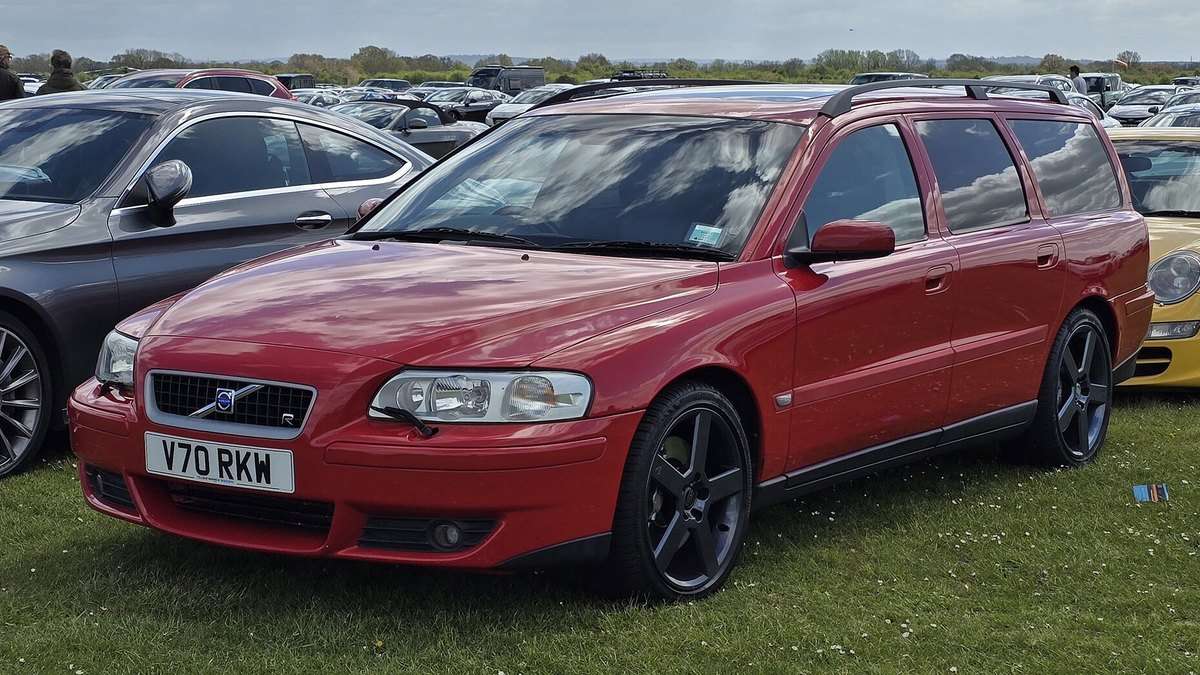
A yellow Volvo estate ought to be an unlikely performance icon. Yet the 850 T-5R helped turn the familiar family-car shape into something enthusiasts actively wanted to see parked outside their house. It was followed by the 850 R, further R-badged saloons and estates, and eventually the technologically ambitious S60 R and V70 R. [1] [2] [3]
The story is more interesting than “Volvo fitted a turbo to an estate”. There were saloons as well, important differences between manual and automatic versions, and a transition from front-wheel drive to more sophisticated all-wheel-drive performance models.
There is also a badge trap. T5, T-5R, R and R-Design are not interchangeable descriptions. Understanding the distinctions is essential to understanding the cars.
What did the R badge mean?
In this part of Volvo’s history, R identified specific high-performance derivatives. The T-5R was a special 850 model; the 850 R followed it. Later S60 R and V70 R models combined dedicated engines, brakes, all-wheel drive and electronically controlled chassis technology. [4] [5] [3]
R-Design served a different role. It denoted a sporting design and equipment specification across a broader range of cars and engines. It could include chassis changes, so dismissing it as nothing but decoration would also be inaccurate. What it did not do was automatically turn an ordinary S60 or V70 into one of the earlier R performance models. [6]
The important generations
| Model | The defining point |
|---|---|
| 850 T-5R | Presented in 1994 and associated with the 1995 model year; front-wheel drive, turbocharged five-cylinder power, saloon and estate. [1] [4] |
| 850 R | The 1996-model-year successor, with significant manual-version mechanical changes. [5] |
| S70 R and first-generation V70 R | The R story continued into Volvo’s renamed and revised large-car family in 1997. [7] |
| V70 R AWD | An all-wheel-drive branch of the first-generation V70 range. [8] |
| S60 R and later V70 R | Revealed in 2002, with sales beginning in 2003; the Four-C, all-wheel-drive generation. [9] [10] |
These dates distinguish presentation, model year and sale. They should not be collapsed into a single universal “launch year”.
850 T-5R: the yellow car was only part of the story
Volvo presented the T-5R at Geneva in 1994. Its UK press material for the following model year described a turbocharged 2.3-litre five-cylinder engine, a temporary boost increase, 17-inch Titan wheels and a sporting interior. Both manual and automatic gearboxes were offered, and buyers could choose a saloon or estate. [1] [4]
The colour made it instantly recognisable, but the T-5R was not exclusively yellow. Black and green cars also formed part of the model’s history. A genuine example does not become less authentic because it lacks the most photogenic paint. [1]
Its visual restraint is part of the appeal. The body remained unmistakably an 850, rather than acquiring an entirely different identity. The contrast between familiar shape and performance specification did much of the work.
Why production numbers need careful handling
Contemporary publicity describes planned runs and market allocations. Those are useful historical facts, but they are not automatically final production totals. A launch announcement saying that a certain number will be built can become inaccurate if the programme is subsequently expanded. [4] [1]
For that reason, a precise rarity claim needs a source that identifies whether the figure means initial allocation, completed global production or cars supplied to one market. Colour totals can introduce another layer of confusion.
The same discipline applies to an individual car. The original model identity, market, engine, transmission and documented history are better evidence than paint and wheels alone.
Was the T-5R a road-going BTCC car?
Not in the literal mechanical sense often implied. Volvo and TWR raced an 850 estate in the British Touring Car Championship in 1994, but the competition car used a naturally aspirated 2.0-litre five-cylinder engine, not the road car’s 2.3-litre turbocharged unit. The racing regulations prohibited forced induction. [11]
The connection was important for the image of the car. An estate competing against saloons made a memorable statement about the relationship between practicality and performance. But a road T-5R was not simply that racing car with carpets and number plates.
There is another useful correction: the estate raced for the 1994 season; Volvo switched to a saloon for 1995. The image endured for much longer than the estate’s actual competition programme. [11]
That does not diminish the T-5R. Its achievement was to make an ordinary-use road car feel special, rather than to recreate a competition machine.
850 R: the manual-versus-automatic distinction matters
The 850 R followed for the 1996 model year, with Volvo’s contemporary press kit describing its debut during the autumn of 1995. It was not merely a T-5R with the punctuation removed. [5]
The manual version received a more ambitious mechanical package, including a larger turbocharger, a limited-slip differential and an output quoted at 250 hp in period material. The automatic retained a different specification. Using the manual’s headline figures and hardware to describe every 850 R is therefore misleading. [5]
That distinction matters more than the colour or the presence of a rear spoiler. A specification comparison should begin with the transmission, not add it as an afterthought.
The 850 R also demonstrates how a special-edition idea can develop into a more established performance derivative. The badge was becoming a recognisable part of Volvo’s range, rather than depending entirely on the impact of one launch colour.
S70 R and V70 R: the story did not jump straight to the 2000s
Volvo’s 1997 annual report records the introduction of the S70 R, V70 R and V70 R AWD. These cars form the bridge between the 850 generation and the later S60 R/V70 R pair. [7]
The names can cause confusion because V70 R spans more than one generation. An early V70 R should not be given the specifications of the later 300 PS car simply because the badge matches.
Volvo’s original V70 technical data also distinguishes performance versions and drivetrain arrangements. The range was not one unchanging “R specification” carried from year to year. [12]
The AWD branch is especially significant. It shows the performance story beginning to move beyond the front-wheel-drive arrangement associated with the 850 T-5R and R. But AWD in one derivative does not retrospectively make every early R an all-wheel-drive car. [8]
This transitional generation deserves attention on its own terms. It is neither merely a renamed 850 nor a less powerful version of a later V70 R. Its specification needs to be read in the context of its own model year.
Love cars you don’t see every day?
Get forgotten cars, surprising motoring stories and the most interesting finds from Unusual Cars by email.
Free to join. No spam. Unsubscribe whenever you like. See our privacy policy.
S60 R and V70 R: the high-technology chapter
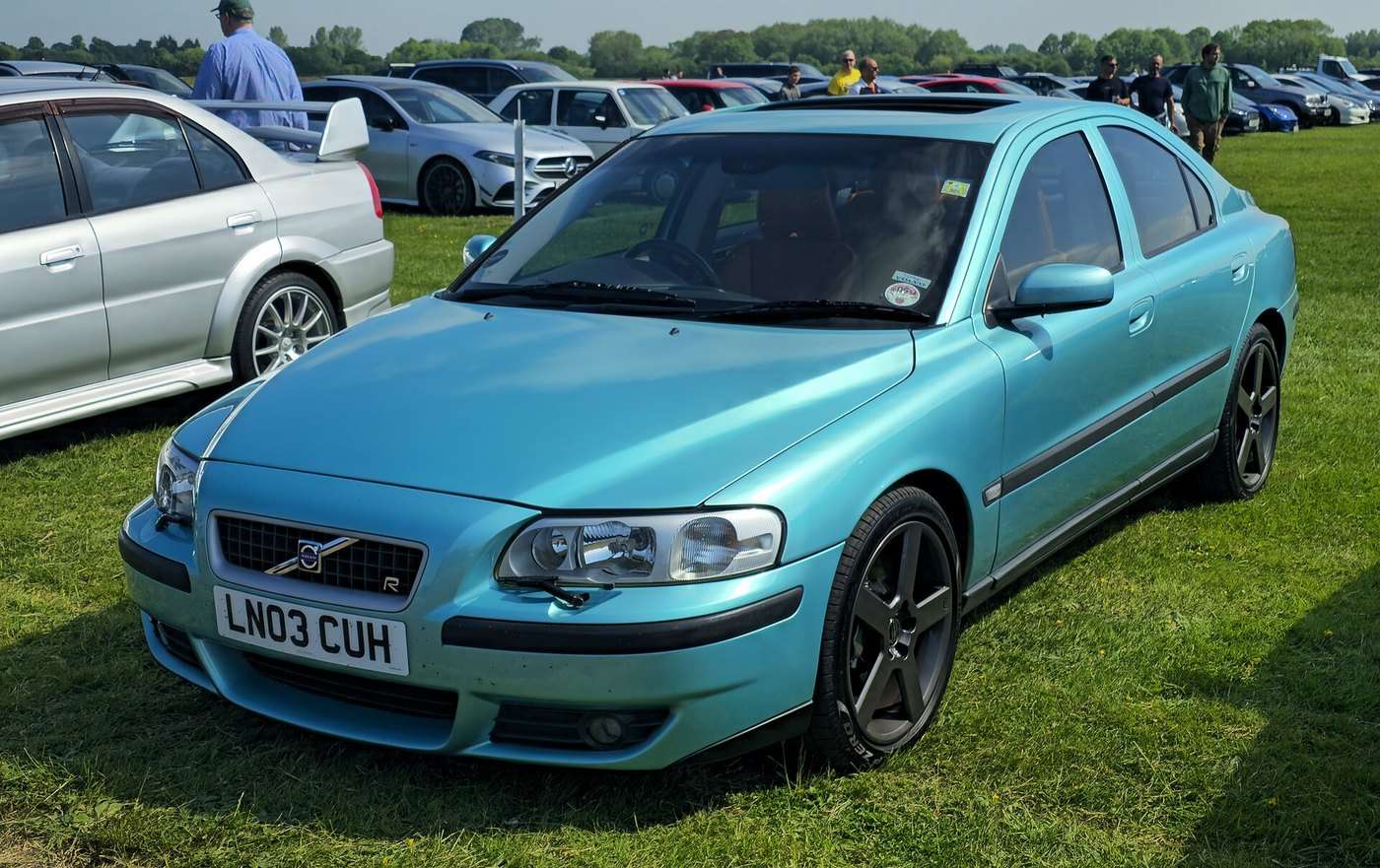
The later S60 R and V70 R were unveiled in 2002, with sales beginning in spring 2003. They combined a turbocharged 2.5-litre five-cylinder engine with all-wheel drive, Brembo brakes and Volvo’s Four-C electronically controlled chassis. [9] [10]
The international engine announcement quoted 300 PS and 400 Nm. It was a substantial change in ambition from the early T-5R: not only a more powerful engine, but a coordinated attempt to manage that performance through the drivetrain, suspension and brakes. [13]
The two bodies retained different practical roles. The S60 supplied the saloon interpretation, while the V70 kept the fast-estate idea alive. Their relationship matters more than the assumption that a Volvo performance car must always be the estate.
What did Four-C actually do?
Four-C continuously adjusted the damping in response to the car’s movement and driving conditions. The driver could select Comfort, Sport or Advanced settings, changing the system’s operating priorities rather than physically replacing the suspension. [9]
That is the important distinction from a simple fixed “sports suspension”. The technology was intended to let one car cover more than one role: relatively relaxed road use and a firmer, more tightly controlled performance setting.
It also helps explain why the later R models should be considered as complete mechanical packages. An engine tune on a regular car does not reproduce the original R’s chassis, brakes and drivetrain.
Gearboxes and model years still matter
Manual and automatic versions were available, and Volvo’s launch information distinguishes their transmissions. A precise performance claim should therefore identify which gearbox and model year it concerns rather than importing the quickest quoted figure into every advert. [3]
For a prospective owner, the useful question is not simply whether a car still produces its original peak power. It is whether the systems that made the R distinctive are present, functioning and correctly maintained. A specialist inspection is particularly valuable when a car has been modified or fitted with replacement suspension.
That is an ownership consideration, not a reason to dismiss the technology. The complexity is part of what made these cars ambitious in the first place.
R versus R-Design: the important difference
A later Volvo wearing R-Design badges is not automatically a successor in mechanical specification to an S60 R or V70 R.
Volvo’s 2013 explanation of the S60, V60 and XC60 R-Design range describes sporting exterior and interior details, chassis revisions and the separate availability of Polestar performance upgrades. It is clear evidence that design specification, chassis package and engine enhancement were related but distinct elements. [6]
The accurate answer therefore sits between two oversimplifications. R-Design was not the same thing as a full R performance derivative, but neither should every R-Design model be dismissed as entirely cosmetic.
The badge tells you where to start looking. The original specification tells you what the car actually has.
Where does Polestar fit?
Polestar is a connected but separate chapter. Volvo acquired Polestar’s performance business and brand in 2015, with the announcement referring to Polestar versions of the S60 and V60. [14]
That does not make Polestar a retrospective alternative name for every R model. Nor does an optimisation package necessarily make a car equivalent to a factory-developed Polestar derivative.
For this history, the useful distinction is straightforward: the T-5R and R cars have their own lineage; R-Design describes a different type of sporting specification; and Polestar requires its own explanation. Keeping those strands separate makes the later history much easier to follow.
Frequently asked questions
Were all Volvo T-5Rs estates?
No. Volvo offered both saloon and estate versions. The estate dominates photographs and popular memory, but the saloon is a genuine part of the model family. [4]
Were all T-5Rs yellow?
No. Black and green examples also belong to the factory history. Paint colour alone is not a reliable authenticity test. [1]
Is an 850 R the same as a T-5R?
No. The 850 R followed the T-5R and had its own specification. The manual version’s mechanical changes are particularly important. [5]
Is a V70 R always all-wheel drive?
Do not infer the drivetrain from the badge alone. The early V70 range included distinct R and R AWD derivatives; the later 2000s V70 R was an all-wheel-drive performance model. [7] [3]
Is R-Design the same as R?
No. R-Design was a broader sporting design and equipment specification. It could include chassis changes, but it did not automatically provide the dedicated R model’s complete mechanical package. [6]
Why Volvo R deserves its own place in performance-car history

The strongest thread is not one colour, one driven axle or even one type of body. It is the idea that performance could be added without abandoning the useful, recognisable shape of a Volvo.
The T-5R made that contrast memorable. The 850 R developed it. The later S60 R and V70 R added a much more sophisticated attempt to control the performance. Together they form a history that is considerably richer than a yellow estate and a turbo badge.
Love cars you don’t see every day?
Get forgotten cars, surprising motoring stories and the most interesting finds from Unusual Cars by email.
Free to join. No spam. Unsubscribe whenever you like. See our privacy policy.
Sources and further reading
- Volvo: 25 years of the 850 (2016)Manufacturer retrospective.
- Volvo: 20 years of the 850 (2011)Manufacturer retrospective.
- Volvo USA: 2004 S60 R and V70 ROriginal manufacturer US model-year release.
- Volvo UK: T-5R press kit (January 1995)Original manufacturer press kit preserved by Volvo Owners Club; PDF, intermittent redirects.
- Volvo UK: 1996 model-year press kitOriginal manufacturer press kit preserved by Volvo Owners Club; PDF, intermittent redirects.
- Volvo: R-Design chassis and equipment (2013)Manufacturer equipment announcement.
- AB Volvo: annual report 1997Original company annual report preserved by KU Leuven; PDF.
- Volvo Cars: the 1990–1999 periodManufacturer historical overview.
- Volvo: S60 R and V70 R launch information (2002)Original manufacturer technical release.
- Volvo: R models and spring 2003 sales introductionOriginal manufacturer launch-timing release.
- Volvo: the 850 estate in the BTCC (2014 retrospective)Manufacturer history with participant testimony.
- Volvo: V70 technical data (1997)Original manufacturer technical data preserved by Volvo Owners Club; PDF.
- Volvo: R-model engine technical information (2002)Original manufacturer technical release.
- Volvo Cars: acquisition of Polestar performance business (2015)Original Volvo Car Canada release distributed by Cision.
